
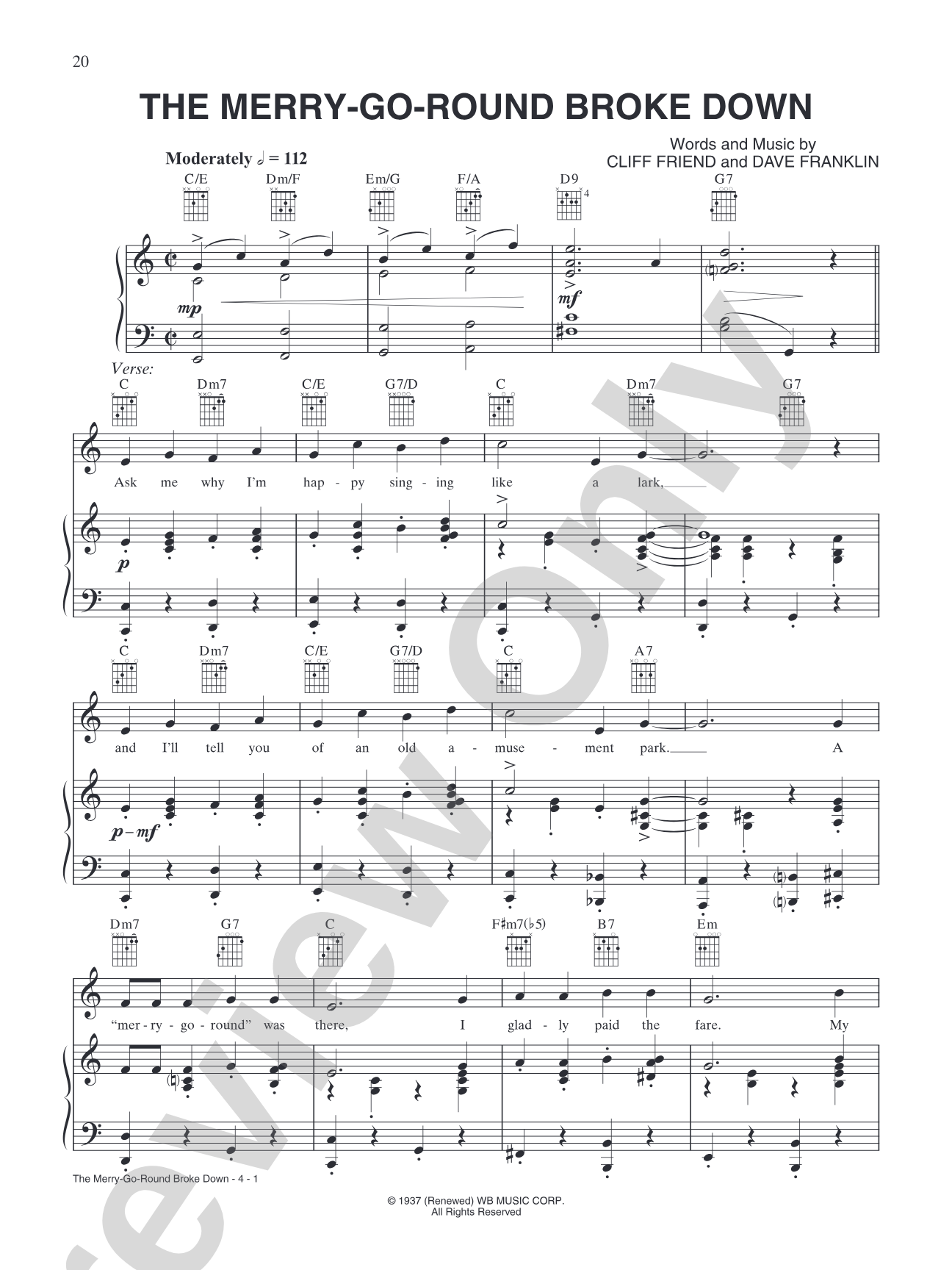

The Merry-Go-Round Broke Down (from "Merrie Melodies & Looney Tunes"): Piano/Vocal/Chords
Merrie Melodies and Themes from Warner Brothers Cartoons
Item: 00-XS-0000215
$4.99
One moment…
Related Items
I'm Forever Blowing Bubbles (from "Merrie Melodies & Looney Tunes"): Piano/Vocal/Chords |
$4.99
|
View | |
The Gold Digger's Song (from "Merrie Melodies & Looney Tunes"): Piano/Vocal/Chords |
$4.99
|
View | |
You Must Have Been a Beautiful Baby (from "Merrie Melodies & Looney Tunes"): Piano/Vocal/Chords |
$4.99
|
View | |
Hello! Ma Baby (from "Merrie Melodies & Looney Tunes"): Piano/Vocal/Chords |
$4.99
|
View | |
A Cup of Coffee, a Sandwich, and You (from "Merrie Melodies & Looney Tunes"): Piano/Vocal/Chords |
$4.99
|
View | |
Merrily We Roll Along (from "Merrie Melodies & Looney Tunes"): Piano/Vocal/Chords |
$4.99
|
View | |
Hooray for Hollywood (from "Merrie Melodies & Looney Tunes"): Piano/Vocal/Chords |
$4.99
|
View | |
The Lady In Red (from "Merrie Melodies & Looney Tunes"): Piano/Vocal/Chords |
$5.99
|
View | |
I Love to Sing-A (from "Merrie Melodies & Looney Tunes"): Piano/Vocal/Chords |
$5.99
|
View | |
What's Up, Doc? (from "The Bugs Bunny Show"): Piano/Vocal/Chords |
$4.99
|
View | |
I’m Just Wild About Harry (from "Merrie Melodies & Looney Tunes"): Piano/Vocal/Chords |
$4.99
|
View | |
A Rainy Night in Rio (from "Merrie Melodies & Looney Tunes"): Piano/Vocal/Chords |
$4.99
|
View | |
Road Runner (from "Merrie Melodies & Looney Tunes"): Piano/Vocal/Chords |
$4.99
|
View | |
Ain't She Sweet (from "Merrie Melodies & Looney Tunes"): Piano/Vocal/Chords |
$4.99
|
View | |
Powerhouse (from "Merrie Melodies & Looney Tunes"): Piano |
$5.99
|
View | |
The Michigan Rag (from "Merrie Melodies & Looney Tunes"): Piano/Vocal/Chords |
$4.99
|
View | |
The Looney Tunes Songbook: Piano/Vocal/Guitar Book |
$19.99
|
View |
Description
The Looney Tunes Songbook features music used by Carl Stalling in the scores for Warner Brothers' beloved cartoons from the 1930s through the early '60s. Included are the familiar theme songs, tunes associated with various characters, Warner Brothers pop songs used as background music, and the wacky melodies of Raymond Scott. Titles: Merrily We Roll Along * The Merry-Go-Round Broke Down * Road Runner * This Is It! * What's Up, Doc? * Dinner Music for a Pack of Hungry Cannibals * In an 18th Century Drawing Room * Powerhouse * Reckless Night on Board an Ocean Liner * The Toy Trumpet * Ain't She Sweet * A Cup of Coffee, a Sandwich, and You * The Gold Digger's Song (We're in the Money) * Hooray for Hollywood * I Love to Sing-a * I'm Forever Blowing Bubbles * The Lady in Red * A Rainy Night in Rio * You Must Have Been a Beautiful Baby * Hello, Ma Baby * I'm Just Wild About Harry * The Michigan Rag.


The Merry-Go-Round Broke Down (from "Merrie Melodies & Looney Tunes"): Piano/Vocal/Chords isn't in MakeMusic Cloud just yet...but it could be. Let us know you'd like to see it, and you'll help shape what comes next. In the meantime, start a free trial and dive into thousands of interactive titles your students can play along with today.
Request This Title
Tell us you want it.
Start Your Free Trial
Explore everything that's ready to play right now.
Sample Audio
No sample audio found.
Sample Video
No sample videos found.
Additional Details
Publisher:
Alfred Music
Page Count:
108
SKU:
00-XS-0000215
More about this title
About the Composer: Cliff Friend
Cliff Friend was a prolific songwriter and composer who contributed significantly to American popular music during the early twentieth century. His work appeared in countless film scores, stage productions, and radio broadcasts, with a particular gift for writing memorable melodies that appealed to both children and adults.
Why we love this
This collection captures the sonic DNA of Warner Brothers animation at its most inventive. Carl Stalling's orchestrations paired with these melodies created a blueprint for comedic timing through music, and having them available in piano/vocal/guitar format makes these arrangements accessible for recitals, educational performances, and classes studying film scoring and early animation history.
What to expect
These melodies bounce with infectious optimism and comedic mischief. Whether bright and lilting or slightly off-kilter, each tune carries the playful spirit of the cartoons that made them famous, inviting performers to embrace stylization and character rather than austere technique.
Who it's for
Pianists, guitarists, and vocalists seeking repertoire that bridges classical training with twentieth-century popular song; educators building units on film music, animation history, or American songwriting; performers looking for accessible, recognizable material that audiences genuinely connect with.
How to get the most out of it
- Lean into the rhythmic playfulness of these melodies; they were written to sync with visual gags, so precision with articulation and tempo shifts matters more than smooth legato lines.
- Use the chord symbols to improvise stylistically appropriate accompaniment; these songs thrive when the pianist responds to the vocalist's phrasing rather than strictly metronomic playing.
- Balance melody and accompaniment so the tune stays audible even when the harmonic foundation grows busier, particularly in numbers like Powerhouse that were designed to drive action sequences forward.
How to use it
Program individual numbers as palate cleansers in recitals built around early-twentieth-century American song; use selections to introduce students to how composers write for moving images; teach ensemble vocalists these arrangements as models for coordinating rhythm, phrasing, and narrative storytelling through music.
Skills your students will build
- Rhythmic flexibility and syncopation in an entertainment context
- Coordination between melody, harmony, and accompaniment textures
- Style-appropriate interpretation of pre-1960s popular song idiom
- Understanding how music drives narrative and emotional timing in visual media
- Transposition and chord substitution using the provided harmonic framework