
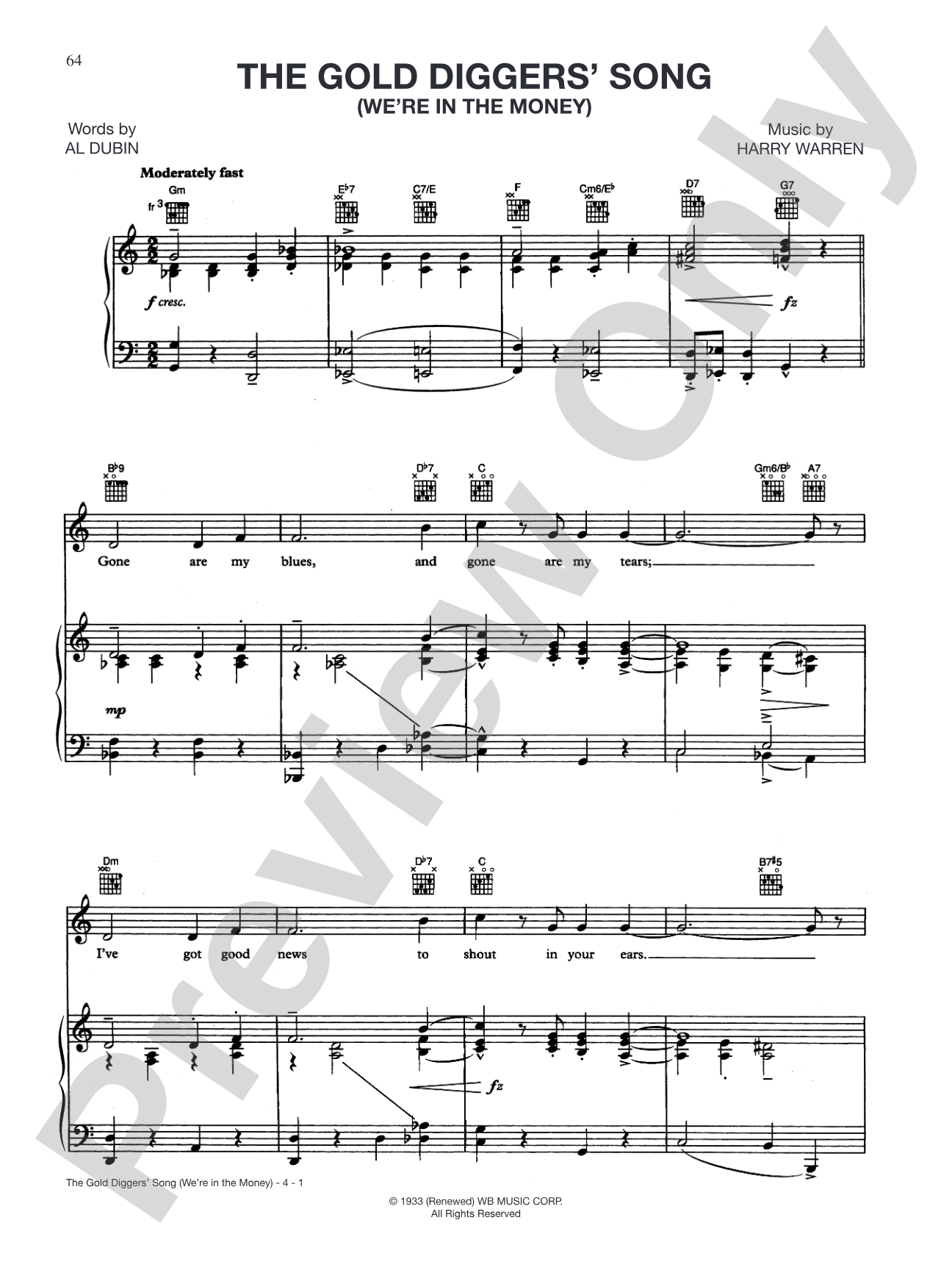

The Gold Digger's Song (from "Merrie Melodies & Looney Tunes"): Piano/Vocal/Chords
Merrie Melodies and Themes from Warner Brothers Cartoons
Item: 00-PS-0012995
$4.99
One moment…
Related Items
I'm Forever Blowing Bubbles (from "Merrie Melodies & Looney Tunes"): Piano/Vocal/Chords |
$4.99
|
View | |
You Must Have Been a Beautiful Baby (from "Merrie Melodies & Looney Tunes"): Piano/Vocal/Chords |
$4.99
|
View | |
Hello! Ma Baby (from "Merrie Melodies & Looney Tunes"): Piano/Vocal/Chords |
$4.99
|
View | |
A Cup of Coffee, a Sandwich, and You (from "Merrie Melodies & Looney Tunes"): Piano/Vocal/Chords |
$4.99
|
View | |
Merrily We Roll Along (from "Merrie Melodies & Looney Tunes"): Piano/Vocal/Chords |
$4.99
|
View | |
Hooray for Hollywood (from "Merrie Melodies & Looney Tunes"): Piano/Vocal/Chords |
$4.99
|
View | |
The Lady In Red (from "Merrie Melodies & Looney Tunes"): Piano/Vocal/Chords |
$5.99
|
View | |
I Love to Sing-A (from "Merrie Melodies & Looney Tunes"): Piano/Vocal/Chords |
$5.99
|
View | |
What's Up, Doc? (from "The Bugs Bunny Show"): Piano/Vocal/Chords |
$4.99
|
View | |
I’m Just Wild About Harry (from "Merrie Melodies & Looney Tunes"): Piano/Vocal/Chords |
$4.99
|
View | |
A Rainy Night in Rio (from "Merrie Melodies & Looney Tunes"): Piano/Vocal/Chords |
$4.99
|
View | |
Road Runner (from "Merrie Melodies & Looney Tunes"): Piano/Vocal/Chords |
$4.99
|
View | |
Ain't She Sweet (from "Merrie Melodies & Looney Tunes"): Piano/Vocal/Chords |
$4.99
|
View | |
Powerhouse (from "Merrie Melodies & Looney Tunes"): Piano |
$5.99
|
View | |
The Michigan Rag (from "Merrie Melodies & Looney Tunes"): Piano/Vocal/Chords |
$4.99
|
View | |
The Merry-Go-Round Broke Down (from "Merrie Melodies & Looney Tunes"): Piano/Vocal/Chords |
$4.99
|
View | |
The Looney Tunes Songbook: Piano/Vocal/Guitar Book |
$19.99
|
View |
Description
The Looney Tunes Songbook features music used by Carl Stalling in the scores for Warner Brothers' beloved cartoons from the 1930s through the early '60s. Included are the familiar theme songs, tunes associated with various characters, Warner Brothers pop songs used as background music, and the wacky melodies of Raymond Scott. Titles: Merrily We Roll Along * The Merry-Go-Round Broke Down * Road Runner * This Is It! * What's Up, Doc? * Dinner Music for a Pack of Hungry Cannibals * In an 18th Century Drawing Room * Powerhouse * Reckless Night on Board an Ocean Liner * The Toy Trumpet * Ain't She Sweet * A Cup of Coffee, a Sandwich, and You * The Gold Digger's Song (We're in the Money) * Hooray for Hollywood * I Love to Sing-a * I'm Forever Blowing Bubbles * The Lady in Red * A Rainy Night in Rio * You Must Have Been a Beautiful Baby * Hello, Ma Baby * I'm Just Wild About Harry * The Michigan Rag.


The Gold Digger's Song (from "Merrie Melodies & Looney Tunes"): Piano/Vocal/Chords isn't in MakeMusic Cloud just yet...but it could be. Let us know you'd like to see it, and you'll help shape what comes next. In the meantime, start a free trial and dive into thousands of interactive titles your students can play along with today.
Request This Title
Tell us you want it.
Start Your Free Trial
Explore everything that's ready to play right now.
Sample Audio
No sample audio found.
Sample Video
No sample videos found.
Additional Details
Publisher:
Alfred Music
Page Count:
108
SKU:
00-PS-0012995
More about this title
About the Composer: Harry Warren
Harry Warren (1893-1981) composed some of the most recognizable melodies in American popular music, with a career spanning from vaudeville through Hollywood's golden age. His prolific output for Warner Brothers cartoons established him as a master of short-form composition, crafting instantly memorable themes that could land a punchline, underscore action, or become a character's musical signature within seconds. Warren won three Academy Awards and remained one of the most performed composers in American music, celebrated equally by concert pianists and jazz musicians for the harmonic sophistication beneath his accessible surfaces.
Why we love this
This collection captures what made cartoon music so effective: melodic clarity, harmonic wit, and the ability to communicate character and action instantly. For pianists and vocalists seeking repertoire that's immediately engaging without sacrificing musicianship, these songs offer genuine compositional craft wrapped in entertainment. Programming selections from this folio alongside contemporary material shows students how strong melody and orchestration can transcend their original context.
What to expect
The music captures a specific moment in American entertainment: playful, energetic, and designed to delight instantly without condescension. Even the silliest titles carry real melodic character and harmonic interest. There's an undeniable joy in playing music that was written to make people smile, and Warren's skill ensures that joy doesn't come at the expense of musicianship.
Who it's for
Pianists and singers seeking repertoire that's musically substantive yet rooted in popular appeal, and teachers who want to introduce students to Golden Age songwriting without leaving the realm of familiar material. It's equally suited to music theater students building a standards repertoire and classical pianists exploring American composition outside the concert hall canon.
How to get the most out of it
- Pay attention to rhythmic precision in the syncopated figures; cartoon timing depends on hitting comedic beats exactly. The notation guides you, but feel the cartoon logic behind the rhythm.
- Shape the melody with character. Whether you're playing Powerhouse or a tender ballad like The Lady in Red, commit fully to the mood Warren establishes.
- Use the chord symbols as a gateway to improvisation. Many of these songs work beautifully with tasteful reharmonization or jazz comping, inviting you to personalize the arrangement.
- If performing vocally, embrace clarity of diction even in fast passages. These melodies were written to be sung clearly over orchestration, so your articulation carries the tune.
How to use it
These pieces work beautifully in variety recitals or thematic programs exploring American song, particularly when you want to bridge classical and popular traditions. Consider pairing selections with film clips or projected animation to remind audiences of their original context, or stand alone as concert pieces that illustrate how effective and enduring cartoon music has proven to be. A mix of instrumental arrangements and vocal selections can anchor a program exploring humor and storytelling in music.
Skills your students will build
- Reading chord symbols and understanding jazz and popular music harmony
- Executing syncopated rhythms with precision and comic timing
- Interpreting style markings and period idioms in early-to-mid-twentieth-century popular song
- Shaping melodies with character and dramatic intent
- Balancing accessibility with artistic integrity in performance