
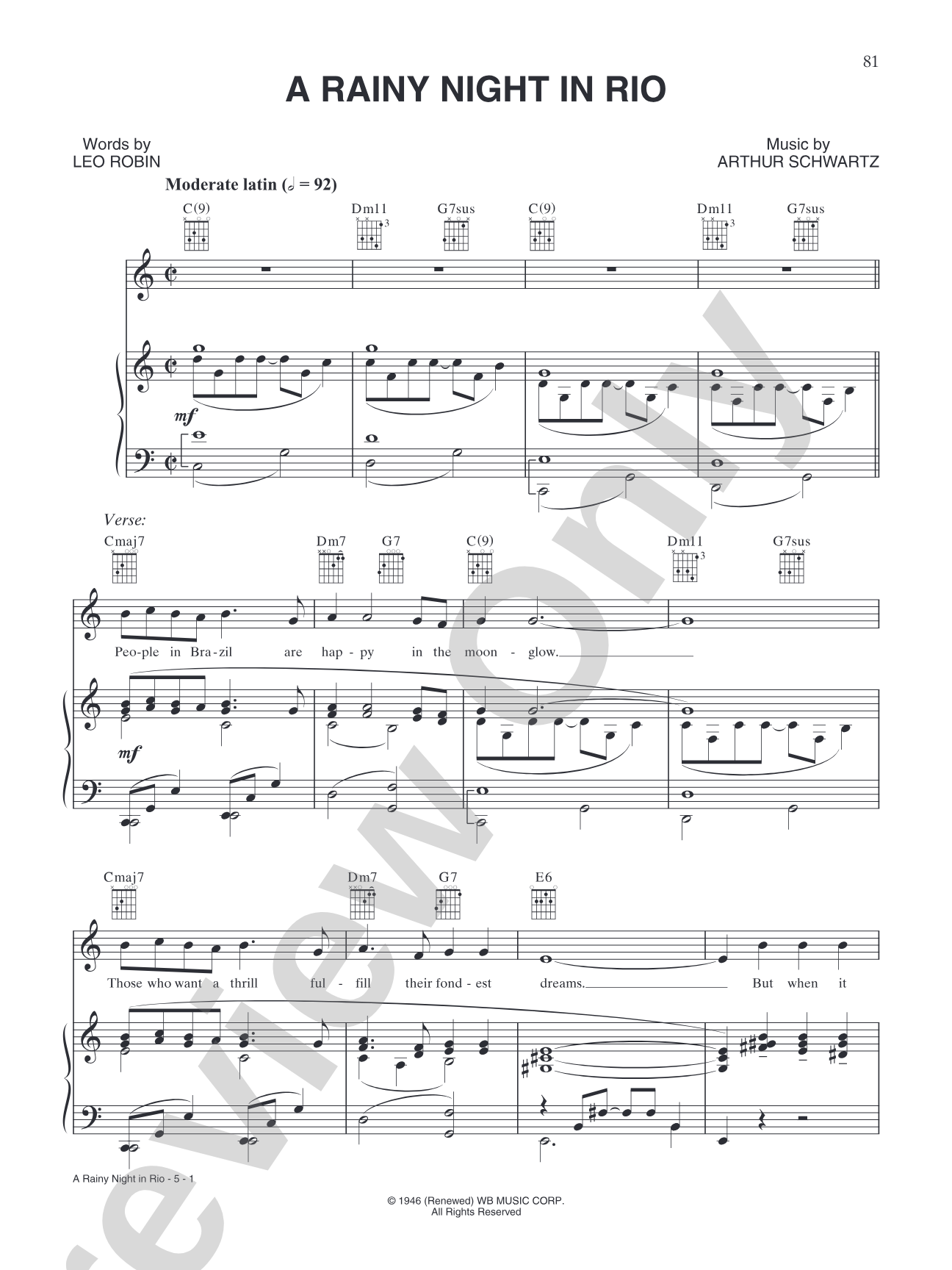

A Rainy Night in Rio (from "Merrie Melodies & Looney Tunes"): Piano/Vocal/Chords
Merrie Melodies and Themes from Warner Brothers Cartoons
Item: 00-XS-0000177
$4.99
One moment…
Related Items
I'm Forever Blowing Bubbles (from "Merrie Melodies & Looney Tunes"): Piano/Vocal/Chords |
$4.99
|
View | |
The Gold Digger's Song (from "Merrie Melodies & Looney Tunes"): Piano/Vocal/Chords |
$4.99
|
View | |
You Must Have Been a Beautiful Baby (from "Merrie Melodies & Looney Tunes"): Piano/Vocal/Chords |
$4.99
|
View | |
Hello! Ma Baby (from "Merrie Melodies & Looney Tunes"): Piano/Vocal/Chords |
$4.99
|
View | |
A Cup of Coffee, a Sandwich, and You (from "Merrie Melodies & Looney Tunes"): Piano/Vocal/Chords |
$4.99
|
View | |
Merrily We Roll Along (from "Merrie Melodies & Looney Tunes"): Piano/Vocal/Chords |
$4.99
|
View | |
Hooray for Hollywood (from "Merrie Melodies & Looney Tunes"): Piano/Vocal/Chords |
$4.99
|
View | |
The Lady In Red (from "Merrie Melodies & Looney Tunes"): Piano/Vocal/Chords |
$5.99
|
View | |
I Love to Sing-A (from "Merrie Melodies & Looney Tunes"): Piano/Vocal/Chords |
$5.99
|
View | |
What's Up, Doc? (from "The Bugs Bunny Show"): Piano/Vocal/Chords |
$4.99
|
View | |
I’m Just Wild About Harry (from "Merrie Melodies & Looney Tunes"): Piano/Vocal/Chords |
$4.99
|
View | |
Road Runner (from "Merrie Melodies & Looney Tunes"): Piano/Vocal/Chords |
$4.99
|
View | |
Ain't She Sweet (from "Merrie Melodies & Looney Tunes"): Piano/Vocal/Chords |
$4.99
|
View | |
Powerhouse (from "Merrie Melodies & Looney Tunes"): Piano |
$5.99
|
View | |
The Michigan Rag (from "Merrie Melodies & Looney Tunes"): Piano/Vocal/Chords |
$4.99
|
View | |
The Merry-Go-Round Broke Down (from "Merrie Melodies & Looney Tunes"): Piano/Vocal/Chords |
$4.99
|
View | |
The Looney Tunes Songbook: Piano/Vocal/Guitar Book |
$19.99
|
View |
Description
The Looney Tunes Songbook features music used by Carl Stalling in the scores for Warner Brothers' beloved cartoons from the 1930s through the early '60s. Included are the familiar theme songs, tunes associated with various characters, Warner Brothers pop songs used as background music, and the wacky melodies of Raymond Scott. Titles: Merrily We Roll Along * The Merry-Go-Round Broke Down * Road Runner * This Is It! * What's Up, Doc? * Dinner Music for a Pack of Hungry Cannibals * In an 18th Century Drawing Room * Powerhouse * Reckless Night on Board an Ocean Liner * The Toy Trumpet * Ain't She Sweet * A Cup of Coffee, a Sandwich, and You * The Gold Digger's Song (We're in the Money) * Hooray for Hollywood * I Love to Sing-a * I'm Forever Blowing Bubbles * The Lady in Red * A Rainy Night in Rio * You Must Have Been a Beautiful Baby * Hello, Ma Baby * I'm Just Wild About Harry * The Michigan Rag.


A Rainy Night in Rio (from "Merrie Melodies & Looney Tunes"): Piano/Vocal/Chords isn't in MakeMusic Cloud just yet...but it could be. Let us know you'd like to see it, and you'll help shape what comes next. In the meantime, start a free trial and dive into thousands of interactive titles your students can play along with today.
Request This Title
Tell us you want it.
Start Your Free Trial
Explore everything that's ready to play right now.
Sample Audio
No sample audio found.
Sample Video
No sample videos found.
Additional Details
Publisher:
Alfred Music
Page Count:
108
SKU:
00-XS-0000177
More about this title
About the Composer: Arthur Schwartz
Arthur Schwartz (1900-1984) composed for Broadway, Hollywood, and radio during the golden age of American popular song. Known for his melodic gift and sophisticated harmonic sense, Schwartz wrote prolifically for stage musicals and film scores, collaborating with lyricists including Howard Dietz and Frank Loesser. His work shaped the sound of American musical theater and earned him lasting recognition as a master of the theatrical song.
Why we love this
This folio captures some of the most inventive and playful music ever written for animation, compiled directly from Carl Stalling's Warner Brothers orchestrations. Having these songs in piano/vocal/chord format makes them accessible for singers, pianists, and guitarists who want to perform this comic repertoire in recitals, educational settings, or casual performances. The variety of styles and tempos within the collection (from the frantic energy of 'Powerhouse' to the romantic whimsy of 'A Rainy Night in Rio') gives performers rich material for exploring character, comedic timing, and narrative storytelling through song.
What to expect
Opening this collection feels like stepping into a golden-age cartoon orchestra: there's mischievous energy, surprising harmonic turns, and melodies that burrow into your ear. The music sparkles with wit and charm, from the romp of 'The Merry-Go-Round Broke Down' to the tender nostalgia of 'Hello, Ma Baby.' Each song carries distinct personality and comedic punch, whether you're playing a slapstick chase number or a romantic interlude.
Who it's for
Singers and pianists performing in cabaret, recital, or educational theater settings will find character songs and novelty numbers that work well in small ensembles or solo contexts. Music educators can use individual selections to introduce students to mid-century American song craft and the compositional techniques behind animation scores. Guitarists and pianists with chord charts can explore this repertoire in jazz or popular music courses.
How to get the most out of it
- Exaggerate rhythmic clarity and articulation to honor the comedic timing Stalling intended; these songs work best when crisp and snappy, not smooth.
- Study the cartoon context if possible; knowing which character or scene accompanies each tune informs your interpretive choices and helps audiences connect the music to its visual origins.
- Balance vocal projection with accompaniment so the lyrics remain the focus; many of these melodies were designed to serve the cartoon action, not to overpower it.
How to use it
Weave individual selections into recitals or revue-style programs celebrating American popular song or film history; this repertoire pairs naturally with other mid-century standards and theater songs. In an educational setting, use these pieces to teach students how composers craft accompaniment patterns, harmonic progressions, and melodic hooks that serve storytelling. Consider programming several selections as a medley or thematic group for a concert featuring music inspired by cinema or animation.
Skills your students will build
- Reading piano accompaniment patterns designed for cartoons (rapid articulation, rhythmic precision, character voice)
- Interpreting lyrics and melody with comedic intent and dramatic clarity
- Understanding harmonic language and voice-leading in American popular song from the 1930s-1960s
- Adapting vocal phrasing and dynamics to match character and narrative context