
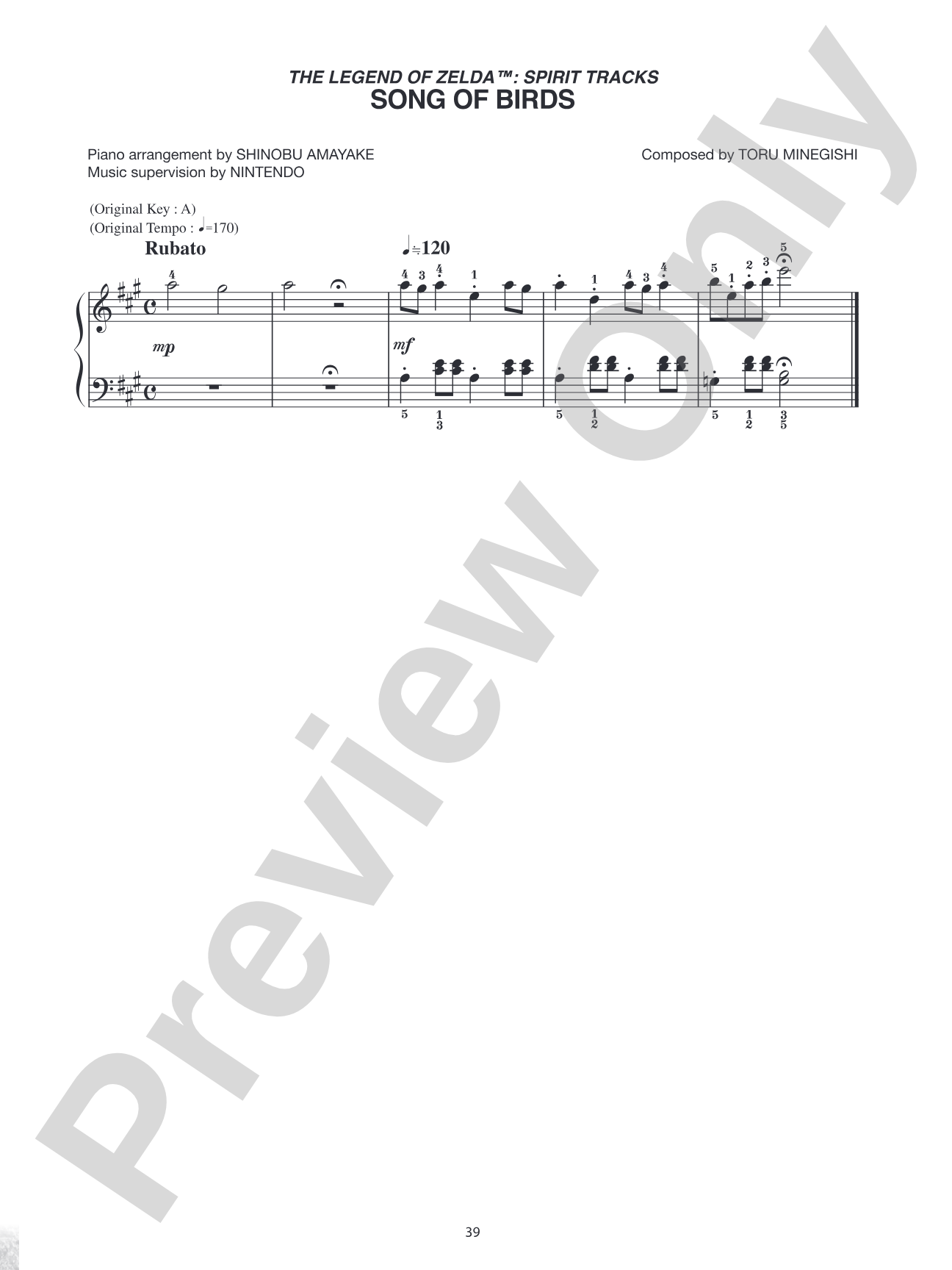

The Legend of Zelda™: Spirit Tracks Song of Birds: Easy Piano
Composed by Koji Kondo, Tominaga Mao, Toru Minegishi, and Asuka Ota
Level: Easy Piano
Item: 00-PS-0015437
$4.99
One moment…
Related Items
The Legend of Zelda™: Spirit Tracks Title Theme: Easy Piano |
$4.99
|
View | |
The Legend of Zelda™: Spirit Tracks Aboda Village: Easy Piano |
$4.99
|
View | |
The Legend of Zelda™: Spirit Tracks Chancellor Coles Theme: Easy Piano |
$4.99
|
View | |
The Legend of Zelda™: Spirit Tracks Hyrule Castle: Easy Piano |
$4.99
|
View | |
The Legend of Zelda™: Spirit Tracks Princess Zeldas Theme: Easy Piano |
$4.99
|
View | |
The Legend of Zelda™: Spirit Tracks The Battle: Easy Piano |
$4.99
|
View | |
The Legend of Zelda™: Spirit Tracks Anjeans Theme: Easy Piano |
$4.99
|
View | |
The Legend of Zelda™: Spirit Tracks Adventuring: Easy Piano |
$4.99
|
View | |
The Legend of Zelda™: Spirit Tracks The Tower of Spirits: Easy Piano |
$4.99
|
View | |
The Legend of Zelda™: Spirit Tracks Riding the Rails 2: Easy Piano |
$4.99
|
View | |
The Legend of Zelda™: Spirit Tracks Linebecks Theme: Easy Piano |
$4.99
|
View | |
The Legend of Zelda™: Spirit Tracks Byrnes Theme: Easy Piano |
$4.99
|
View | |
The Legend of Zelda™: Spirit Tracks Seabed: Easy Piano |
$4.99
|
View | |
The Legend of Zelda™: Spirit Tracks Hero of the Tracks: Easy Piano |
$4.99
|
View | |
The Legend of Zelda™: Spirit Tracks Fighting: Easy Piano |
$4.99
|
View | |
The Legend of Zelda™: Spirit Tracks Song of Awakening: Easy Piano |
$4.99
|
View | |
The Legend of Zelda™: Spirit Tracks Song of Healing: Easy Piano |
$4.99
|
View | |
The Legend of Zelda™: Spirit Tracks Song of Discovery: Easy Piano |
$4.99
|
View | |
The Legend of Zelda™: Spirit Tracks Song of Light: Easy Piano |
$4.99
|
View | |
The Legend of Zelda™: Spirit Tracks Fanfare of the Spirit Tracks: Easy Piano |
$4.99
|
View | |
The Legend of Zelda™: Spirit Tracks Game Over: Easy Piano |
$4.99
|
View | |
The Legend of Zelda™: Spirit Tracks for Easy Piano: Piano Book |
$15.99
|
View |
Description
The soundtrack to Nintendo's The Legend of Zelda™: Spirit Tracks is packed with melodic themes that sound great on the piano! With this officially licensed sheet music collection, pianists can dazzle friends and family by playing 22 familiar themes from the popular video game. The arrangements in this Easy Piano edition are moderately streamlined compared to those in the separately published Intermediate-Advanced edition, yet they retain a full and impressive sound. Titles: Title Theme * Aboda Village * Chancellor Cole's Theme * Hyrule Castle * Princess Zelda's Theme * The Battle * Anjean's Theme * Adventuring * The Tower of Spirits * Riding the Rails 2 (Main Theme) * Linebeck's Theme * Byrne's Theme * Seabed * Hero of the Tracks * Fighting * Song of Awakening * Song of Healing * Song of Discovery * Song of Birds * Song of Light * Fanfare of the Spirit Tracks * Game Over.


The Legend of Zelda™: Spirit Tracks Song of Birds: Easy Piano isn't in MakeMusic Cloud just yet...but it could be. Let us know you'd like to see it, and you'll help shape what comes next. In the meantime, start a free trial and dive into thousands of interactive titles your students can play along with today.
Request This Title
Tell us you want it.
Start Your Free Trial
Explore everything that's ready to play right now.
Sample Audio
No sample audio found.
Sample Video
No sample videos found.
Additional Details
Publisher:
Alfred Music
Page Count:
40
SKU:
00-PS-0015437
More about this title
About the Composer: Toru Minegishi
Toru Minegishi is a video game composer at Nintendo who has shaped the sonic identity of some of the company's most beloved franchises. His work on The Legend of Zelda series demonstrates his skill at writing memorable melodic themes that serve narrative and gameplay moments with equal effectiveness.
Minegishi's approach to game music composition prioritizes accessibility without sacrificing musical interest. His themes for Spirit Tracks balance simplicity with enough harmonic and melodic sophistication to engage both casual listeners and serious musicians, making his work particularly valuable for education contexts where students benefit from music that sounds both familiar and genuinely rewarding to perform.
Why we love this
Twenty-two themes means you have genuine variety within a single collection, from quiet village atmospheres to action-driven battle music to the mysterious spirit songs that anchor the game's narrative. The arrangements respect the original melodies while genuinely simplifying the underlying piano writing, so students never feel like they're playing a watered-down version. This is the kind of collection that generates real excitement in a studio or classroom because every student recognizes the music from day one.
What to expect
These arrangements capture the warmth and adventure of Spirit Tracks without the complexity that might overshadow the melody. Playing through the collection feels like a guided tour of the game's world, moving from intimate village themes to grand orchestral moments, all rendered in music that sits comfortably under the hands while still sounding impressively full.
Who it's for
Early-intermediate pianists who want to play recognizable, engaging music without wrestling with advanced technical demands. Students drawn to video game music will progress through this collection with genuine motivation, and teachers will appreciate having a full recital's worth of material that students actually want to practice.
How to get the most out of it
- Allow the sustained chords and left-hand patterns to create harmonic depth rather than rushing through them; the game's original orchestration often features rich string pads that piano sustain pedal can effectively evoke.
- Experiment with slight tempo flexibility on the slower themes like Aboda Village and Anjean's Theme to bring out the reflective quality of the original soundtrack.
- Shape the melodic lines with consistent voicing across both hands; many of these themes benefit from treating the piano as an ensemble rather than separating melody and accompaniment.
- Study the original video game recordings to internalize the phrasing and rubato Nintendo intended, then adapt those choices to match the easier piano voicing.
How to use it
Slot individual pieces into student recitals throughout the year, or program a Spirit Tracks suite as a fun thematic concert that bridges video game appreciation and classical piano literature. The collection's breadth means students at similar levels can each claim their own favorites, making it perfect for group studios or classroom ensemble arrangements where multiple pianists perform together.
Skills your students will build
- Reading and sustaining harmonic progressions across both hands
- Balancing accompaniment texture with single-line melody
- Pedal control for achieving resonance without muddiness
- Phrasing and musical storytelling within accessible harmonic frameworks
- Sight-reading and learning multiple styles within one collection