
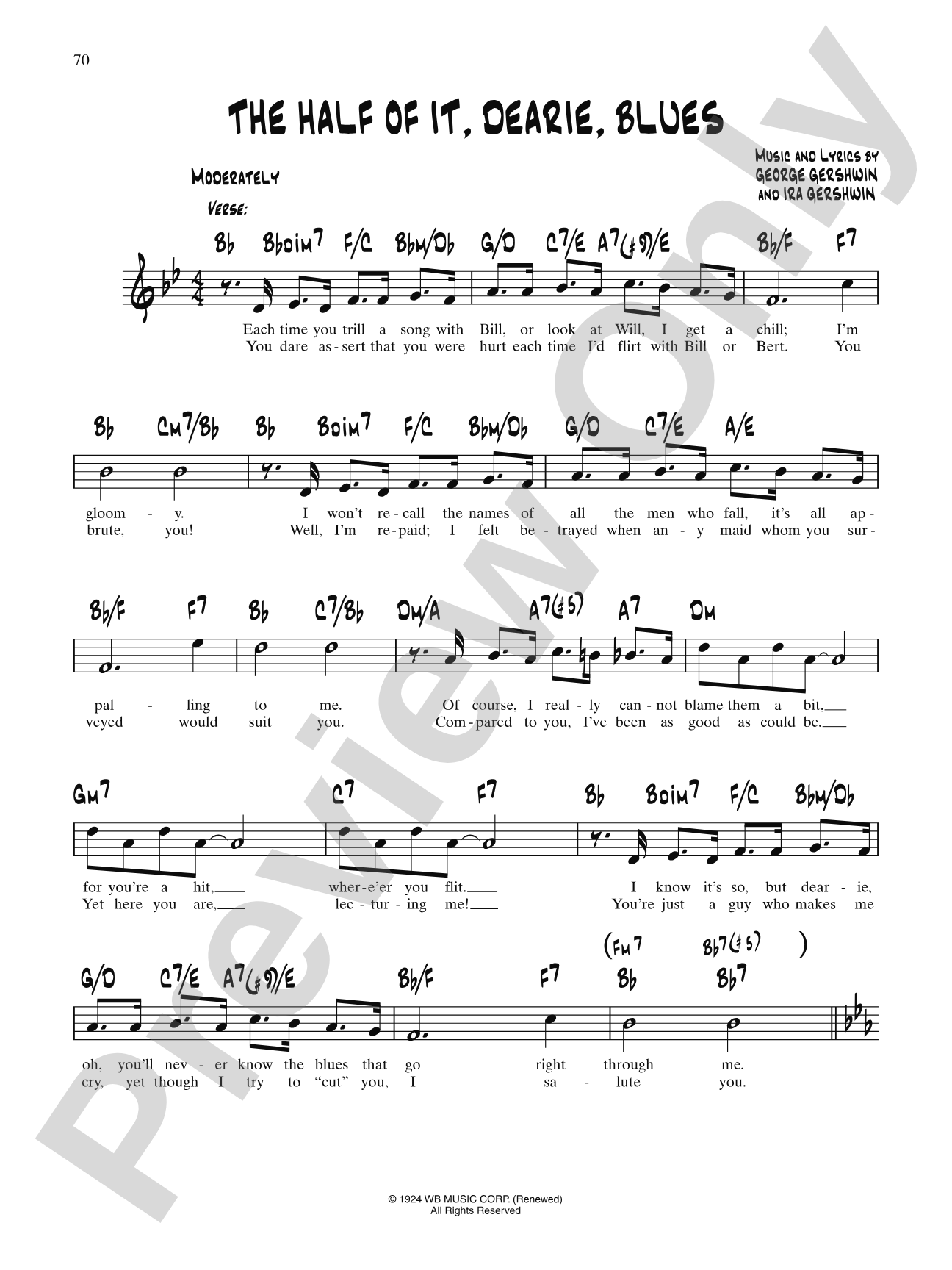

The Half Of It, Dearie, Blues (From "Lady, Be Good"): Lead Sheet
George and Ira Gershwin
Item: 00-PSL-000811
$4.99
One moment…
Related Items
I Loves You, Porgy (From "Porgy And Bess"): Lead Sheet |
$4.99
|
View | |
Bess You Is My Woman Now (From "Porgy And Bess"): Lead Sheet |
$4.99
|
View | |
It Ain't Necessarily So (From "Porgy And Bess"): Lead Sheet |
$4.99
|
View | |
Let's Call The Whole Thing Off (From "Shall We Dance"): Lead Sheet |
$4.99
|
View | |
Bidin' My Time: Lead Sheet |
$4.99
|
View | |
Fascinating Rhythm: Lead Sheet |
$4.99
|
View | |
The Man That Got Away (From "A Star Is Born"): Lead Sheet |
$4.99
|
View | |
What Causes That?: Lead Sheet |
$4.99
|
View | |
For You, For Me, Forever More: Lead Sheet |
$4.99
|
View | |
Aren't You Kind Of Glad We Did?: Lead Sheet |
$4.99
|
View | |
Long Ago And Far Away (From "Cover Girl"): Lead Sheet |
$4.99
|
View | |
Boy! What Love Has Done To Me!: Lead Sheet |
$4.99
|
View | |
Woman Is A Sometime Thing (Porgy & Bess): Lead Sheet |
$4.99
|
View | |
By Strauss (From "The Show Is On"): Lead Sheet |
$4.99
|
View | |
Changing My Tune: Lead Sheet |
$4.99
|
View | |
I Can't Be Bothered Now: Lead Sheet |
$4.99
|
View | |
I Got Plenty O' Nuttin' (From "Porgy And Bess"): Lead Sheet |
$4.99
|
View | |
I Was Doing All Right: Lead Sheet |
$4.99
|
View | |
I've Got Beginner's Luck: Lead Sheet |
$4.99
|
View | |
Just Another Rhumba: Lead Sheet |
$4.99
|
View | |
Hi Ho: Lead Sheet |
$4.99
|
View | |
My Man's Gone Now (From "Porgy And Bess"): Lead Sheet |
$4.99
|
View | |
Real American Folk Song (Is A Rag): Lead Sheet |
$4.99
|
View | |
Shall We Dance? (From "Shall We Dance"): Lead Sheet |
$4.99
|
View | |
Slap That Bass (From "Shall We Dance"): Lead Sheet |
$4.99
|
View | |
Stiff Upper Lip: Lead Sheet |
$4.99
|
View | |
There's A Boat Dats Leavin' Soon For New York (From "Porgy And Bess®"): Lead Sheet |
$4.99
|
View | |
Things Are Looking Up: Lead Sheet |
$4.99
|
View | |
Home Blues: Lead Sheet |
$4.99
|
View | |
Could You Use Me?: Lead Sheet |
$4.99
|
View | |
Sam And Delilah: Lead Sheet |
$4.99
|
View | |
Strike Up The Band! (From "Strike Up The Band"): Lead Sheet |
$4.99
|
View | |
Soon: Lead Sheet |
$4.99
|
View | |
My One And Only: Lead Sheet |
$4.99
|
View | |
Liza (All The Clouds'll Roll Away): Lead Sheet |
$4.99
|
View | |
Funny Face (overture): Lead Sheet |
$4.99
|
View | |
High Hat: Lead Sheet |
$4.99
|
View | |
World Is Mine: Lead Sheet |
$4.99
|
View | |
Let's Kiss And Make Up: Lead Sheet |
$4.99
|
View | |
Yankee Doodle Rhythm: Lead Sheet |
$4.99
|
View | |
Oh Gee! - Oh Joy!: Lead Sheet |
$4.99
|
View | |
K-ra-zy For You: Lead Sheet |
$4.99
|
View | |
Oh, So Nice: Lead Sheet |
$4.99
|
View | |
How Long Has This Been Going On? (From "Rosalie"): Lead Sheet |
$4.99
|
View | |
Feeling I'm Falling: Lead Sheet |
$4.99
|
View | |
Feeling Sentimental: Lead Sheet |
$4.99
|
View | |
Of Thee I Sing: Lead Sheet |
$4.99
|
View | |
Who Cares? (So Long As You Care For Me) (From "Of Thee I Sing"): Lead Sheet |
$4.99
|
View | |
Delishious: Lead Sheet |
$4.99
|
View | |
Somebody From Somewhere: Lead Sheet |
$4.99
|
View |
Description
This is the first "Artist Edition" in our bestselling Just . . . Real Book series. Containing well over 100 songs from George and Ira Gershwin, this is an invaluable resource for all musicians and fans of the Gershwin legacy. As with all books in the Just Real Book series, each arrangement is done to the highest standards. This new edition was produced with the full cooperation and approval of the Gershwin estate. Comb bound.


The Half Of It, Dearie, Blues (From "Lady, Be Good"): Lead Sheet isn't in MakeMusic Cloud just yet...but it could be. Let us know you'd like to see it, and you'll help shape what comes next. In the meantime, start a free trial and dive into thousands of interactive titles your students can play along with today.
Request This Title
Tell us you want it.
Start Your Free Trial
Explore everything that's ready to play right now.
Sample Audio
No sample audio found.
Sample Video
No sample videos found.
Additional Details
Series:
Just Real Books Series
Publisher:
Alfred Music
Page Count:
248
SKU:
00-PSL-000811
More about this title
About the Composer: George Gershwin
George Gershwin (1898-1937) bridged classical and popular music in ways no American composer before him had achieved. His rhythmic sophistication, harmonic innovation, and gift for melody made him a transformative figure in jazz-influenced concert music and musical theater. Gershwin's works for stage, orchestra, and solo instruments remain central to music education because they exemplify how serious compositional craft can emerge from vernacular American idioms. His partnership with lyricist Ira Gershwin produced some of the most enduring songs in the American songbook, works that continue to challenge and inspire musicians across all genres.
Why we love this
This lead sheet captures one of Gershwin's most sophisticated blues-influenced melodies in a format designed for real-world jazz performance. The Just Real Book series earned its reputation by respecting the composer's voice while serving working musicians, and this Gershwin edition delivers both historical authenticity and practical playability. Guitarists gain access to a song that demands genuine harmonic understanding and melodic phrasing without sacrificing the joy of playing timeless American music.
What to expect
This song carries the languid, introspective mood of a late-night ballroom; the blues feel is sophisticated rather than raw, the melody tinged with wry humor and romantic resignation. The harmonic language suggests both the drawing room and the jazz club, creating an elegant but emotionally present soundscape that invites both restraint and expressive depth.
Who it's for
Jazz guitarists and musicians comfortable with swing and standards repertoire will find this lead sheet essential for their working library. Students serious about jazz harmony and melodic transcription benefit from studying how Gershwin constructs this particular blues, and instructors can use it to teach the difference between blues as a form and blues as a harmonic and melodic language. Any musician interested in the American songbook will value having access to Gershwin's work in a reliable, estate-approved edition.
How to get the most out of it
- Approach the blues inflections in the melody as compositional choices, not decorative slides; Gershwin wrote these chromatic and blue-note passages with precision to create the song's specific character.
- Attend to the harmonic rhythm and allow chord changes to breathe; rushing through the changes flattens the sophisticated movement Gershwin crafted into this tune.
- Use dynamics and rubato to highlight the lyrical quality of the melody even within a jazz context; this piece rewards singers and improvisers who treat it as a song first.
- Explore how reharmonization options open up without losing the essential Gershwin sound; experiment with substitutions that honor the original harmonic logic.
How to use it
Pair this with other standards from the same era to build a jazz program that respects compositional craftsmanship; guitarists often program Gershwin alongside Porter, Kern, and Rodgers to demonstrate the harmonic and melodic diversity of 1920s-30s songwriting. This single lead sheet works equally well as part of a study unit on Gershwin's theatrical output or as a standalone recital piece that connects jazz performance to concert music history.
Skills your students will build
- Reading and interpreting lead sheet notation with harmonic sophistication
- Understanding blues harmony in a jazz standard context
- Applying chromatic passing tones and blue notes as compositional elements rather than improvisation clichés
- Developing melodic phrasing that balances jazz swing with song-like legibility
- Recognizing Gershwin's harmonic vocabulary and voice-leading choices