
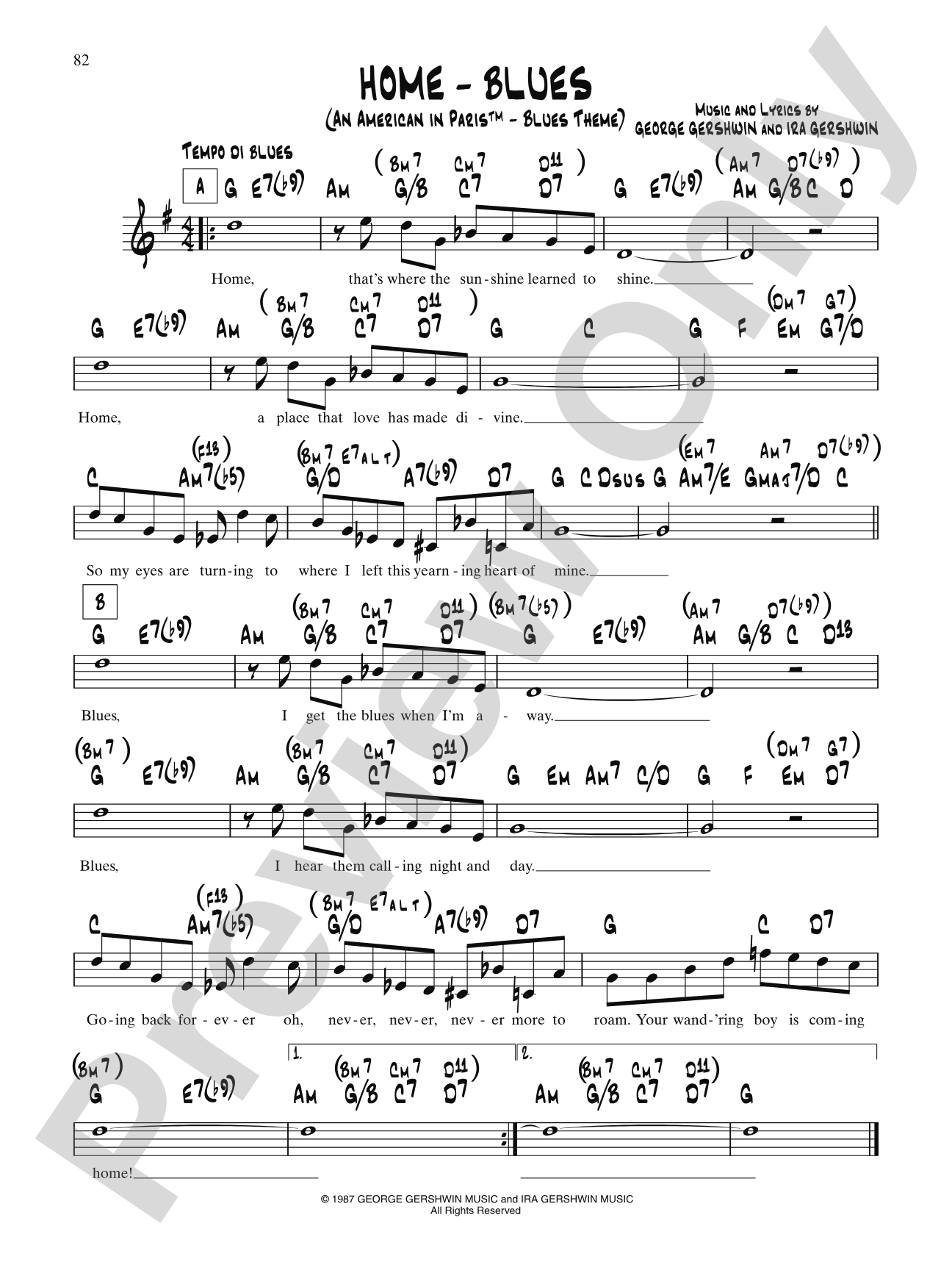

Home Blues: Lead Sheet
George and Ira Gershwin
Item: 00-PSL-000763
$4.99
One moment…
Related Items
I Loves You, Porgy (From "Porgy And Bess"): Lead Sheet |
$4.99
|
View | |
Bess You Is My Woman Now (From "Porgy And Bess"): Lead Sheet |
$4.99
|
View | |
It Ain't Necessarily So (From "Porgy And Bess"): Lead Sheet |
$4.99
|
View | |
Let's Call The Whole Thing Off (From "Shall We Dance"): Lead Sheet |
$4.99
|
View | |
Bidin' My Time: Lead Sheet |
$4.99
|
View | |
Fascinating Rhythm: Lead Sheet |
$4.99
|
View | |
The Man That Got Away (From "A Star Is Born"): Lead Sheet |
$4.99
|
View | |
What Causes That?: Lead Sheet |
$4.99
|
View | |
For You, For Me, Forever More: Lead Sheet |
$4.99
|
View | |
Aren't You Kind Of Glad We Did?: Lead Sheet |
$4.99
|
View | |
Long Ago And Far Away (From "Cover Girl"): Lead Sheet |
$4.99
|
View | |
Boy! What Love Has Done To Me!: Lead Sheet |
$4.99
|
View | |
Woman Is A Sometime Thing (Porgy & Bess): Lead Sheet |
$4.99
|
View | |
By Strauss (From "The Show Is On"): Lead Sheet |
$4.99
|
View | |
Changing My Tune: Lead Sheet |
$4.99
|
View | |
I Can't Be Bothered Now: Lead Sheet |
$4.99
|
View | |
I Got Plenty O' Nuttin' (From "Porgy And Bess"): Lead Sheet |
$4.99
|
View | |
I Was Doing All Right: Lead Sheet |
$4.99
|
View | |
I've Got Beginner's Luck: Lead Sheet |
$4.99
|
View | |
Just Another Rhumba: Lead Sheet |
$4.99
|
View | |
Hi Ho: Lead Sheet |
$4.99
|
View | |
My Man's Gone Now (From "Porgy And Bess"): Lead Sheet |
$4.99
|
View | |
Real American Folk Song (Is A Rag): Lead Sheet |
$4.99
|
View | |
Shall We Dance? (From "Shall We Dance"): Lead Sheet |
$4.99
|
View | |
Slap That Bass (From "Shall We Dance"): Lead Sheet |
$4.99
|
View | |
Stiff Upper Lip: Lead Sheet |
$4.99
|
View | |
There's A Boat Dats Leavin' Soon For New York (From "Porgy And Bess®"): Lead Sheet |
$4.99
|
View | |
Things Are Looking Up: Lead Sheet |
$4.99
|
View | |
Could You Use Me?: Lead Sheet |
$4.99
|
View | |
Sam And Delilah: Lead Sheet |
$4.99
|
View | |
Strike Up The Band! (From "Strike Up The Band"): Lead Sheet |
$4.99
|
View | |
Soon: Lead Sheet |
$4.99
|
View | |
My One And Only: Lead Sheet |
$4.99
|
View | |
Liza (All The Clouds'll Roll Away): Lead Sheet |
$4.99
|
View | |
Funny Face (overture): Lead Sheet |
$4.99
|
View | |
High Hat: Lead Sheet |
$4.99
|
View | |
World Is Mine: Lead Sheet |
$4.99
|
View | |
Let's Kiss And Make Up: Lead Sheet |
$4.99
|
View | |
Yankee Doodle Rhythm: Lead Sheet |
$4.99
|
View | |
Oh Gee! - Oh Joy!: Lead Sheet |
$4.99
|
View | |
K-ra-zy For You: Lead Sheet |
$4.99
|
View | |
Oh, So Nice: Lead Sheet |
$4.99
|
View | |
How Long Has This Been Going On? (From "Rosalie"): Lead Sheet |
$4.99
|
View | |
Feeling I'm Falling: Lead Sheet |
$4.99
|
View | |
Feeling Sentimental: Lead Sheet |
$4.99
|
View | |
Of Thee I Sing: Lead Sheet |
$4.99
|
View | |
Who Cares? (So Long As You Care For Me) (From "Of Thee I Sing"): Lead Sheet |
$4.99
|
View | |
Delishious: Lead Sheet |
$4.99
|
View | |
Somebody From Somewhere: Lead Sheet |
$4.99
|
View | |
Blah, Blah, Blah (From "Delicious"): Lead Sheet |
$4.99
|
View |
Description
This is the first "Artist Edition" in our bestselling Just . . . Real Book series. Containing well over 100 songs from George and Ira Gershwin, this is an invaluable resource for all musicians and fans of the Gershwin legacy. As with all books in the Just Real Book series, each arrangement is done to the highest standards. This new edition was produced with the full cooperation and approval of the Gershwin estate. Comb bound.


Home Blues: Lead Sheet isn't in MakeMusic Cloud just yet...but it could be. Let us know you'd like to see it, and you'll help shape what comes next. In the meantime, start a free trial and dive into thousands of interactive titles your students can play along with today.
Request This Title
Tell us you want it.
Start Your Free Trial
Explore everything that's ready to play right now.
Sample Audio
No sample audio found.
Sample Video
No sample videos found.
Additional Details
Series:
Just Real Books Series
Publisher:
Alfred Music
Page Count:
248
SKU:
00-PSL-000763
More about this title
About the Composer: George Gershwin
George Gershwin (1898-1937) shaped American music by fusing jazz idioms with classical forms at a moment when that fusion seemed impossible to many. His theater songs and concert works became the soundtrack to the Jazz Age, and his harmonic language—chromatic, blues-inflected, rhythmically inventive—remains a masterclass in songwriting craft. For musicians learning jazz standards, Gershwin's melodies and chord progressions offer clarity, sophistication, and endless interpretive possibility.
Ira Gershwin, George's lyricist brother, crafted words with the same precision George brought to melody. Their partnership produced some of the twentieth century's most singable, most recorded songs. Understanding Gershwin's output means understanding how American popular song came to mean something larger than entertainment; it became literature.
Why we love this
This collection gives guitarists direct access to the harmonic architecture and melodic sophistication that defined American jazz standards. Over 100 songs means you're not sampling Gershwin; you're immersed in his vocabulary, which builds recognition and internalization in ways scattered songbooks cannot. The lead sheet format demands real musicianship from the player—you're interpreting, voicing, and making choices, not just reading notation.
What to expect
Stepping into a room full of intelligent, witty melodies that sit beautifully under the hand. The harmonic movement is conversational and urbane; even straightforward songs surprise you with unexpected chord changes that feel inevitable once you hear them. There's elegance here, and enough rhythmic swagger to keep things grounded in the blues.
Who it's for
Jazz guitarists studying the standards repertoire, music students mining American songwriting for historical context and harmonic vocabulary, and performers preparing programs of classic American music. This is essential for anyone serious about understanding how to comp, solo, and arrange within the jazz tradition.
How to get the most out of it
- Pay attention to Gershwin's chromatic passing chords and secondary dominants; they're not ornamental. They define the harmonic language and change how the melody lands.
- Use guide tones to navigate the changes. Gershwin's progressions are logical but often unexpected; tracking the movement of the third and seventh through each chord sharpens your solo conception.
- Approach the melody with rubato. These are songs written for singers and theater; they demand phrasing and breath, not metronomic accuracy.
- Experiment with reharmonization after you've played the chart straight. Gershwin's voicings are a foundation, not a ceiling.
How to use it
Use this as a core text for jazz guitar study, returning to it across multiple semesters or years as your facility and harmonic understanding deepen. It's equally valuable for programming a vintage jazz concert, building a repertoire of duets for guitar and voice, or creating a research project on jazz standards and their theatrical origins.
Skills your students will build
- Reading lead sheets and composing chord-based accompaniments
- Recognizing and executing common jazz harmonic patterns (ii-V-I, secondary dominants, chromatic passing chords)
- Phrasing melody through changes and managing rubato in a rhythmic context
- Analyzing song form (AABA, ABAC, etc.) and identifying harmonic function within phrases
- Building a working vocabulary of standards and their variations across performances