
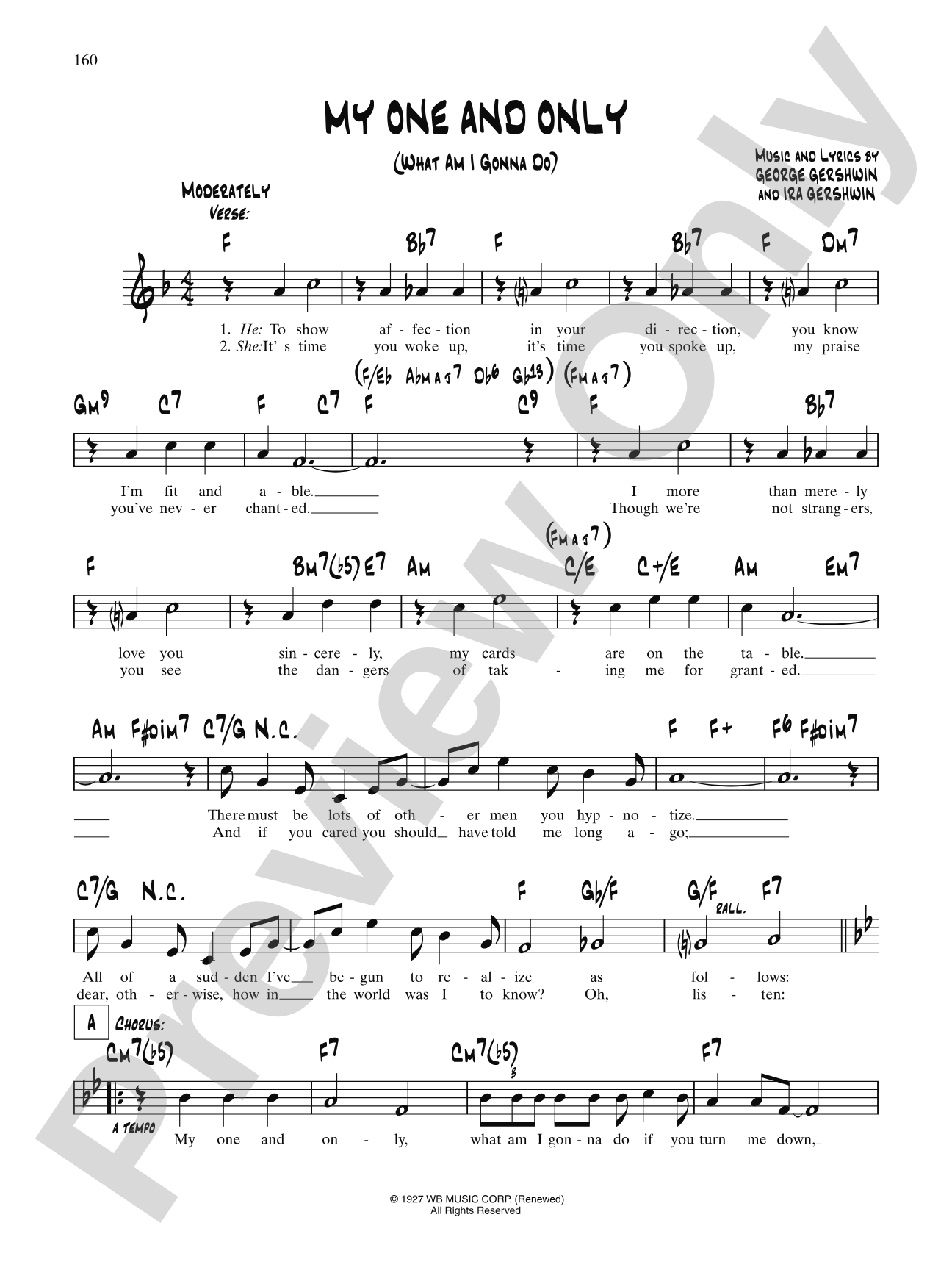

My One And Only: Lead Sheet
George and Ira Gershwin
Item: 00-PSL-000769
$4.99
One moment…
Related Items
I Loves You, Porgy (From "Porgy And Bess"): Lead Sheet |
$4.99
|
View | |
Bess You Is My Woman Now (From "Porgy And Bess"): Lead Sheet |
$4.99
|
View | |
It Ain't Necessarily So (From "Porgy And Bess"): Lead Sheet |
$4.99
|
View | |
Let's Call The Whole Thing Off (From "Shall We Dance"): Lead Sheet |
$4.99
|
View | |
Bidin' My Time: Lead Sheet |
$4.99
|
View | |
Fascinating Rhythm: Lead Sheet |
$4.99
|
View | |
The Man That Got Away (From "A Star Is Born"): Lead Sheet |
$4.99
|
View | |
What Causes That?: Lead Sheet |
$4.99
|
View | |
For You, For Me, Forever More: Lead Sheet |
$4.99
|
View | |
Aren't You Kind Of Glad We Did?: Lead Sheet |
$4.99
|
View | |
Long Ago And Far Away (From "Cover Girl"): Lead Sheet |
$4.99
|
View | |
Boy! What Love Has Done To Me!: Lead Sheet |
$4.99
|
View | |
Woman Is A Sometime Thing (Porgy & Bess): Lead Sheet |
$4.99
|
View | |
By Strauss (From "The Show Is On"): Lead Sheet |
$4.99
|
View | |
Changing My Tune: Lead Sheet |
$4.99
|
View | |
I Can't Be Bothered Now: Lead Sheet |
$4.99
|
View | |
I Got Plenty O' Nuttin' (From "Porgy And Bess"): Lead Sheet |
$4.99
|
View | |
I Was Doing All Right: Lead Sheet |
$4.99
|
View | |
I've Got Beginner's Luck: Lead Sheet |
$4.99
|
View | |
Just Another Rhumba: Lead Sheet |
$4.99
|
View | |
Hi Ho: Lead Sheet |
$4.99
|
View | |
My Man's Gone Now (From "Porgy And Bess"): Lead Sheet |
$4.99
|
View | |
Real American Folk Song (Is A Rag): Lead Sheet |
$4.99
|
View | |
Shall We Dance? (From "Shall We Dance"): Lead Sheet |
$4.99
|
View | |
Slap That Bass (From "Shall We Dance"): Lead Sheet |
$4.99
|
View | |
Stiff Upper Lip: Lead Sheet |
$4.99
|
View | |
There's A Boat Dats Leavin' Soon For New York (From "Porgy And Bess®"): Lead Sheet |
$4.99
|
View | |
Things Are Looking Up: Lead Sheet |
$4.99
|
View | |
Home Blues: Lead Sheet |
$4.99
|
View | |
Could You Use Me?: Lead Sheet |
$4.99
|
View | |
Sam And Delilah: Lead Sheet |
$4.99
|
View | |
Strike Up The Band! (From "Strike Up The Band"): Lead Sheet |
$4.99
|
View | |
Soon: Lead Sheet |
$4.99
|
View | |
Liza (All The Clouds'll Roll Away): Lead Sheet |
$4.99
|
View | |
Funny Face (overture): Lead Sheet |
$4.99
|
View | |
High Hat: Lead Sheet |
$4.99
|
View | |
World Is Mine: Lead Sheet |
$4.99
|
View | |
Let's Kiss And Make Up: Lead Sheet |
$4.99
|
View | |
Yankee Doodle Rhythm: Lead Sheet |
$4.99
|
View | |
Oh Gee! - Oh Joy!: Lead Sheet |
$4.99
|
View | |
K-ra-zy For You: Lead Sheet |
$4.99
|
View | |
Oh, So Nice: Lead Sheet |
$4.99
|
View | |
How Long Has This Been Going On? (From "Rosalie"): Lead Sheet |
$4.99
|
View | |
Feeling I'm Falling: Lead Sheet |
$4.99
|
View | |
Feeling Sentimental: Lead Sheet |
$4.99
|
View | |
Of Thee I Sing: Lead Sheet |
$4.99
|
View | |
Who Cares? (So Long As You Care For Me) (From "Of Thee I Sing"): Lead Sheet |
$4.99
|
View | |
Delishious: Lead Sheet |
$4.99
|
View | |
Somebody From Somewhere: Lead Sheet |
$4.99
|
View | |
Blah, Blah, Blah (From "Delicious"): Lead Sheet |
$4.99
|
View |
Description
This is the first "Artist Edition" in our bestselling Just . . . Real Book series. Containing well over 100 songs from George and Ira Gershwin, this is an invaluable resource for all musicians and fans of the Gershwin legacy. As with all books in the Just Real Book series, each arrangement is done to the highest standards. This new edition was produced with the full cooperation and approval of the Gershwin estate. Comb bound.


My One And Only: Lead Sheet isn't in MakeMusic Cloud just yet...but it could be. Let us know you'd like to see it, and you'll help shape what comes next. In the meantime, start a free trial and dive into thousands of interactive titles your students can play along with today.
Request This Title
Tell us you want it.
Start Your Free Trial
Explore everything that's ready to play right now.
Sample Audio
No sample audio found.
Sample Video
No sample videos found.
Additional Details
Series:
Just Real Books Series
Publisher:
Alfred Music
Page Count:
248
SKU:
00-PSL-000769
More about this title
About the Composer: George Gershwin
George Gershwin (1898-1937) was an American composer who bridged classical and popular music with unprecedented success. His works for piano, orchestra, and musical theater established him as a defining voice of the Jazz Age, combining European compositional sophistication with distinctly American idioms and rhythmic vitality.
Ira Gershwin (1896-1983) was George's lyricist and frequent collaborator, crafting witty, elegant, and emotionally direct lyrics that became the standard against which American songwriting is measured. Together, the brothers created some of the most enduring songs in the American songbook, works that continue to define jazz standards and popular music education.
Why we love this
This collection captures the harmonic richness and melodic sophistication that made Gershwin standards the foundation of jazz pedagogy. Over 100 songs means you have genuine flexibility in repertoire selection for student performance, combos, or jam session material without sacrificing artistic substance. The lead sheet format respects musicians' interpretive freedom while the Gershwin estate's official approval ensures accuracy and completeness.
What to expect
These songs pulse with the optimism and sophistication of 1920s and 30s New York, where jazz language met Tin Pan Alley craft. The melodies are singable yet harmonically complex; the lyrical wit and emotional directness create immediate connection even as the harmonic palette rewards deeper listening and study. Whether you approach them as jazz standards or as windows into American cultural history, they feel both timeless and distinctly of their era.
Who it's for
Jazz guitarists seeking authoritative, comprehensive access to the Gershwin canon will find this resource essential for both performance and composition study. Band directors and jazz educators can draw from this collection for ensemble arrangements, student combo projects, and historical listening assignments. Serious amateurs and students pursuing jazz or American music studies benefit from having the complete official songbook in lead sheet format.
How to get the most out of it
- Pay attention to Gershwin's chromatic voice leading and secondary dominants; these songs reward careful harmonic analysis and sensitive chord substitution choices.
- Balance melodic phrasing with the jazz tradition of rhythmic reinterpretation; these lead sheets support both straight reading and modern harmonic reharmonization.
- Use the extensive repertoire to build thematic programming around specific song cycles or lyrical themes rather than treating each tune in isolation.
- Reference recordings of classic interpretations to understand the stylistic context, then develop your own approach rather than defaulting to one definitive version.
How to use it
Feature individual Gershwin standards in student recitals or combo performances throughout the year, drawing from this collection to match skill levels and ensemble configurations. Sequence several Gershwin pieces in a single concert to explore how his compositional voice evolved or how different arrangers and performers have interpreted the same material. Use this as the core repertoire for a jazz history unit or semester-long songbook project where students analyze, perform, and reharmonize selections of their choosing.
Skills your students will build
- Reading and interpreting lead sheets with jazz notation conventions
- Understanding chromatic harmony and voice leading in popular song contexts
- Analyzing and playing chord substitutions rooted in jazz tradition
- Developing interpretive choices in melody and rhythm while respecting song structure
- Recognizing and performing the specific harmonic vocabulary of the Great American Songbook