
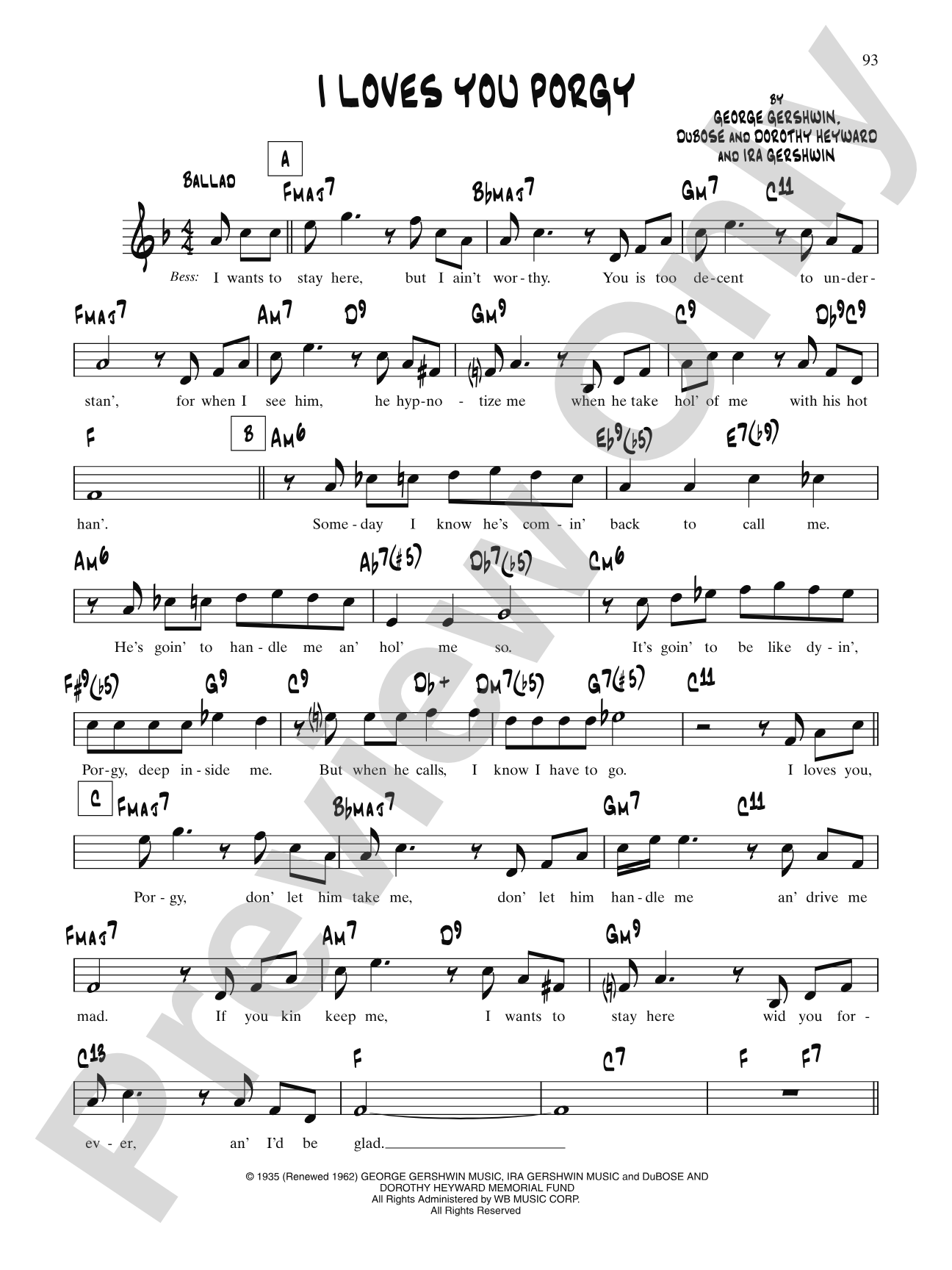

I Loves You, Porgy (From "Porgy And Bess"): Lead Sheet
George and Ira Gershwin
Item: 00-PSL-000206
$4.99
One moment…
Related Items
Bess You Is My Woman Now (From "Porgy And Bess"): Lead Sheet |
$4.99
|
View | |
It Ain't Necessarily So (From "Porgy And Bess"): Lead Sheet |
$4.99
|
View | |
Let's Call The Whole Thing Off (From "Shall We Dance"): Lead Sheet |
$4.99
|
View | |
Bidin' My Time: Lead Sheet |
$4.99
|
View | |
Fascinating Rhythm: Lead Sheet |
$4.99
|
View | |
The Man That Got Away (From "A Star Is Born"): Lead Sheet |
$4.99
|
View | |
What Causes That?: Lead Sheet |
$4.99
|
View | |
For You, For Me, Forever More: Lead Sheet |
$4.99
|
View | |
Aren't You Kind Of Glad We Did?: Lead Sheet |
$4.99
|
View | |
Long Ago And Far Away (From "Cover Girl"): Lead Sheet |
$4.99
|
View | |
Boy! What Love Has Done To Me!: Lead Sheet |
$4.99
|
View | |
Woman Is A Sometime Thing (Porgy & Bess): Lead Sheet |
$4.99
|
View | |
By Strauss (From "The Show Is On"): Lead Sheet |
$4.99
|
View | |
Changing My Tune: Lead Sheet |
$4.99
|
View | |
I Can't Be Bothered Now: Lead Sheet |
$4.99
|
View | |
I Got Plenty O' Nuttin' (From "Porgy And Bess"): Lead Sheet |
$4.99
|
View | |
I Was Doing All Right: Lead Sheet |
$4.99
|
View | |
I've Got Beginner's Luck: Lead Sheet |
$4.99
|
View | |
Just Another Rhumba: Lead Sheet |
$4.99
|
View | |
Hi Ho: Lead Sheet |
$4.99
|
View | |
My Man's Gone Now (From "Porgy And Bess"): Lead Sheet |
$4.99
|
View | |
Real American Folk Song (Is A Rag): Lead Sheet |
$4.99
|
View | |
Shall We Dance? (From "Shall We Dance"): Lead Sheet |
$4.99
|
View | |
Slap That Bass (From "Shall We Dance"): Lead Sheet |
$4.99
|
View | |
Stiff Upper Lip: Lead Sheet |
$4.99
|
View | |
There's A Boat Dats Leavin' Soon For New York (From "Porgy And Bess®"): Lead Sheet |
$4.99
|
View | |
Things Are Looking Up: Lead Sheet |
$4.99
|
View | |
Home Blues: Lead Sheet |
$4.99
|
View | |
Could You Use Me?: Lead Sheet |
$4.99
|
View | |
Sam And Delilah: Lead Sheet |
$4.99
|
View | |
Strike Up The Band! (From "Strike Up The Band"): Lead Sheet |
$4.99
|
View | |
Soon: Lead Sheet |
$4.99
|
View | |
My One And Only: Lead Sheet |
$4.99
|
View | |
Liza (All The Clouds'll Roll Away): Lead Sheet |
$4.99
|
View | |
Funny Face (overture): Lead Sheet |
$4.99
|
View | |
High Hat: Lead Sheet |
$4.99
|
View | |
World Is Mine: Lead Sheet |
$4.99
|
View | |
Let's Kiss And Make Up: Lead Sheet |
$4.99
|
View | |
Yankee Doodle Rhythm: Lead Sheet |
$4.99
|
View | |
Oh Gee! - Oh Joy!: Lead Sheet |
$4.99
|
View | |
K-ra-zy For You: Lead Sheet |
$4.99
|
View | |
Oh, So Nice: Lead Sheet |
$4.99
|
View | |
How Long Has This Been Going On? (From "Rosalie"): Lead Sheet |
$4.99
|
View | |
Feeling I'm Falling: Lead Sheet |
$4.99
|
View | |
Feeling Sentimental: Lead Sheet |
$4.99
|
View | |
Of Thee I Sing: Lead Sheet |
$4.99
|
View | |
Who Cares? (So Long As You Care For Me) (From "Of Thee I Sing"): Lead Sheet |
$4.99
|
View | |
Delishious: Lead Sheet |
$4.99
|
View | |
Somebody From Somewhere: Lead Sheet |
$4.99
|
View | |
Blah, Blah, Blah (From "Delicious"): Lead Sheet |
$4.99
|
View |
Description
This is the first "Artist Edition" in our bestselling Just . . . Real Book series. Containing well over 100 songs from George and Ira Gershwin, this is an invaluable resource for all musicians and fans of the Gershwin legacy. As with all books in the Just Real Book series, each arrangement is done to the highest standards. This new edition was produced with the full cooperation and approval of the Gershwin estate. Comb bound.


I Loves You, Porgy (From "Porgy And Bess"): Lead Sheet isn't in MakeMusic Cloud just yet...but it could be. Let us know you'd like to see it, and you'll help shape what comes next. In the meantime, start a free trial and dive into thousands of interactive titles your students can play along with today.
Request This Title
Tell us you want it.
Start Your Free Trial
Explore everything that's ready to play right now.
Sample Audio
No sample audio found.
Sample Video
No sample videos found.
Additional Details
Series:
Just Real Books Series
Publisher:
Alfred Music
Page Count:
248
SKU:
00-PSL-000206
More about this title
About the Composer: George Gershwin
George Gershwin (1898–1937) bridged concert music and American popular song with unmatched fluency. His rhythmic sophistication, harmonic adventurousness, and gift for melody shaped jazz and musical theater while earning respect from classical composers worldwide.
Ira Gershwin (1896–1983) was George's lyricist and collaborator on nearly all his major theatrical works. Their partnership produced some of the American songbook's most enduring standards, marked by Ira's wit, conversational phrasing, and ability to match George's musical innovations with equally inventive text.
Why we love this
This lead sheet captures one of the most emotionally resonant moments in American opera, and having it in a guitar-friendly format opens the piece to musicians who might not otherwise explore Gershwin's harmonic language. The melody is instantly recognizable, but the lead sheet format forces you to reckon with the underlying changes, making it an ideal vehicle for understanding how standard jazz progressions can carry profound emotional weight.
What to expect
The opening is tender and almost fragile, with a warmth that comes from minor-tinged harmony and a simple, singable melody. As the song unfolds, Gershwin's sophistication becomes clear: unexpected chromatic movements, delayed resolutions, and a sense of longing that feels both intimate and operatic.
Who it's for
Jazz guitarists and lead sheet readers who want to expand their standard repertoire with pieces that demand both melodic sensitivity and harmonic understanding. This is also valuable for guitarists studying composition or arrangement, since Gershwin's voice-leading offers concrete lessons in how to write music that sits naturally on the voice while remaining harmonically sophisticated.
How to get the most out of it
- Honor the lyrical shape of the melody over strict rhythmic precision. Gershwin's vocal writing here breathes; let your phrasing reflect the text and emotional arc rather than locking rigidly to the beat.
- Study the chord changes in context of the vocal line. Notice where tensions resolve and where Gershwin delays resolution for harmonic color; these choices inform how you voice and voice-lead your comping.
- Treat the bridge as a moment of tonal shift. The harmonic landscape changes noticeably in the B section; mark those changes in your chart so you don't lose your place or default to patterns from the A sections.
How to use it
Feature this in a jazz standards set or a program exploring American song from theater. Its operatic roots and emotional directness make it work equally well in a concert focused on Gershwin or in a broader evening of standards that traces how art song sensibilities shaped jazz repertoire.
Skills your students will build
- Reading and interpreting lead sheet notation for jazz standards
- Understanding chord-melody relationships in dramatic vocal writing
- Voice-leading and comping choices that respect the emotional shape of a ballad
- Transposing and adapting standards to suit guitar voicings and ranges