
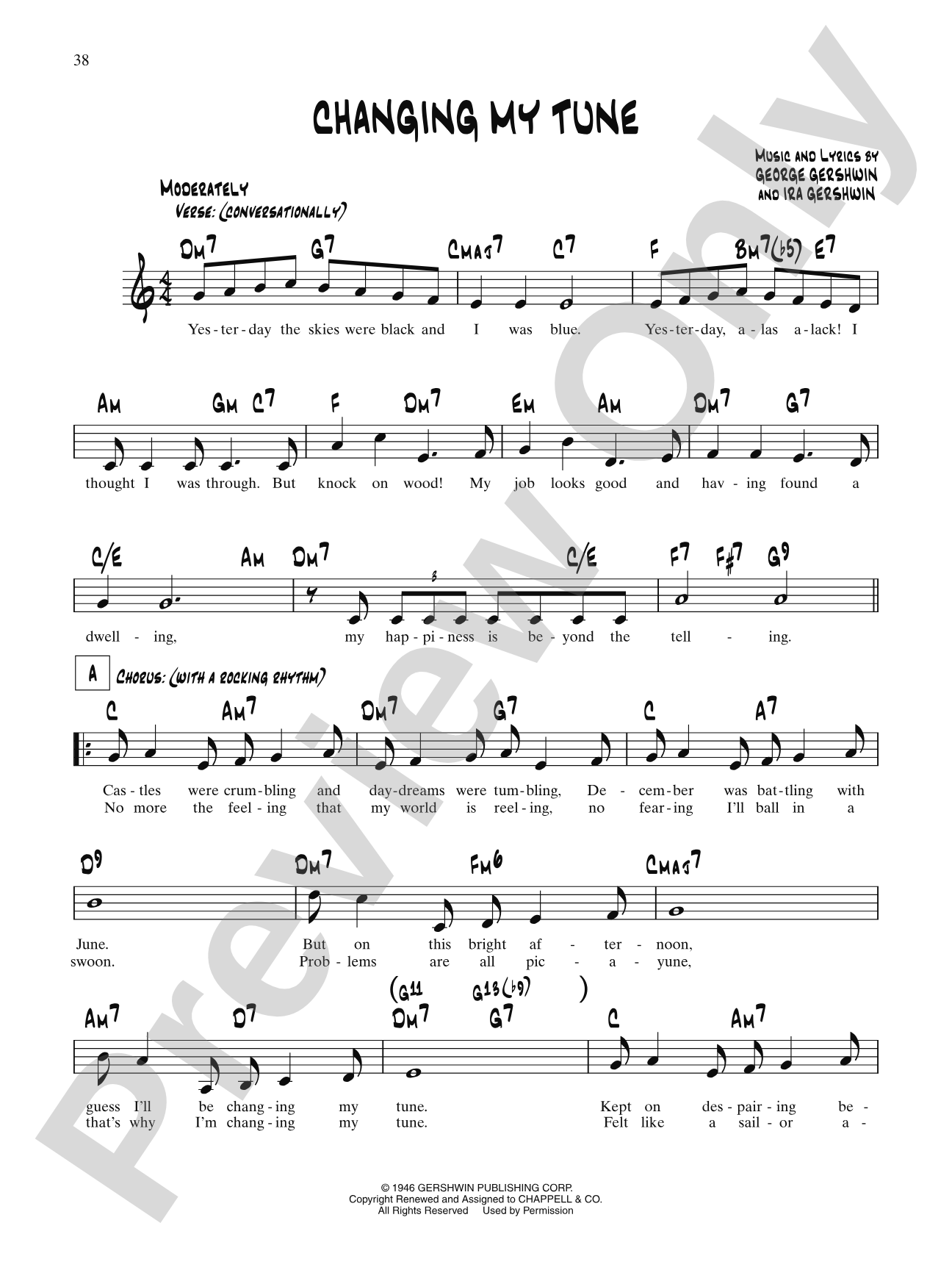

Changing My Tune: Lead Sheet
George and Ira Gershwin
Item: 00-PSL-000749
$4.99
One moment…
Related Items
I Loves You, Porgy (From "Porgy And Bess"): Lead Sheet |
$4.99
|
View | |
Bess You Is My Woman Now (From "Porgy And Bess"): Lead Sheet |
$4.99
|
View | |
It Ain't Necessarily So (From "Porgy And Bess"): Lead Sheet |
$4.99
|
View | |
Let's Call The Whole Thing Off (From "Shall We Dance"): Lead Sheet |
$4.99
|
View | |
Bidin' My Time: Lead Sheet |
$4.99
|
View | |
Fascinating Rhythm: Lead Sheet |
$4.99
|
View | |
The Man That Got Away (From "A Star Is Born"): Lead Sheet |
$4.99
|
View | |
What Causes That?: Lead Sheet |
$4.99
|
View | |
For You, For Me, Forever More: Lead Sheet |
$4.99
|
View | |
Aren't You Kind Of Glad We Did?: Lead Sheet |
$4.99
|
View | |
Long Ago And Far Away (From "Cover Girl"): Lead Sheet |
$4.99
|
View | |
Boy! What Love Has Done To Me!: Lead Sheet |
$4.99
|
View | |
Woman Is A Sometime Thing (Porgy & Bess): Lead Sheet |
$4.99
|
View | |
By Strauss (From "The Show Is On"): Lead Sheet |
$4.99
|
View | |
I Can't Be Bothered Now: Lead Sheet |
$4.99
|
View | |
I Got Plenty O' Nuttin' (From "Porgy And Bess"): Lead Sheet |
$4.99
|
View | |
I Was Doing All Right: Lead Sheet |
$4.99
|
View | |
I've Got Beginner's Luck: Lead Sheet |
$4.99
|
View | |
Just Another Rhumba: Lead Sheet |
$4.99
|
View | |
Hi Ho: Lead Sheet |
$4.99
|
View | |
My Man's Gone Now (From "Porgy And Bess"): Lead Sheet |
$4.99
|
View | |
Real American Folk Song (Is A Rag): Lead Sheet |
$4.99
|
View | |
Shall We Dance? (From "Shall We Dance"): Lead Sheet |
$4.99
|
View | |
Slap That Bass (From "Shall We Dance"): Lead Sheet |
$4.99
|
View | |
Stiff Upper Lip: Lead Sheet |
$4.99
|
View | |
There's A Boat Dats Leavin' Soon For New York (From "Porgy And Bess®"): Lead Sheet |
$4.99
|
View | |
Things Are Looking Up: Lead Sheet |
$4.99
|
View | |
Home Blues: Lead Sheet |
$4.99
|
View | |
Could You Use Me?: Lead Sheet |
$4.99
|
View | |
Sam And Delilah: Lead Sheet |
$4.99
|
View | |
Strike Up The Band! (From "Strike Up The Band"): Lead Sheet |
$4.99
|
View | |
Soon: Lead Sheet |
$4.99
|
View | |
My One And Only: Lead Sheet |
$4.99
|
View | |
Liza (All The Clouds'll Roll Away): Lead Sheet |
$4.99
|
View | |
Funny Face (overture): Lead Sheet |
$4.99
|
View | |
High Hat: Lead Sheet |
$4.99
|
View | |
World Is Mine: Lead Sheet |
$4.99
|
View | |
Let's Kiss And Make Up: Lead Sheet |
$4.99
|
View | |
Yankee Doodle Rhythm: Lead Sheet |
$4.99
|
View | |
Oh Gee! - Oh Joy!: Lead Sheet |
$4.99
|
View | |
K-ra-zy For You: Lead Sheet |
$4.99
|
View | |
Oh, So Nice: Lead Sheet |
$4.99
|
View | |
How Long Has This Been Going On? (From "Rosalie"): Lead Sheet |
$4.99
|
View | |
Feeling I'm Falling: Lead Sheet |
$4.99
|
View | |
Feeling Sentimental: Lead Sheet |
$4.99
|
View | |
Of Thee I Sing: Lead Sheet |
$4.99
|
View | |
Who Cares? (So Long As You Care For Me) (From "Of Thee I Sing"): Lead Sheet |
$4.99
|
View | |
Delishious: Lead Sheet |
$4.99
|
View | |
Somebody From Somewhere: Lead Sheet |
$4.99
|
View | |
Blah, Blah, Blah (From "Delicious"): Lead Sheet |
$4.99
|
View |
Description
This is the first "Artist Edition" in our bestselling Just . . . Real Book series. Containing well over 100 songs from George and Ira Gershwin, this is an invaluable resource for all musicians and fans of the Gershwin legacy. As with all books in the Just Real Book series, each arrangement is done to the highest standards. This new edition was produced with the full cooperation and approval of the Gershwin estate. Comb bound.


Changing My Tune: Lead Sheet isn't in MakeMusic Cloud just yet...but it could be. Let us know you'd like to see it, and you'll help shape what comes next. In the meantime, start a free trial and dive into thousands of interactive titles your students can play along with today.
Request This Title
Tell us you want it.
Start Your Free Trial
Explore everything that's ready to play right now.
Sample Audio
No sample audio found.
Sample Video
No sample videos found.
Additional Details
Series:
Just Real Books Series
Publisher:
Alfred Music
Page Count:
248
SKU:
00-PSL-000749
More about this title
About the Composer: George Gershwin
George Gershwin (1898-1937) bridged classical and popular music in ways that reshaped American composition. His rhythmic vitality, harmonic sophistication, and gift for melody made him a dominant voice in musical theater, film, and concert music during the 1920s and 1930s. His brother Ira, one of the era's greatest lyricists, crafted witty, conversational words that moved seamlessly between comedy and genuine emotion, making their collaborations some of the most enduring songs in the American songbook.
For musicians and educators, Gershwin's work offers a masterclass in bridging idioms. His standards reward close listening: melodies that seem simple reveal intricate harmonic underpinnings, and his rhythmic language sounds contemporary even a century later. Teaching and performing his music builds understanding of how great songwriting combines accessibility with sophistication.
Why we love this
This collection assembles over 100 Gershwin standards in lead sheet form, making it an essential reference for jazz guitarists, interpreters, and musicians studying American songwriting. The high production standards and the Gershwin estate's involvement ensure accuracy and respect for the originals, giving you reliable charts for repertoire you'll return to throughout your career.
What to expect
Opening this book feels like walking into a room where some of the most gifted melodists and lyricists of the American century are working. The music crackles with wit, yearning, and rhythmic energy. Whether you're playing a tender ballad or a spirited up-tempo number, Gershwin's language feels both historically rooted and startlingly alive.
Who it's for
Jazz guitarists building their standards vocabulary, musicians exploring American songbook classics, and anyone seeking reliable lead sheets for some of the 20th century's most important compositions. This is equally valuable for a working musician gigging regularly and a serious student studying the architecture of great song.
How to get the most out of it
- Study the harmonic movement beneath each melody. Gershwin's chord progressions often contain chromatic passing chords and unexpected reharmonizations that reward attention and shape your interpretive choices.
- Use the lead sheet as a starting point for your own accompaniment voicings. Jazz guitarists thrive when they make these standards their own, and Gershwin's melodies are sturdy enough to support varied harmonic treatments.
- Pay attention to the melodic shape and phrasing rather than rushing tempos. Many of these songs gain depth when you give the lines room to breathe.
How to use it
Use this as your primary reference for programming Gershwin standards in jazz combos, chamber settings, or solo recitals. The breadth of the collection means you can build an entire evening of music around these songs, or select carefully to pair with other 20th-century repertoire. Many charts work equally well as teaching tools for understanding song form and harmonic function.
Skills your students will build
- reading lead sheets and interpreting harmonic notation
- recognizing and playing chromatic passing chords and jazz reharmonization
- understanding song form and melodic phrasing in American standards
- accompanying yourself while maintaining strong harmonic awareness
- transposing and adapting charts to different keys for ensemble play