
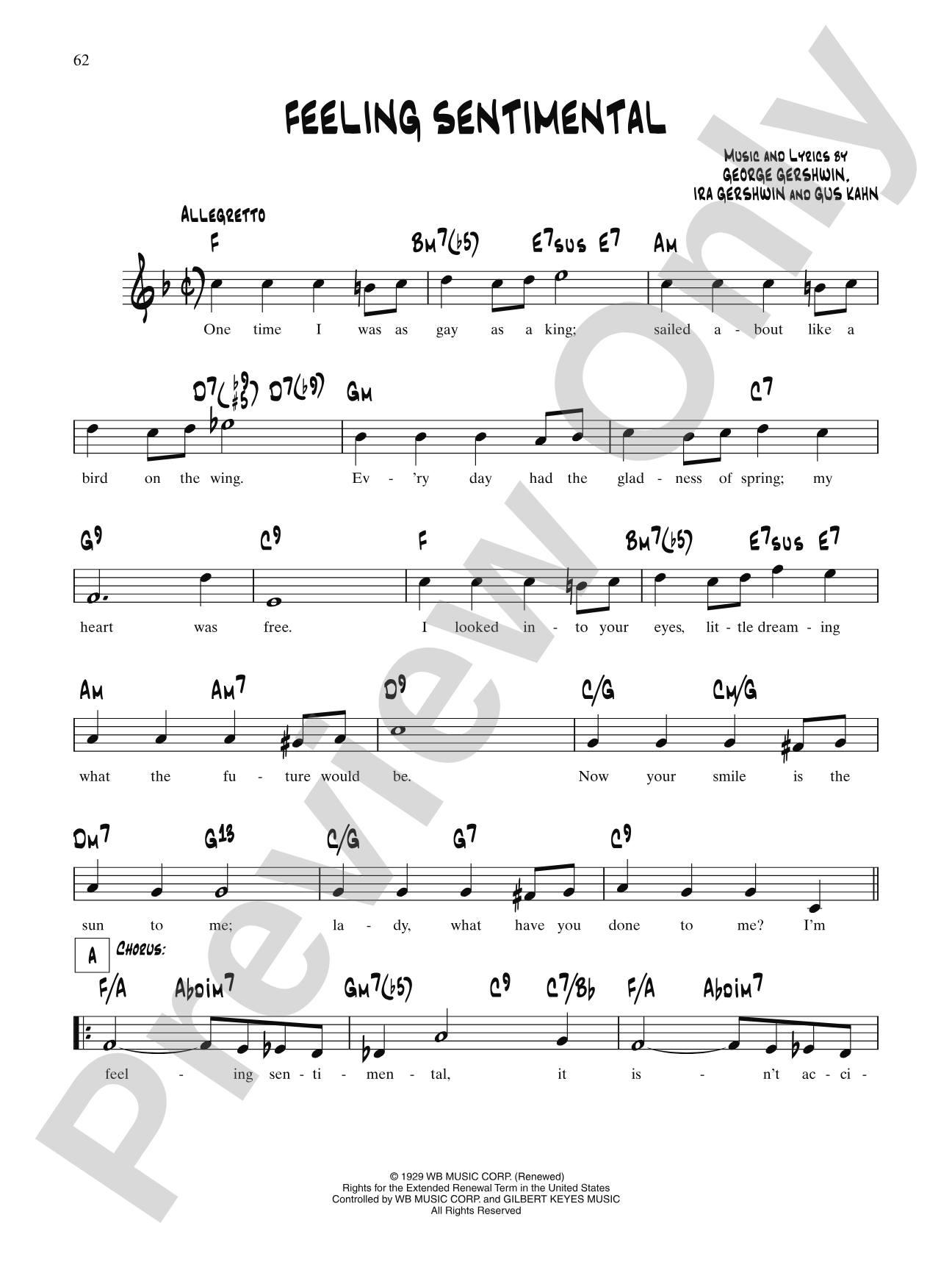

Feeling Sentimental: Lead Sheet
George and Ira Gershwin
Item: 00-PSL-000781
$4.99
One moment…
Related Items
I Loves You, Porgy (From "Porgy And Bess"): Lead Sheet |
$4.99
|
View | |
Bess You Is My Woman Now (From "Porgy And Bess"): Lead Sheet |
$4.99
|
View | |
It Ain't Necessarily So (From "Porgy And Bess"): Lead Sheet |
$4.99
|
View | |
Let's Call The Whole Thing Off (From "Shall We Dance"): Lead Sheet |
$4.99
|
View | |
Bidin' My Time: Lead Sheet |
$4.99
|
View | |
Fascinating Rhythm: Lead Sheet |
$4.99
|
View | |
The Man That Got Away (From "A Star Is Born"): Lead Sheet |
$4.99
|
View | |
What Causes That?: Lead Sheet |
$4.99
|
View | |
For You, For Me, Forever More: Lead Sheet |
$4.99
|
View | |
Aren't You Kind Of Glad We Did?: Lead Sheet |
$4.99
|
View | |
Long Ago And Far Away (From "Cover Girl"): Lead Sheet |
$4.99
|
View | |
Boy! What Love Has Done To Me!: Lead Sheet |
$4.99
|
View | |
Woman Is A Sometime Thing (Porgy & Bess): Lead Sheet |
$4.99
|
View | |
By Strauss (From "The Show Is On"): Lead Sheet |
$4.99
|
View | |
Changing My Tune: Lead Sheet |
$4.99
|
View | |
I Can't Be Bothered Now: Lead Sheet |
$4.99
|
View | |
I Got Plenty O' Nuttin' (From "Porgy And Bess"): Lead Sheet |
$4.99
|
View | |
I Was Doing All Right: Lead Sheet |
$4.99
|
View | |
I've Got Beginner's Luck: Lead Sheet |
$4.99
|
View | |
Just Another Rhumba: Lead Sheet |
$4.99
|
View | |
Hi Ho: Lead Sheet |
$4.99
|
View | |
My Man's Gone Now (From "Porgy And Bess"): Lead Sheet |
$4.99
|
View | |
Real American Folk Song (Is A Rag): Lead Sheet |
$4.99
|
View | |
Shall We Dance? (From "Shall We Dance"): Lead Sheet |
$4.99
|
View | |
Slap That Bass (From "Shall We Dance"): Lead Sheet |
$4.99
|
View | |
Stiff Upper Lip: Lead Sheet |
$4.99
|
View | |
There's A Boat Dats Leavin' Soon For New York (From "Porgy And Bess®"): Lead Sheet |
$4.99
|
View | |
Things Are Looking Up: Lead Sheet |
$4.99
|
View | |
Home Blues: Lead Sheet |
$4.99
|
View | |
Could You Use Me?: Lead Sheet |
$4.99
|
View | |
Sam And Delilah: Lead Sheet |
$4.99
|
View | |
Strike Up The Band! (From "Strike Up The Band"): Lead Sheet |
$4.99
|
View | |
Soon: Lead Sheet |
$4.99
|
View | |
My One And Only: Lead Sheet |
$4.99
|
View | |
Liza (All The Clouds'll Roll Away): Lead Sheet |
$4.99
|
View | |
Funny Face (overture): Lead Sheet |
$4.99
|
View | |
High Hat: Lead Sheet |
$4.99
|
View | |
World Is Mine: Lead Sheet |
$4.99
|
View | |
Let's Kiss And Make Up: Lead Sheet |
$4.99
|
View | |
Yankee Doodle Rhythm: Lead Sheet |
$4.99
|
View | |
Oh Gee! - Oh Joy!: Lead Sheet |
$4.99
|
View | |
K-ra-zy For You: Lead Sheet |
$4.99
|
View | |
Oh, So Nice: Lead Sheet |
$4.99
|
View | |
How Long Has This Been Going On? (From "Rosalie"): Lead Sheet |
$4.99
|
View | |
Feeling I'm Falling: Lead Sheet |
$4.99
|
View | |
Of Thee I Sing: Lead Sheet |
$4.99
|
View | |
Who Cares? (So Long As You Care For Me) (From "Of Thee I Sing"): Lead Sheet |
$4.99
|
View | |
Delishious: Lead Sheet |
$4.99
|
View | |
Somebody From Somewhere: Lead Sheet |
$4.99
|
View | |
Blah, Blah, Blah (From "Delicious"): Lead Sheet |
$4.99
|
View |
Description
This is the first "Artist Edition" in our bestselling Just . . . Real Book series. Containing well over 100 songs from George and Ira Gershwin, this is an invaluable resource for all musicians and fans of the Gershwin legacy. As with all books in the Just Real Book series, each arrangement is done to the highest standards. This new edition was produced with the full cooperation and approval of the Gershwin estate. Comb bound.


Feeling Sentimental: Lead Sheet isn't in MakeMusic Cloud just yet...but it could be. Let us know you'd like to see it, and you'll help shape what comes next. In the meantime, start a free trial and dive into thousands of interactive titles your students can play along with today.
Request This Title
Tell us you want it.
Start Your Free Trial
Explore everything that's ready to play right now.
Sample Audio
No sample audio found.
Sample Video
No sample videos found.
Additional Details
Series:
Just Real Books Series
Publisher:
Alfred Music
Page Count:
248
SKU:
00-PSL-000781
More about this title
About the Composer: George Gershwin
George Gershwin (1898-1937) bridged classical composition and American popular music with uncommon skill, creating a catalog of songs that defined the Jazz Age and remain central to the Great American Songbook. His gift for melody and harmonic sophistication made him equally at home writing concert works like Rhapsody in Blue and standards for Broadway and film, and his influence on jazz musicians, composers, and educators spans a century.
Why we love this
Over 100 Gershwin songs in a single, estate-approved resource means guitarists can explore the full range of his melodic genius without hunting across multiple books. The lead sheet format demands real musical understanding: you're not reading a chord chart, you're learning to voice and interpret standards the way jazz musicians do, which deepens your harmonic literacy and ear training in ways tab alone never will.
What to expect
Gershwin's melodies are direct and singable, yet his harmonies move with unexpected elegance, creating music that feels both accessible and sophisticated. These songs balance the warmth of golden-age Broadway with the rhythmic snap of jazz, inviting you into a world where technical mastery and genuine emotion coexist.
Who it's for
Guitarists serious about jazz standards, chord melody players, accompanists working with singers, and anyone building a foundation in the American songbook. This resource works equally well for self-directed study, private instruction, or as a reference in a contemporary jazz ensemble.
How to get the most out of it
- Voice the changes with intention. Gershwin's harmonies reward thoughtful voicing choices; experiment with upper structure triads and extensions to find the sound that sits best under each melody line.
- Listen to multiple recordings of the same song before settling on your interpretation. You'll notice how different era musicians approached tempo, rhythm feel, and phrasing, which will inform your own musical choices.
- Pay attention to the bridge. Gershwin often modulated or introduced fresh harmonic movement in the B section; these moments deserve extra rehearsal and clarity so the form reads clearly.
- Treat the melody as a conversation partner, not a servant. These songs were written for singers and improvising musicians; your job is to support that tradition by playing lines that breathe and respond to the melody's shape.
How to use it
Pull individual songs for jazz combo sets, student recitals, or coffee house gigs where the Gershwin name carries immediate recognition and appeal. The breadth of material also makes this an ideal standalone curriculum for a semester-long study of one composer's evolution across different song types and eras.
Skills your students will build
- Reading lead sheets and vocal melody lines with chord symbols
- Voice leading and harmonic interpretation of jazz standards
- Understanding song form (AABA, ABAC) through Gershwin's structural approach
- Developing rhythmic flexibility and swing feel in accompaniment
- Analyzing and performing modal interchange and chromatic harmony