
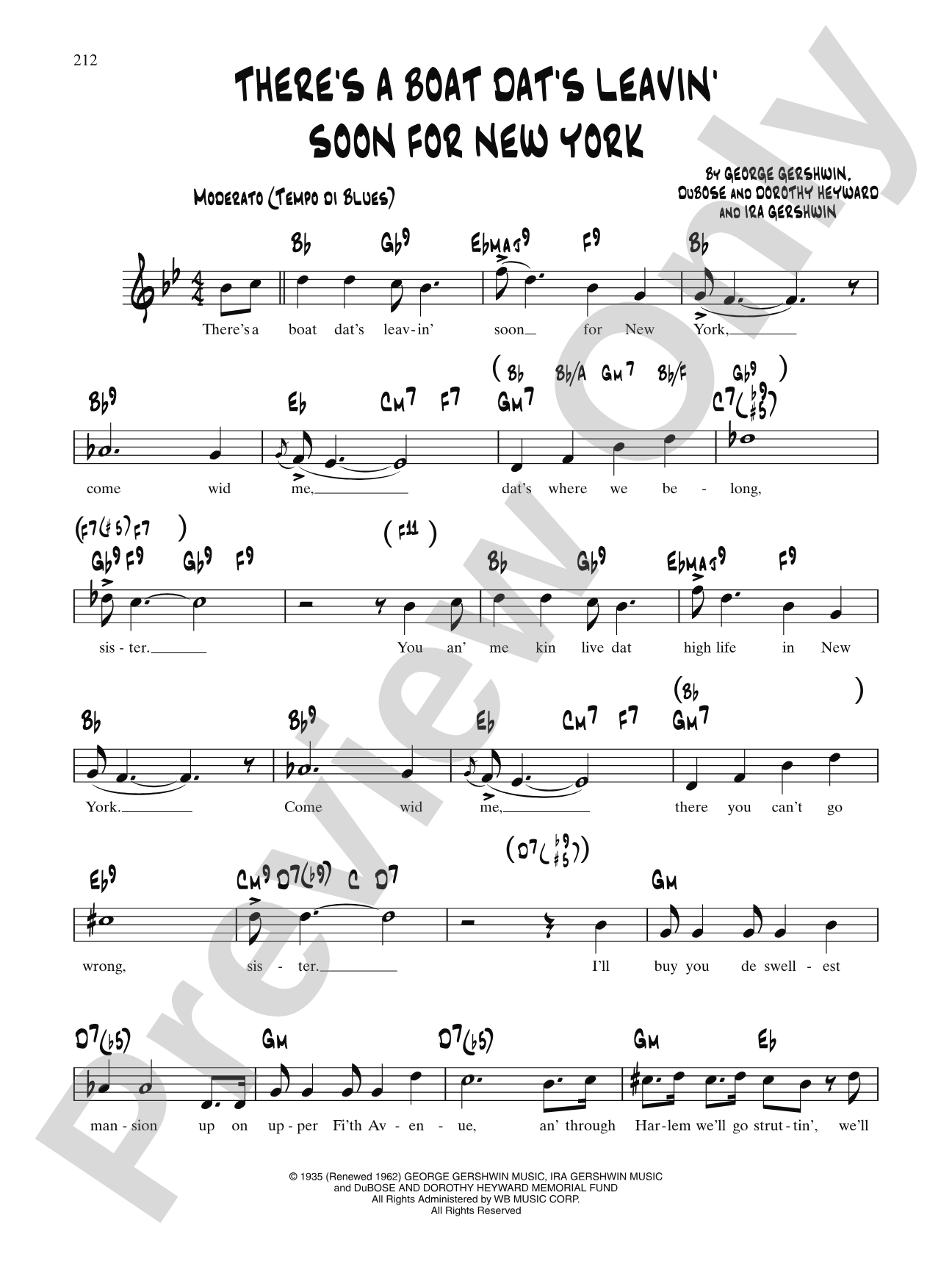

There's A Boat Dats Leavin' Soon For New York (From "Porgy And Bess®"): Lead Sheet
George and Ira Gershwin
Item: 00-PSL-000761
$4.99
One moment…
Related Items
I Loves You, Porgy (From "Porgy And Bess"): Lead Sheet |
$4.99
|
View | |
Bess You Is My Woman Now (From "Porgy And Bess"): Lead Sheet |
$4.99
|
View | |
It Ain't Necessarily So (From "Porgy And Bess"): Lead Sheet |
$4.99
|
View | |
Let's Call The Whole Thing Off (From "Shall We Dance"): Lead Sheet |
$4.99
|
View | |
Bidin' My Time: Lead Sheet |
$4.99
|
View | |
Fascinating Rhythm: Lead Sheet |
$4.99
|
View | |
The Man That Got Away (From "A Star Is Born"): Lead Sheet |
$4.99
|
View | |
What Causes That?: Lead Sheet |
$4.99
|
View | |
For You, For Me, Forever More: Lead Sheet |
$4.99
|
View | |
Aren't You Kind Of Glad We Did?: Lead Sheet |
$4.99
|
View | |
Long Ago And Far Away (From "Cover Girl"): Lead Sheet |
$4.99
|
View | |
Boy! What Love Has Done To Me!: Lead Sheet |
$4.99
|
View | |
Woman Is A Sometime Thing (Porgy & Bess): Lead Sheet |
$4.99
|
View | |
By Strauss (From "The Show Is On"): Lead Sheet |
$4.99
|
View | |
Changing My Tune: Lead Sheet |
$4.99
|
View | |
I Can't Be Bothered Now: Lead Sheet |
$4.99
|
View | |
I Got Plenty O' Nuttin' (From "Porgy And Bess"): Lead Sheet |
$4.99
|
View | |
I Was Doing All Right: Lead Sheet |
$4.99
|
View | |
I've Got Beginner's Luck: Lead Sheet |
$4.99
|
View | |
Just Another Rhumba: Lead Sheet |
$4.99
|
View | |
Hi Ho: Lead Sheet |
$4.99
|
View | |
My Man's Gone Now (From "Porgy And Bess"): Lead Sheet |
$4.99
|
View | |
Real American Folk Song (Is A Rag): Lead Sheet |
$4.99
|
View | |
Shall We Dance? (From "Shall We Dance"): Lead Sheet |
$4.99
|
View | |
Slap That Bass (From "Shall We Dance"): Lead Sheet |
$4.99
|
View | |
Stiff Upper Lip: Lead Sheet |
$4.99
|
View | |
Things Are Looking Up: Lead Sheet |
$4.99
|
View | |
Home Blues: Lead Sheet |
$4.99
|
View | |
Could You Use Me?: Lead Sheet |
$4.99
|
View | |
Sam And Delilah: Lead Sheet |
$4.99
|
View | |
Strike Up The Band! (From "Strike Up The Band"): Lead Sheet |
$4.99
|
View | |
Soon: Lead Sheet |
$4.99
|
View | |
My One And Only: Lead Sheet |
$4.99
|
View | |
Liza (All The Clouds'll Roll Away): Lead Sheet |
$4.99
|
View | |
Funny Face (overture): Lead Sheet |
$4.99
|
View | |
High Hat: Lead Sheet |
$4.99
|
View | |
World Is Mine: Lead Sheet |
$4.99
|
View | |
Let's Kiss And Make Up: Lead Sheet |
$4.99
|
View | |
Yankee Doodle Rhythm: Lead Sheet |
$4.99
|
View | |
Oh Gee! - Oh Joy!: Lead Sheet |
$4.99
|
View | |
K-ra-zy For You: Lead Sheet |
$4.99
|
View | |
Oh, So Nice: Lead Sheet |
$4.99
|
View | |
How Long Has This Been Going On? (From "Rosalie"): Lead Sheet |
$4.99
|
View | |
Feeling I'm Falling: Lead Sheet |
$4.99
|
View | |
Feeling Sentimental: Lead Sheet |
$4.99
|
View | |
Of Thee I Sing: Lead Sheet |
$4.99
|
View | |
Who Cares? (So Long As You Care For Me) (From "Of Thee I Sing"): Lead Sheet |
$4.99
|
View | |
Delishious: Lead Sheet |
$4.99
|
View | |
Somebody From Somewhere: Lead Sheet |
$4.99
|
View | |
Blah, Blah, Blah (From "Delicious"): Lead Sheet |
$4.99
|
View |
Description
This is the first "Artist Edition" in our bestselling Just . . . Real Book series. Containing well over 100 songs from George and Ira Gershwin, this is an invaluable resource for all musicians and fans of the Gershwin legacy. As with all books in the Just Real Book series, each arrangement is done to the highest standards. This new edition was produced with the full cooperation and approval of the Gershwin estate. Comb bound.


There's A Boat Dats Leavin' Soon For New York (From "Porgy And Bess®"): Lead Sheet isn't in MakeMusic Cloud just yet...but it could be. Let us know you'd like to see it, and you'll help shape what comes next. In the meantime, start a free trial and dive into thousands of interactive titles your students can play along with today.
Request This Title
Tell us you want it.
Start Your Free Trial
Explore everything that's ready to play right now.
Sample Audio
No sample audio found.
Sample Video
No sample videos found.
Additional Details
Series:
Just Real Books Series
Publisher:
Alfred Music
Page Count:
248
SKU:
00-PSL-000761
More about this title
About the Composer: George Gershwin
George Gershwin (1898-1937) bridged concert music and popular song with unprecedented fluency, composing both ambitious orchestral works and standards that defined American musical theater. His collaborations with lyricist Ira Gershwin and librettists DuBose and Dorothy Heyward produced "Porgy and Bess," a landmark opera that remains central to the American musical canon and continues to influence how musicians approach jazz harmony, blues idiom, and theatrical storytelling.
For music educators, Gershwin's output offers immediate classroom value: his melodies are singable and memorable, his harmonic language introduces jazz reharmonization possibilities, and his orchestrations reward detailed listening. Teachers use his work to demonstrate how classical training and vernacular music can coexist, making him essential to any curriculum exploring 20th-century American composition.
Why we love this
This lead sheet captures one of Gershwin's most recognizable melodies in a format that invites reharmonization and improvisation. Guitarists will find the melody straightforward enough to sight-read quickly while the chord changes offer genuine harmonic sophistication, making it equally valuable for students learning jazz changes and experienced players seeking authentic Gershwin vocabulary.
What to expect
The melody lands with infectious optimism, then deepens into the blues-inflected harmonic language that Gershwin wove through "Porgy and Bess." There's a conversational quality to the phrasing, as if the tune is inviting you into a story; the chord changes suggest possibility and introspection in equal measure.
Who it's for
Jazz guitarists building a standards repertoire, classical guitarists exploring American songbook arrangements, and ensemble musicians seeking authentic lead sheets for rehearsal and performance. This resource works equally well for intermediate players learning jazz changes and experienced performers refining their interpretation of a canonical work.
How to get the most out of it
- Sing the melody first before mapping it to the fretboard. Gershwin's vocal writing is intentional, and internalizing the line's phrasing will guide your rhythmic interpretation and help you anticipate where the chords shift.
- Experiment with reharmonization in the sections where the original changes feel predictable. Jazz guitarists have recorded dozens of approaches to this tune; use the lead sheet as a starting point rather than a ceiling.
- Pay attention to the lyrical text, even as an instrumentalist. The words shape the emotional arc and timing; knowing that "there's a boat dats leavin' soon for New York" carries both hope and urgency will inform your tempo and dynamics.
- Listen to multiple recordings spanning different eras (Porgy and Bess original cast, jazz trio versions, contemporary interpretations) to understand how this tune adapts across styles while maintaining its essential character.
How to use it
Include this alongside other American standards in a jazz or popular music concert to anchor a Gershwin-focused set. It also serves as an excellent bridge repertoire piece in mixed-style programs, signaling musical literacy and offering guitarists a chance to improvise within a historically grounded context.
Skills your students will build
- Reading lead sheet notation with chord symbols
- Interpreting jazz harmony and reharmonization options
- Connecting melody to underlying harmonic structure
- Building fluency with standards-based repertoire
- Phrasing vocal melodies on guitar with stylistic accuracy