
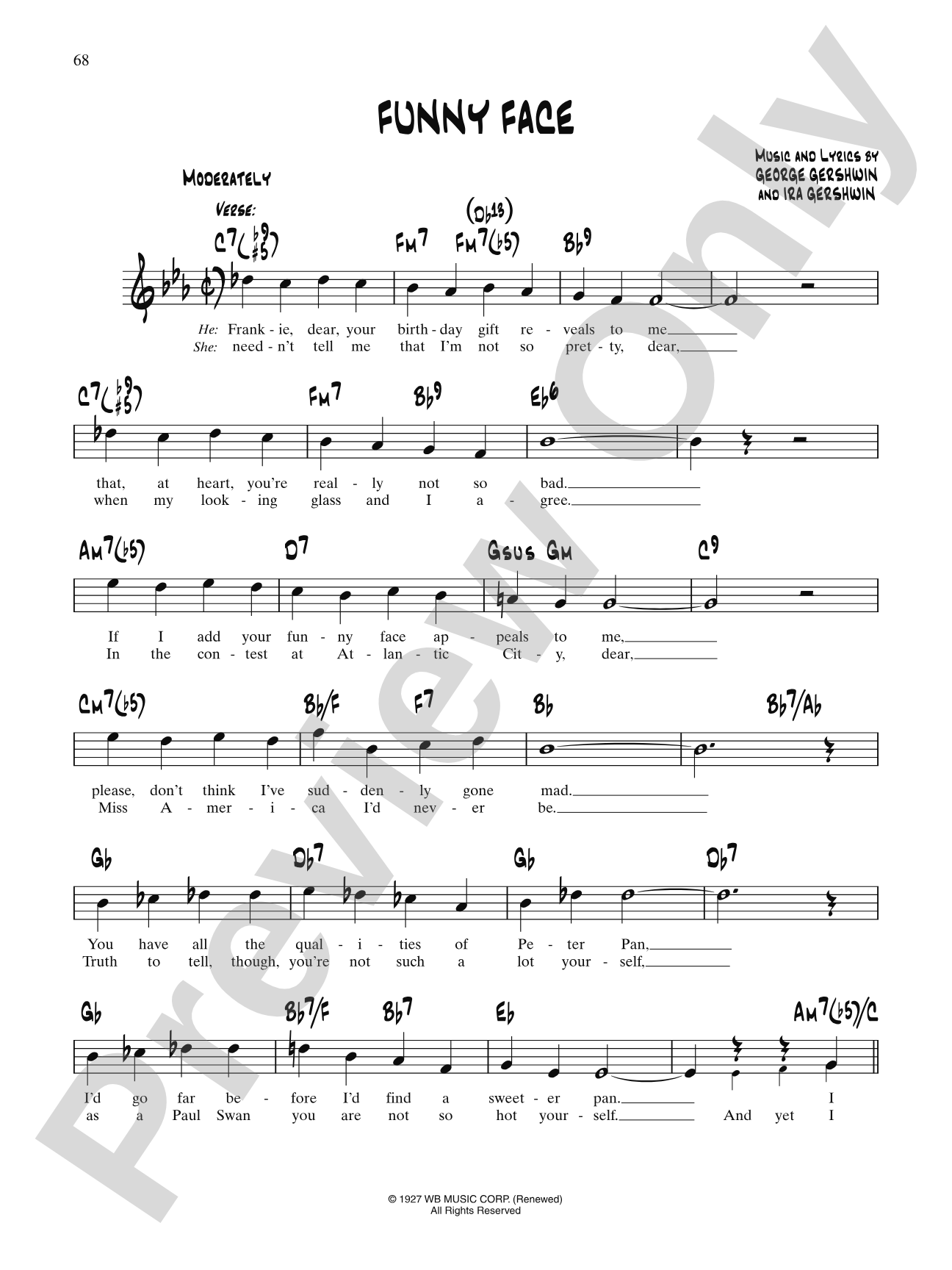

Funny Face (overture): Lead Sheet
George and Ira Gershwin
Item: 00-PSL-000771
$4.99
One moment…
Related Items
I Loves You, Porgy (From "Porgy And Bess"): Lead Sheet |
$4.99
|
View | |
Bess You Is My Woman Now (From "Porgy And Bess"): Lead Sheet |
$4.99
|
View | |
It Ain't Necessarily So (From "Porgy And Bess"): Lead Sheet |
$4.99
|
View | |
Let's Call The Whole Thing Off (From "Shall We Dance"): Lead Sheet |
$4.99
|
View | |
Bidin' My Time: Lead Sheet |
$4.99
|
View | |
Fascinating Rhythm: Lead Sheet |
$4.99
|
View | |
The Man That Got Away (From "A Star Is Born"): Lead Sheet |
$4.99
|
View | |
What Causes That?: Lead Sheet |
$4.99
|
View | |
For You, For Me, Forever More: Lead Sheet |
$4.99
|
View | |
Aren't You Kind Of Glad We Did?: Lead Sheet |
$4.99
|
View | |
Long Ago And Far Away (From "Cover Girl"): Lead Sheet |
$4.99
|
View | |
Boy! What Love Has Done To Me!: Lead Sheet |
$4.99
|
View | |
Woman Is A Sometime Thing (Porgy & Bess): Lead Sheet |
$4.99
|
View | |
By Strauss (From "The Show Is On"): Lead Sheet |
$4.99
|
View | |
Changing My Tune: Lead Sheet |
$4.99
|
View | |
I Can't Be Bothered Now: Lead Sheet |
$4.99
|
View | |
I Got Plenty O' Nuttin' (From "Porgy And Bess"): Lead Sheet |
$4.99
|
View | |
I Was Doing All Right: Lead Sheet |
$4.99
|
View | |
I've Got Beginner's Luck: Lead Sheet |
$4.99
|
View | |
Just Another Rhumba: Lead Sheet |
$4.99
|
View | |
Hi Ho: Lead Sheet |
$4.99
|
View | |
My Man's Gone Now (From "Porgy And Bess"): Lead Sheet |
$4.99
|
View | |
Real American Folk Song (Is A Rag): Lead Sheet |
$4.99
|
View | |
Shall We Dance? (From "Shall We Dance"): Lead Sheet |
$4.99
|
View | |
Slap That Bass (From "Shall We Dance"): Lead Sheet |
$4.99
|
View | |
Stiff Upper Lip: Lead Sheet |
$4.99
|
View | |
There's A Boat Dats Leavin' Soon For New York (From "Porgy And Bess®"): Lead Sheet |
$4.99
|
View | |
Things Are Looking Up: Lead Sheet |
$4.99
|
View | |
Home Blues: Lead Sheet |
$4.99
|
View | |
Could You Use Me?: Lead Sheet |
$4.99
|
View | |
Sam And Delilah: Lead Sheet |
$4.99
|
View | |
Strike Up The Band! (From "Strike Up The Band"): Lead Sheet |
$4.99
|
View | |
Soon: Lead Sheet |
$4.99
|
View | |
My One And Only: Lead Sheet |
$4.99
|
View | |
Liza (All The Clouds'll Roll Away): Lead Sheet |
$4.99
|
View | |
High Hat: Lead Sheet |
$4.99
|
View | |
World Is Mine: Lead Sheet |
$4.99
|
View | |
Let's Kiss And Make Up: Lead Sheet |
$4.99
|
View | |
Yankee Doodle Rhythm: Lead Sheet |
$4.99
|
View | |
Oh Gee! - Oh Joy!: Lead Sheet |
$4.99
|
View | |
K-ra-zy For You: Lead Sheet |
$4.99
|
View | |
Oh, So Nice: Lead Sheet |
$4.99
|
View | |
How Long Has This Been Going On? (From "Rosalie"): Lead Sheet |
$4.99
|
View | |
Feeling I'm Falling: Lead Sheet |
$4.99
|
View | |
Feeling Sentimental: Lead Sheet |
$4.99
|
View | |
Of Thee I Sing: Lead Sheet |
$4.99
|
View | |
Who Cares? (So Long As You Care For Me) (From "Of Thee I Sing"): Lead Sheet |
$4.99
|
View | |
Delishious: Lead Sheet |
$4.99
|
View | |
Somebody From Somewhere: Lead Sheet |
$4.99
|
View | |
Blah, Blah, Blah (From "Delicious"): Lead Sheet |
$4.99
|
View |
Description
This is the first "Artist Edition" in our bestselling Just . . . Real Book series. Containing well over 100 songs from George and Ira Gershwin, this is an invaluable resource for all musicians and fans of the Gershwin legacy. As with all books in the Just Real Book series, each arrangement is done to the highest standards. This new edition was produced with the full cooperation and approval of the Gershwin estate. Comb bound.


Funny Face (overture): Lead Sheet isn't in MakeMusic Cloud just yet...but it could be. Let us know you'd like to see it, and you'll help shape what comes next. In the meantime, start a free trial and dive into thousands of interactive titles your students can play along with today.
Request This Title
Tell us you want it.
Start Your Free Trial
Explore everything that's ready to play right now.
Sample Audio
No sample audio found.
Sample Video
No sample videos found.
Additional Details
Series:
Just Real Books Series
Publisher:
Alfred Music
Page Count:
248
SKU:
00-PSL-000771
More about this title
About the Composer: George Gershwin
George Gershwin (1898-1937) bridged classical and popular music with an ease that few composers have matched. His melodies became the soundtrack to American life in the 1920s and 1930s, and his willingness to experiment with jazz harmonies and rhythmic innovation influenced generations of composers across multiple genres.
Gershwin's collaborative partnership with his brother Ira, a lyricist of uncommon wit and sophistication, produced some of the most enduring musical theater works of the twentieth century. Their shows, including Funny Face, reveal a composer who understood both the demands of the stage and the deeper harmonic possibilities lurking beneath accessible, singable tunes.
Why we love this
This comprehensive Gershwin real book gives guitar players immediate access to the harmonic language and melodic sensibility that shaped jazz standards. The lead sheet format keeps the focus on melody and chord changes rather than fingering patterns, making it ideal for musicians building improvisational vocabulary and understanding how standards are constructed.
What to expect
Gershwin's music radiates optimism and sophistication in equal measure. These melodies sparkle with rhythmic playfulness and surprising harmonic turns; the lead sheet format lets you feel the elegant simplicity of the original while imagining your own interpretive choices layered on top.
Who it's for
This book serves guitarists working in jazz, musical theater, and standards repertoire who want to build fluency with one of the twentieth century's most important composers. Whether you're a jazz comper, an improviser building a repertoire, or a musician studying American songwriting, the breadth and authority of this collection make it an essential reference.
How to get the most out of it
- Study the melody first without the chords. Gershwin's lines are singable and memorable; internalizing the tune makes chord substitutions and variations feel purposeful rather than arbitrary.
- Pay attention to the harmonic rhythm. Gershwin often places chord changes on unexpected beats, creating forward momentum. Don't rush through passages with frequent harmonic movement.
- Explore the space between the written changes. Lead sheets give you the scaffolding; use it as a starting point for comping that reflects the style of the era and the piece's character.
- Reference recordings of the original theater performances when available. Hearing how singers and orchestras phrased these melodies will inform your interpretation and reveal performance practices that sheet music alone cannot capture.
How to use it
Use individual selections from this collection to anchor jazz combo performances, musical theater pit sessions, or standards nights. The range of tempos, moods, and musical styles within the Gershwin catalog means you can program contrasting pieces that showcase different sides of the composer's voice across a single set or concert.
Skills your students will build
- Reading lead sheet chord symbols and melody lines
- Recognizing harmonic progressions common to American standards
- Developing sensitivity to syncopation and rhythmic displacement in jazz-influenced composition
- Understanding the relationship between melody and harmonic function
- Building improvisational vocabulary grounded in composed material