
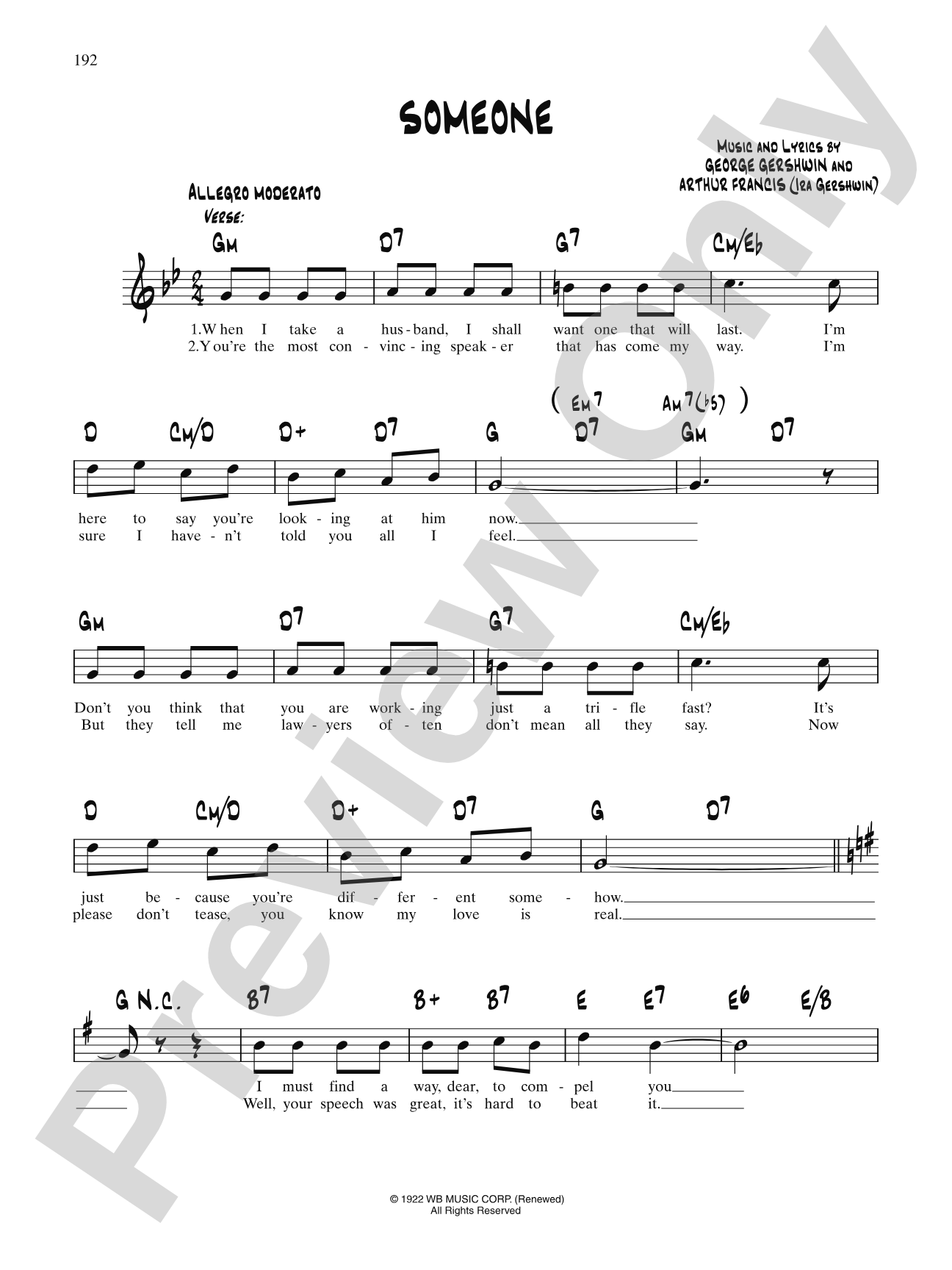

Someone: Lead Sheet
George and Ira Gershwin
Item: 00-PSL-000805
$4.99
One moment…
Related Items
I Loves You, Porgy (From "Porgy And Bess"): Lead Sheet |
$4.99
|
View | |
Bess You Is My Woman Now (From "Porgy And Bess"): Lead Sheet |
$4.99
|
View | |
It Ain't Necessarily So (From "Porgy And Bess"): Lead Sheet |
$4.99
|
View | |
Let's Call The Whole Thing Off (From "Shall We Dance"): Lead Sheet |
$4.99
|
View | |
Bidin' My Time: Lead Sheet |
$4.99
|
View | |
Fascinating Rhythm: Lead Sheet |
$4.99
|
View | |
The Man That Got Away (From "A Star Is Born"): Lead Sheet |
$4.99
|
View | |
What Causes That?: Lead Sheet |
$4.99
|
View | |
For You, For Me, Forever More: Lead Sheet |
$4.99
|
View | |
Aren't You Kind Of Glad We Did?: Lead Sheet |
$4.99
|
View | |
Long Ago And Far Away (From "Cover Girl"): Lead Sheet |
$4.99
|
View | |
Boy! What Love Has Done To Me!: Lead Sheet |
$4.99
|
View | |
Woman Is A Sometime Thing (Porgy & Bess): Lead Sheet |
$4.99
|
View | |
By Strauss (From "The Show Is On"): Lead Sheet |
$4.99
|
View | |
Changing My Tune: Lead Sheet |
$4.99
|
View | |
I Can't Be Bothered Now: Lead Sheet |
$4.99
|
View | |
I Got Plenty O' Nuttin' (From "Porgy And Bess"): Lead Sheet |
$4.99
|
View | |
I Was Doing All Right: Lead Sheet |
$4.99
|
View | |
I've Got Beginner's Luck: Lead Sheet |
$4.99
|
View | |
Just Another Rhumba: Lead Sheet |
$4.99
|
View | |
Hi Ho: Lead Sheet |
$4.99
|
View | |
My Man's Gone Now (From "Porgy And Bess"): Lead Sheet |
$4.99
|
View | |
Real American Folk Song (Is A Rag): Lead Sheet |
$4.99
|
View | |
Shall We Dance? (From "Shall We Dance"): Lead Sheet |
$4.99
|
View | |
Slap That Bass (From "Shall We Dance"): Lead Sheet |
$4.99
|
View | |
Stiff Upper Lip: Lead Sheet |
$4.99
|
View | |
There's A Boat Dats Leavin' Soon For New York (From "Porgy And Bess®"): Lead Sheet |
$4.99
|
View | |
Things Are Looking Up: Lead Sheet |
$4.99
|
View | |
Home Blues: Lead Sheet |
$4.99
|
View | |
Could You Use Me?: Lead Sheet |
$4.99
|
View | |
Sam And Delilah: Lead Sheet |
$4.99
|
View | |
Strike Up The Band! (From "Strike Up The Band"): Lead Sheet |
$4.99
|
View | |
Soon: Lead Sheet |
$4.99
|
View | |
My One And Only: Lead Sheet |
$4.99
|
View | |
Liza (All The Clouds'll Roll Away): Lead Sheet |
$4.99
|
View | |
Funny Face (overture): Lead Sheet |
$4.99
|
View | |
High Hat: Lead Sheet |
$4.99
|
View | |
World Is Mine: Lead Sheet |
$4.99
|
View | |
Let's Kiss And Make Up: Lead Sheet |
$4.99
|
View | |
Yankee Doodle Rhythm: Lead Sheet |
$4.99
|
View | |
Oh Gee! - Oh Joy!: Lead Sheet |
$4.99
|
View | |
K-ra-zy For You: Lead Sheet |
$4.99
|
View | |
Oh, So Nice: Lead Sheet |
$4.99
|
View | |
How Long Has This Been Going On? (From "Rosalie"): Lead Sheet |
$4.99
|
View | |
Feeling I'm Falling: Lead Sheet |
$4.99
|
View | |
Feeling Sentimental: Lead Sheet |
$4.99
|
View | |
Of Thee I Sing: Lead Sheet |
$4.99
|
View | |
Who Cares? (So Long As You Care For Me) (From "Of Thee I Sing"): Lead Sheet |
$4.99
|
View | |
Delishious: Lead Sheet |
$4.99
|
View | |
Somebody From Somewhere: Lead Sheet |
$4.99
|
View |
Description
This is the first "Artist Edition" in our bestselling Just . . . Real Book series. Containing well over 100 songs from George and Ira Gershwin, this is an invaluable resource for all musicians and fans of the Gershwin legacy. As with all books in the Just Real Book series, each arrangement is done to the highest standards. This new edition was produced with the full cooperation and approval of the Gershwin estate. Comb bound.


Someone: Lead Sheet isn't in MakeMusic Cloud just yet...but it could be. Let us know you'd like to see it, and you'll help shape what comes next. In the meantime, start a free trial and dive into thousands of interactive titles your students can play along with today.
Request This Title
Tell us you want it.
Start Your Free Trial
Explore everything that's ready to play right now.
Sample Audio
No sample audio found.
Sample Video
No sample videos found.
Additional Details
Series:
Just Real Books Series
Publisher:
Alfred Music
Page Count:
248
SKU:
00-PSL-000805
More about this title
About the Composer: George Gershwin
George Gershwin (1898-1937) bridged the worlds of classical music and American popular song with an originality that still defines twentieth-century composition. His rhythmic invention, harmonic sophistication, and gift for melody made him one of the most performed composers in the concert hall and the jazz standard repertoire. Gershwin's collaborations with his brother Ira, one of America's greatest lyricists, produced songs of enduring elegance and emotional depth that remain central to the American songbook.
For music educators and performers, Gershwin's work offers a masterclass in how popular music can achieve formal and harmonic complexity without sacrificing accessibility. His melodies reward careful study, and his chord progressions challenge musicians to think deeply about jazz harmony and voice leading.
Why we love this
This collection gives guitarists immediate access to over 100 songs from one of the most important American composers, all arranged to professional standards and approved by the Gershwin estate. The breadth means you can program Gershwin across an entire season, or dive deep into a single concert centered on his legacy, without hunting through scattered books. For serious jazz guitarists and classical musicians exploring the standard repertoire, having this density of material in one resource streamlines preparation and expands what you can learn from a single composer.
What to expect
These songs carry the sophisticated elegance of 1920s and 1930s New York alongside moments of genuine tenderness and humor. The harmonic language is both accessible and intricate, inviting you into a world where jazz idioms coexist with classical sensibility. Playing through this collection feels like stepping into a well-furnished room where every detail reflects intention and craftsmanship.
Who it's for
Jazz and fingerstyle guitarists who want to deepen their knowledge of the standard repertoire and build proficiency with Gershwin's harmonic language. Classical guitarists exploring twentieth-century American music will find substantial material for recitals, and intermediate to advanced players ready to move beyond simplified lead sheets into real book territory.
How to get the most out of it
- Listen to multiple recordings of the same song (vocal, instrumental, different arrangers) before settling on your interpretation. Gershwin's melodies are vehicles for personal expression, and understanding how different musicians have shaped them informs your own choices.
- Pay close attention to the harmonic movement beneath the melody. Gershwin's chord progressions often contain voice-leading details and chromatic motion that reward fingering choices that preserve smooth hand position and voice continuity across changes.
- Approach the syncopation and rhythmic displacement with precision. Many of these songs sit in the jazz idiom, where the distance between the melody and the beat creates much of their character. Anchor yourself to the underlying pulse while letting the line breathe.
- Use the lead sheet notation as a starting point, not a ceiling. The chord symbols give you the harmonic framework, but how you voice chords, where you place the melody in the register, and whether you comp or solo are all decisions that shape the piece.
How to use it
Build a Gershwin-centered recital or concert series, selecting contrasting songs that showcase different moods and harmonic colors across the collection. Use individual songs as standards repertoire for jazz combos, duo recitals with singers or other instrumentalists, or solo guitar programs exploring American songwriting. This book also works as a semester-long or yearlong study resource, where students can systematically work through the catalog to internalize Gershwin's compositional voice.
Skills your students will build
- Chord melody arrangement and voicing on guitar
- Jazz harmony and harmonic analysis (extended chords, chromatic voice leading, substitutions)
- Sight-reading lead sheet notation
- Stylistic interpretation of the American standard
- Rhythmic flexibility and swing phrasing
- Memorization and transposition of jazz standards