
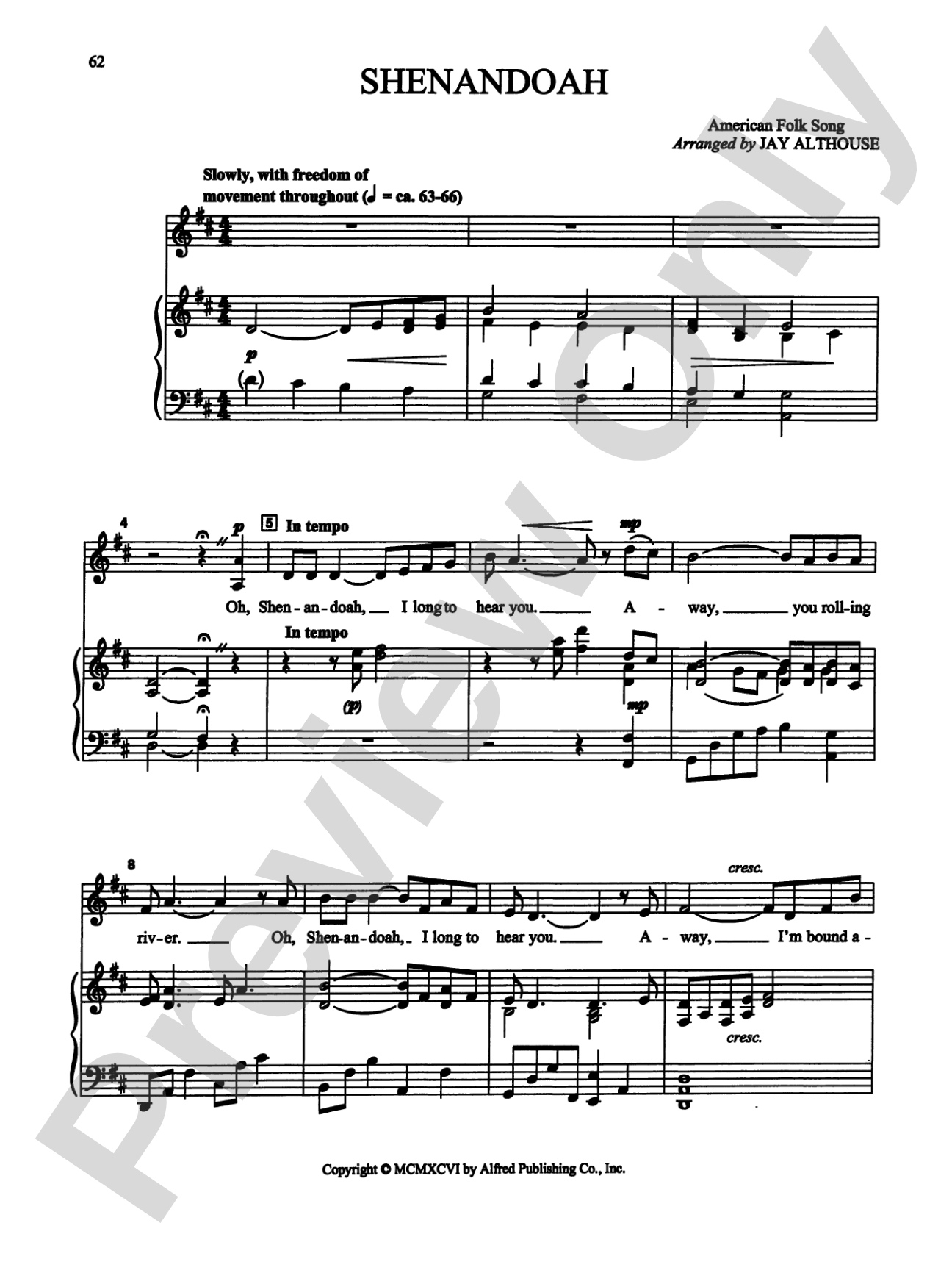

Shenandoah - Piano/Vocal Solo (Medium High): Piano/Vocal Solo (Medium High)
14 Folk Songs Arranged for Solo Voice and Piano for Recitals, Concerts, and Contests
Compiled and ed. Jay Althouse
Item: 00-PS-0017655
$4.99
Pickup currently not available
Related Items
All My Trials - Piano/Vocal Solo (Medium High): Piano/Vocal Solo (Medium High) |
$4.99
|
View | |
All Through the Night - Piano/Vocal Solo (Medium High): Piano/Vocal Solo (Medium High) |
$4.99
|
View | |
Camptown Races - Piano/Vocal Solo (Medium High): Piano/Vocal Solo (Medium High) |
$4.99
|
View | |
Cindy - Piano/Vocal Solo (Medium High): Piano/Vocal Solo (Medium High) |
$5.99
|
View | |
Fire Down Below - Piano/Vocal Solo (Medium High): Piano/Vocal Solo (Medium High) |
$5.99
|
View | |
Follow the Drinking Gourd - Piano/Vocal Solo (Medium High): Piano/Vocal Solo (Medium High) |
$4.99
|
View | |
Go 'Way from My Window - Piano/Vocal Solo (Medium High): Piano/Vocal Solo (Medium High) |
$4.99
|
View | |
He's Gone Away - Piano/Vocal Solo (Medium High): Piano/Vocal Solo (Medium High) |
$4.99
|
View | |
Old Dan Tucker - Piano/Vocal Solo (Medium High): Piano/Vocal Solo (Medium High) |
$5.99
|
View | |
Poor Boy - Piano/Vocal Solo (Medium High): Piano/Vocal Solo (Medium High) |
$4.99
|
View | |
Poor Wayfaring Stranger - Piano/Vocal Solo (Medium High): Piano/Vocal Solo (Medium High) |
$4.99
|
View | |
Simple Gifts - Piano/Vocal Solo (Medium High): Piano/Vocal Solo (Medium High) |
$4.99
|
View | |
The Water Is Wide - Piano/Vocal Solo (Medium High): Piano/Vocal Solo (Medium High) |
$4.99
|
View | |
All My Trials - Piano/Vocal Solo (Medium Low): Piano/Vocal Solo (Medium Low) |
$4.99
|
View | |
All Through the Night - Piano/Vocal Solo (Medium Low): Piano/Vocal Solo (Medium Low) |
$4.99
|
View | |
Camptown Races - Piano/Vocal Solo (Medium Low): Piano/Vocal Solo (Medium Low) |
$4.99
|
View | |
Cindy - Piano/Vocal Solo (Medium Low): Piano/Vocal Solo (Medium Low) |
$5.99
|
View | |
Fire Down Below - Piano/Vocal Solo (Medium Low): Piano/Vocal Solo (Medium Low) |
$5.99
|
View | |
Follow the Drinking Gourd - Piano/Vocal Solo (Medium Low): Piano/Vocal Solo (Medium Low) |
$4.99
|
View | |
Go 'Way from My Window - Piano/Vocal Solo (Medium Low): Piano/Vocal Solo (Medium Low) |
$4.99
|
View | |
He's Gone Away - Piano/Vocal Solo (Medium Low): Piano/Vocal Solo (Medium Low) |
$4.99
|
View | |
Old Dan Tucker - Piano/Vocal Solo (Medium Low): Piano/Vocal Solo (Medium Low) |
$5.99
|
View | |
Poor Boy - Piano/Vocal Solo (Medium Low): Piano/Vocal Solo (Medium Low) |
$4.99
|
View | |
Poor Wayfaring Stranger - Piano/Vocal Solo (Medium Low): Piano/Vocal Solo (Medium Low) |
$4.99
|
View | |
Shenandoah - Piano/Vocal Solo (Medium Low): Piano/Vocal Solo (Medium Low) |
$4.99
|
View | |
Simple Gifts - Piano/Vocal Solo (Medium Low): Piano/Vocal Solo (Medium Low) |
$4.99
|
View | |
The Water Is Wide - Piano/Vocal Solo (Medium Low): Piano/Vocal Solo (Medium Low) |
$4.99
|
View | |
Folk Songs for Solo Singers, Vol. 2: High Voice Book & Online Audio |
$26.99
|
View | |
Folk Songs for Solo Singers, Vol. 2: High Voice Book |
$15.99
|
View | |
Folk Songs for Solo Singers, Vol. 2: High Voice CD |
$16.99
|
View | |
Folk Songs for Solo Singers, Vol. 2: Medium High Voice Book & Online Audio |
$26.99
|
View | |
Folk Songs for Solo Singers, Vol. 2: Medium High Voice Book |
$15.99
|
View | |
Folk Songs for Solo Singers, Vol. 2: Medium High Voice CD |
$16.99
|
View | |
Folk Songs for Solo Singers, Vol. 2: Medium Low Voice Book & Online Audio |
$26.99
|
View | |
Folk Songs for Solo Singers, Vol. 2: Medium Low Voice Book |
$15.99
|
View | |
Folk Songs for Solo Singers, Vol. 2: Medium Low Voice CD |
$16.99
|
View |
Description
This volume of 14 best-loved folk songs for solo voice and piano contains memorable works arranged by three of Alfred Music's top writers: Jay Althouse, Mark Hayes and Ruth Elaine Schram. Titles: All My Trials * All Through the Night * Camptown Races * Cindy * Fire Down Below * Follow the Drinking Gourd * Go 'Way from My Window * He's Gone Away * Old Dan Tucker * Poor Boy * Poor Wayfaring Stranger * Shenandoah * Simple Gifts * The Water Is Wide. This title is available in MakeMusic Cloud.


Shenandoah - Piano/Vocal Solo (Medium High): Piano/Vocal Solo (Medium High) isn't in MakeMusic Cloud just yet...but it could be. Let us know you'd like to see it, and you'll help shape what comes next. In the meantime, start a free trial and dive into thousands of interactive titles your students can play along with today.
Request This Title
Tell us you want it.
Start Your Free Trial
Explore everything that's ready to play right now.
Sample Audio
1
Audio File
--:--
0:00
0:00
Sample Video
No sample videos found.
Additional Details
Series:
For Solo Singers
Publisher:
Alfred Music
Page Count:
64
SKU:
00-PS-0017655
More about this title
About the Arranger: Jay Althouse

Jay Althouse holds degrees in Music Education and Music from Indiana University of Pennsylvania, where he was later recognized with the Distinguished Alumni award. His career spans both the publishing industry, where he spent eight years managing rights and licenses and served on the Executive Board of the Music Publishers Association of America, and prolific composition work that has resulted in more than 800 choral pieces across all skill levels.
Beyond his choral output, Althouse has established himself as a thoughtful curator and adapter of vocal music. He has compiled and arranged numerous respected solo collections, co-written children's musicals with his wife Sally K. Albrecht, and authored several educational resources including The Complete Choral Warm-up Book and Accent on Composers. His work is regularly performed throughout the English-speaking world, and his compositions have earned multiple ASCAP Special Awards. He serves on the National Advisory Board of the Folk Art Society of America and contributes regularly to the organization's publications.
Why we love this
Althouse and his collaborators (Mark Hayes and Ruth Elaine Schram) have arranged these 14 folk standards with genuine respect for both the singers who perform them and the songs themselves. Each arrangement sits comfortably for a medium-high voice while offering enough musical substance to make the piano part engaging and supportive rather than simply accompanying. The collection works equally well for a recital program or festival appearance because the songs are recognizable enough to draw audiences in but arranged with enough care to demonstrate serious artistry.
What to expect
These arrangements celebrate the directness and emotional honesty of American folk tradition while providing enough harmonic and textural variation to sustain interest across a full recital. Moving from the contemplative depth of "The Water Is Wide" to the rhythmic energy of "Camptown Races" creates a natural arc that keeps both singer and listener engaged.
Who it's for
Solo singers preparing recital programs or festival competitions will find 14 dependable arrangements that sit well for medium-high voices. This collection appeals to singers who want familiar material arranged with sophistication rather than oversimplification, and who value accompaniments that enhance rather than overshadow the vocal line.
How to get the most out of it
- Study the piano part first to understand its relationship to your melodic line. These arrangements often use the keyboard to establish harmonic depth, so knowing how the accompaniment supports your phrasing will shape your interpretation.
- Treat each song as a distinct character study rather than moving through a collection. The arrangements vary considerably in texture and mood, from sparse accompaniments to richer harmonic writing.
- Pay attention to the text and narrative of each folk song. These melodies carry stories and emotional weight that the arrangements honor; your vocal interpretation should reflect that content.
How to use it
Open or close a recital with one of the more understated pieces like "Poor Wayfaring Stranger" to establish an intimate connection with your audience. Alternatively, sequence two or three contrasting selections from the collection as a thematic group that demonstrates your versatility with American song literature.
Skills your students will build
- Interpreting folk melodies with vocal maturity and emotional depth
- Coordinating phrasing across simple and complex harmonic accompaniments
- Managing sustained lines and breath control in slower arrangements
- Building rapport with accompanists through understanding piano textures