
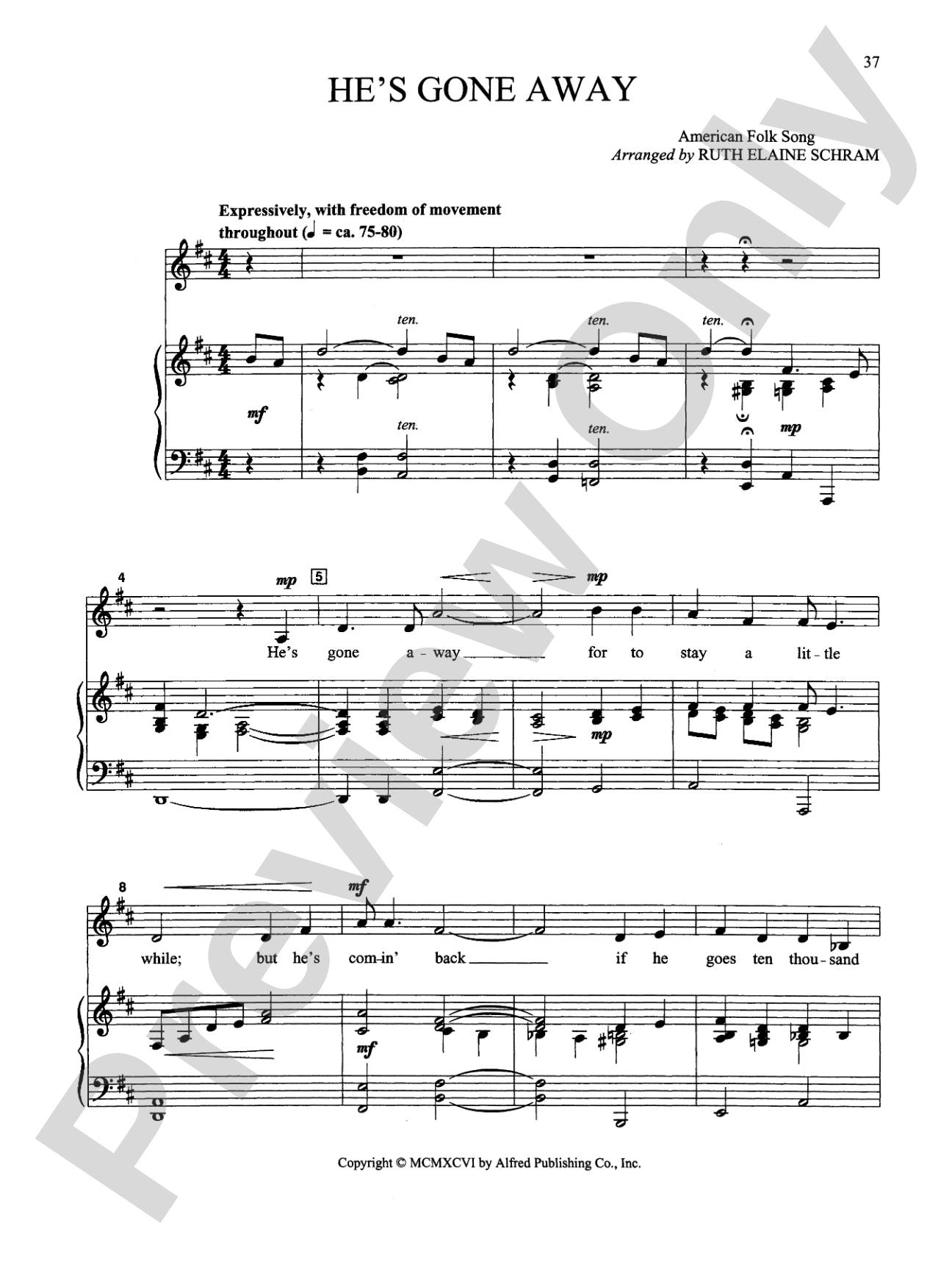

He's Gone Away - Piano/Vocal Solo (Medium Low): Piano/Vocal Solo (Medium Low)
14 Folk Songs Arranged for Solo Voice and Piano for Recitals, Concerts, and Contests
Compiled and ed. Jay Althouse
Item: 00-PS-0017665

$4.99
Pickup currently not available
Related Items
All My Trials - Piano/Vocal Solo (Medium High): Piano/Vocal Solo (Medium High) |
$4.99
|
View | |
All Through the Night - Piano/Vocal Solo (Medium High): Piano/Vocal Solo (Medium High) |
$4.99
|
View | |
Camptown Races - Piano/Vocal Solo (Medium High): Piano/Vocal Solo (Medium High) |
$4.99
|
View | |
Cindy - Piano/Vocal Solo (Medium High): Piano/Vocal Solo (Medium High) |
$5.99
|
View | |
Fire Down Below - Piano/Vocal Solo (Medium High): Piano/Vocal Solo (Medium High) |
$5.99
|
View | |
Follow the Drinking Gourd - Piano/Vocal Solo (Medium High): Piano/Vocal Solo (Medium High) |
$4.99
|
View | |
Go 'Way from My Window - Piano/Vocal Solo (Medium High): Piano/Vocal Solo (Medium High) |
$4.99
|
View | |
He's Gone Away - Piano/Vocal Solo (Medium High): Piano/Vocal Solo (Medium High) |
$4.99
|
View | |
Old Dan Tucker - Piano/Vocal Solo (Medium High): Piano/Vocal Solo (Medium High) |
$5.99
|
View | |
Poor Boy - Piano/Vocal Solo (Medium High): Piano/Vocal Solo (Medium High) |
$4.99
|
View | |
Poor Wayfaring Stranger - Piano/Vocal Solo (Medium High): Piano/Vocal Solo (Medium High) |
$4.99
|
View | |
Shenandoah - Piano/Vocal Solo (Medium High): Piano/Vocal Solo (Medium High) |
$4.99
|
View | |
Simple Gifts - Piano/Vocal Solo (Medium High): Piano/Vocal Solo (Medium High) |
$4.99
|
View | |
The Water Is Wide - Piano/Vocal Solo (Medium High): Piano/Vocal Solo (Medium High) |
$4.99
|
View | |
All My Trials - Piano/Vocal Solo (Medium Low): Piano/Vocal Solo (Medium Low) |
$4.99
|
View | |
All Through the Night - Piano/Vocal Solo (Medium Low): Piano/Vocal Solo (Medium Low) |
$4.99
|
View | |
Camptown Races - Piano/Vocal Solo (Medium Low): Piano/Vocal Solo (Medium Low) |
$4.99
|
View | |
Cindy - Piano/Vocal Solo (Medium Low): Piano/Vocal Solo (Medium Low) |
$5.99
|
View | |
Fire Down Below - Piano/Vocal Solo (Medium Low): Piano/Vocal Solo (Medium Low) |
$5.99
|
View | |
Follow the Drinking Gourd - Piano/Vocal Solo (Medium Low): Piano/Vocal Solo (Medium Low) |
$4.99
|
View | |
Go 'Way from My Window - Piano/Vocal Solo (Medium Low): Piano/Vocal Solo (Medium Low) |
$4.99
|
View | |
Old Dan Tucker - Piano/Vocal Solo (Medium Low): Piano/Vocal Solo (Medium Low) |
$5.99
|
View | |
Poor Boy - Piano/Vocal Solo (Medium Low): Piano/Vocal Solo (Medium Low) |
$4.99
|
View | |
Poor Wayfaring Stranger - Piano/Vocal Solo (Medium Low): Piano/Vocal Solo (Medium Low) |
$4.99
|
View | |
Shenandoah - Piano/Vocal Solo (Medium Low): Piano/Vocal Solo (Medium Low) |
$4.99
|
View | |
Simple Gifts - Piano/Vocal Solo (Medium Low): Piano/Vocal Solo (Medium Low) |
$4.99
|
View | |
The Water Is Wide - Piano/Vocal Solo (Medium Low): Piano/Vocal Solo (Medium Low) |
$4.99
|
View | |
Folk Songs for Solo Singers, Vol. 2: High Voice Book & Online Audio |
$26.99
|
View | |
Folk Songs for Solo Singers, Vol. 2: High Voice Book |
$15.99
|
View | |
Folk Songs for Solo Singers, Vol. 2: High Voice CD |
$16.99
|
View | |
Folk Songs for Solo Singers, Vol. 2: Medium High Voice Book & Online Audio |
$26.99
|
View | |
Folk Songs for Solo Singers, Vol. 2: Medium High Voice Book |
$15.99
|
View | |
Folk Songs for Solo Singers, Vol. 2: Medium High Voice CD |
$16.99
|
View | |
Folk Songs for Solo Singers, Vol. 2: Medium Low Voice Book & Online Audio |
$26.99
|
View | |
Folk Songs for Solo Singers, Vol. 2: Medium Low Voice Book |
$15.99
|
View | |
Folk Songs for Solo Singers, Vol. 2: Medium Low Voice CD |
$16.99
|
View |
Description
This volume of 14 best-loved folk songs for solo voice and piano contains memorable works arranged by three of Alfred Music's top writers: Jay Althouse, Mark Hayes and Ruth Elaine Schram. Titles: All My Trials * All Through the Night * Camptown Races * Cindy * Fire Down Below * Follow the Drinking Gourd * Go 'Way from My Window * He's Gone Away * Old Dan Tucker * Poor Boy * Poor Wayfaring Stranger * Shenandoah * Simple Gifts * The Water Is Wide. This title is available in MakeMusic Cloud. A Federation Festivals 2020-2024 selection.


Don't just read it, hear it, play along with it, and watch your students grow with it. In MakeMusic Cloud, He's Gone Away - Piano/Vocal Solo (Medium Low): Piano/Vocal Solo (Medium Low) comes alive with professional accompaniment, adjustable tempo, and built-in practice tools that turn solo practice into real progress.
Open in the Player
Jump straight in and assign it today.
Start Your Free Trial
Open this title and explore the full library in minutes.
Sample Audio
1
Audio File
--:--
0:00
0:00
Sample Video
No sample videos found.
Additional Details
Series:
For Solo Singers
Publisher:
Alfred Music
Page Count:
64
SKU:
00-PS-0017665
More about this title
About the Arranger: Ruth Elaine Schram
Ruth Elaine Schram brings decades of experience arranging vocal literature for singers at all levels. Her work balances accessibility with musical integrity, creating arrangements that honor folk traditions while remaining singable and engaging for performers in educational and recital settings.
Why we love this
Schram's arrangements respect the lyrical character of each folk song while providing piano writing that supports rather than overwhelms the singer. The collection spans a genuine range of American folk traditions, from spirituals to work songs to parlor pieces, giving you material that works equally well in a recital program or festival competition without feeling like a sampler.
What to expect
These arrangements invite you into intimate spaces. Whether you're singing about hard labor, lost love, or simple faith, the piano writing creates a conversational rather than theatrical atmosphere, letting each folk story unfold naturally without oversized accompaniment.
Who it's for
Solo singers preparing for recital performances or festival competitions will find reliable, musical arrangements across a broad range of folk idioms. This collection works for intermediate to advanced singers who want to build a competitive festival set or create a cohesive recital program without assembling individual octavos.
How to get the most out of it
- Find the legit vocal line in each arrangement. Schram often writes piano textures that can obscure where the melody wants to breathe; mark your phrases clearly and let the accompaniment serve that line rather than compete with it.
- Study the harmonic movement under sustained vowels. Many of these songs sit quietly, and the piano's harmonic support becomes your anchor; listen through the full chord progression before rushing the next phrase.
- Use the federated festival context to your advantage. These pieces are known commodities for adjudicators, which means your interpretation and storytelling become the differentiators; invest in the specific emotional core of each song rather than treating arrangements as neutral vehicles.
- Balance vocal weight across the fourteen songs. The collection mixes shorter character pieces with longer narrative ballads; program them thoughtfully so neither style dominates and each song's particular mood lands distinctly.
How to use it
Program clusters of 2-3 thematically related songs from this collection to create coherence across your recital or festival slot. The variety within the book allows you to construct a program that opens with a well-known spiritual, includes a character song or two, and closes with something that lingers in memory, without needing to hunt down songs from multiple sources.
Skills your students will build
- Interpretation of American folk idioms and regional song traditions
- Sustaining vocal legit tone through simple but harmonically rich accompaniment
- Phrasing and storytelling in first-person narrative songs
- Balancing projection with intimacy in recital acoustics
- Quick stylistic shifts across contrasting folk genres within a single program