
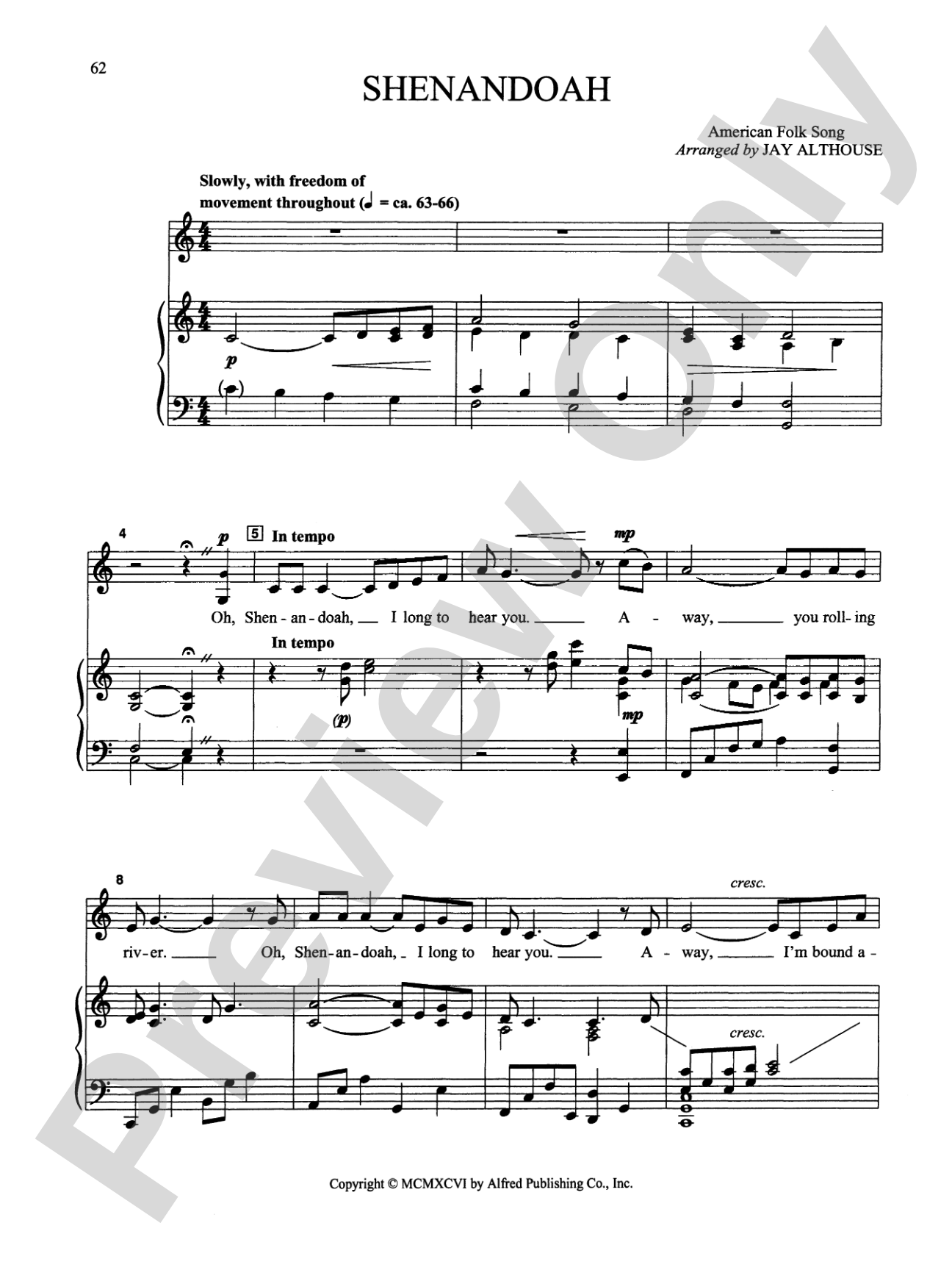

Shenandoah - Piano/Vocal Solo (Medium Low): Piano/Vocal Solo (Medium Low)
14 Folk Songs Arranged for Solo Voice and Piano for Recitals, Concerts, and Contests
Compiled and ed. Jay Althouse
Item: 00-PS-0017669

$4.99
Pickup currently not available
Related Items
All My Trials - Piano/Vocal Solo (Medium High): Piano/Vocal Solo (Medium High) |
$4.99
|
View | |
All Through the Night - Piano/Vocal Solo (Medium High): Piano/Vocal Solo (Medium High) |
$4.99
|
View | |
Camptown Races - Piano/Vocal Solo (Medium High): Piano/Vocal Solo (Medium High) |
$4.99
|
View | |
Cindy - Piano/Vocal Solo (Medium High): Piano/Vocal Solo (Medium High) |
$5.99
|
View | |
Fire Down Below - Piano/Vocal Solo (Medium High): Piano/Vocal Solo (Medium High) |
$5.99
|
View | |
Follow the Drinking Gourd - Piano/Vocal Solo (Medium High): Piano/Vocal Solo (Medium High) |
$4.99
|
View | |
Go 'Way from My Window - Piano/Vocal Solo (Medium High): Piano/Vocal Solo (Medium High) |
$4.99
|
View | |
He's Gone Away - Piano/Vocal Solo (Medium High): Piano/Vocal Solo (Medium High) |
$4.99
|
View | |
Old Dan Tucker - Piano/Vocal Solo (Medium High): Piano/Vocal Solo (Medium High) |
$5.99
|
View | |
Poor Boy - Piano/Vocal Solo (Medium High): Piano/Vocal Solo (Medium High) |
$4.99
|
View | |
Poor Wayfaring Stranger - Piano/Vocal Solo (Medium High): Piano/Vocal Solo (Medium High) |
$4.99
|
View | |
Shenandoah - Piano/Vocal Solo (Medium High): Piano/Vocal Solo (Medium High) |
$4.99
|
View | |
Simple Gifts - Piano/Vocal Solo (Medium High): Piano/Vocal Solo (Medium High) |
$4.99
|
View | |
The Water Is Wide - Piano/Vocal Solo (Medium High): Piano/Vocal Solo (Medium High) |
$4.99
|
View | |
All My Trials - Piano/Vocal Solo (Medium Low): Piano/Vocal Solo (Medium Low) |
$4.99
|
View | |
All Through the Night - Piano/Vocal Solo (Medium Low): Piano/Vocal Solo (Medium Low) |
$4.99
|
View | |
Camptown Races - Piano/Vocal Solo (Medium Low): Piano/Vocal Solo (Medium Low) |
$4.99
|
View | |
Cindy - Piano/Vocal Solo (Medium Low): Piano/Vocal Solo (Medium Low) |
$5.99
|
View | |
Fire Down Below - Piano/Vocal Solo (Medium Low): Piano/Vocal Solo (Medium Low) |
$5.99
|
View | |
Follow the Drinking Gourd - Piano/Vocal Solo (Medium Low): Piano/Vocal Solo (Medium Low) |
$4.99
|
View | |
Go 'Way from My Window - Piano/Vocal Solo (Medium Low): Piano/Vocal Solo (Medium Low) |
$4.99
|
View | |
He's Gone Away - Piano/Vocal Solo (Medium Low): Piano/Vocal Solo (Medium Low) |
$4.99
|
View | |
Old Dan Tucker - Piano/Vocal Solo (Medium Low): Piano/Vocal Solo (Medium Low) |
$5.99
|
View | |
Poor Boy - Piano/Vocal Solo (Medium Low): Piano/Vocal Solo (Medium Low) |
$4.99
|
View | |
Poor Wayfaring Stranger - Piano/Vocal Solo (Medium Low): Piano/Vocal Solo (Medium Low) |
$4.99
|
View | |
Simple Gifts - Piano/Vocal Solo (Medium Low): Piano/Vocal Solo (Medium Low) |
$4.99
|
View | |
The Water Is Wide - Piano/Vocal Solo (Medium Low): Piano/Vocal Solo (Medium Low) |
$4.99
|
View | |
Folk Songs for Solo Singers, Vol. 2: High Voice Book & Online Audio |
$26.99
|
View | |
Folk Songs for Solo Singers, Vol. 2: High Voice Book |
$15.99
|
View | |
Folk Songs for Solo Singers, Vol. 2: High Voice CD |
$16.99
|
View | |
Folk Songs for Solo Singers, Vol. 2: Medium High Voice Book & Online Audio |
$26.99
|
View | |
Folk Songs for Solo Singers, Vol. 2: Medium High Voice Book |
$15.99
|
View | |
Folk Songs for Solo Singers, Vol. 2: Medium High Voice CD |
$16.99
|
View | |
Folk Songs for Solo Singers, Vol. 2: Medium Low Voice Book & Online Audio |
$26.99
|
View | |
Folk Songs for Solo Singers, Vol. 2: Medium Low Voice Book |
$15.99
|
View | |
Folk Songs for Solo Singers, Vol. 2: Medium Low Voice CD |
$16.99
|
View |
Description
This volume of 14 best-loved folk songs for solo voice and piano contains memorable works arranged by three of Alfred Music's top writers: Jay Althouse, Mark Hayes and Ruth Elaine Schram. Titles: All My Trials * All Through the Night * Camptown Races * Cindy * Fire Down Below * Follow the Drinking Gourd * Go 'Way from My Window * He's Gone Away * Old Dan Tucker * Poor Boy * Poor Wayfaring Stranger * Shenandoah * Simple Gifts * The Water Is Wide. This title is available in MakeMusic Cloud. A Federation Festivals 2020-2024 selection.


Don't just read it, hear it, play along with it, and watch your students grow with it. In MakeMusic Cloud, Shenandoah - Piano/Vocal Solo (Medium Low): Piano/Vocal Solo (Medium Low) comes alive with professional accompaniment, adjustable tempo, and built-in practice tools that turn solo practice into real progress.
Open in the Player
Jump straight in and assign it today.
Start Your Free Trial
Open this title and explore the full library in minutes.
Sample Audio
1
Audio File
--:--
0:00
0:00
Sample Video
No sample videos found.
Additional Details
Series:
For Solo Singers
Publisher:
Alfred Music
Page Count:
64
SKU:
00-PS-0017669
More about this title
About the Arranger: Jay Althouse

Jay Althouse holds degrees in Music Education and Music from Indiana University of Pennsylvania, where he later received the Distinguished Alumni award. His career spans both the publishing industry, where he spent eight years managing rights and licenses while serving on the Executive Board of the Music Publishers Association of America, and composition, resulting in over 800 choral works performed across the English-speaking world.
Beyond his prolific output as a composer, Althouse has shaped music education through numerous collaborative projects and instructional resources. He co-wrote children's musicals with his wife Sally K. Albrecht, compiled influential vocal solo collections including Folk Songs for Solo Singers, and authored several classroom-focused books on music theory and composer study. As a writer member of ASCAP and regular recipient of the ASCAP Special Award, he remains active in folk music circles, serving on the National Advisory Board of the Folk Art Society of America.
Why we love this
Althouse brings decades of experience arranging folk material for singers, and this collection reflects that mastery. The arrangements by Althouse, Mark Hayes, and Ruth Elaine Schram balance accessibility with musical substance, making these songs genuinely singable in a recital setting while preserving their character. Recognition as a Federation Festivals selection confirms these arrangements work in competitive contexts where both artistic integrity and performance readiness matter.
What to expect
This collection centers the quiet dignity and earnest emotion at the heart of American and British folk tradition. The piano accompaniments create intimate spaces around familiar melodies, letting the voice lead while the harmonies deepen the storytelling without overwhelm.
Who it's for
Solo singers preparing concert or festival recitals will find a cohesive collection of well-loved folk material arranged for comfortable medium-low range. Whether building a complete program or selecting individual songs to complement other repertoire, singers at the intermediate level will appreciate both the accessibility and the artistic credibility these arrangements provide.
How to get the most out of it
- Establish the story behind each folk song before you rehearse it. These melodies carry regional and cultural weight; understanding the narrative context shapes phrasing and emotional clarity.
- Work through the piano part carefully alongside the vocal line rather than separately. The accompaniments are integral to the arrangements and often suggest harmonic colors that inform vocal interpretation.
- Pay attention to the tessitura within your medium-low range. These settings should sit comfortably in your voice, but test the extremes of each song early so you can plan your interpretive choices without strain.
- Vary your approach to tempo and rubato across the collection. Not every folk song benefits from the same rhythmic treatment; let the character and regional origin of each piece guide your tempo choices.
How to use it
Use these songs as the foundation for a folk-themed recital, or distribute them across multiple programs throughout a season. The 14-song range allows you to curate smaller sets that work alongside classical or contemporary art songs, creating programming contrast while maintaining coherence.
Skills your students will build
- Sustaining legit tone across phrase arcs in folk idiom
- Balancing storytelling clarity with musical phrase shape
- Responding to harmonic language in piano accompaniments
- Interpreting regional and cultural inflection within a singable arrangement