
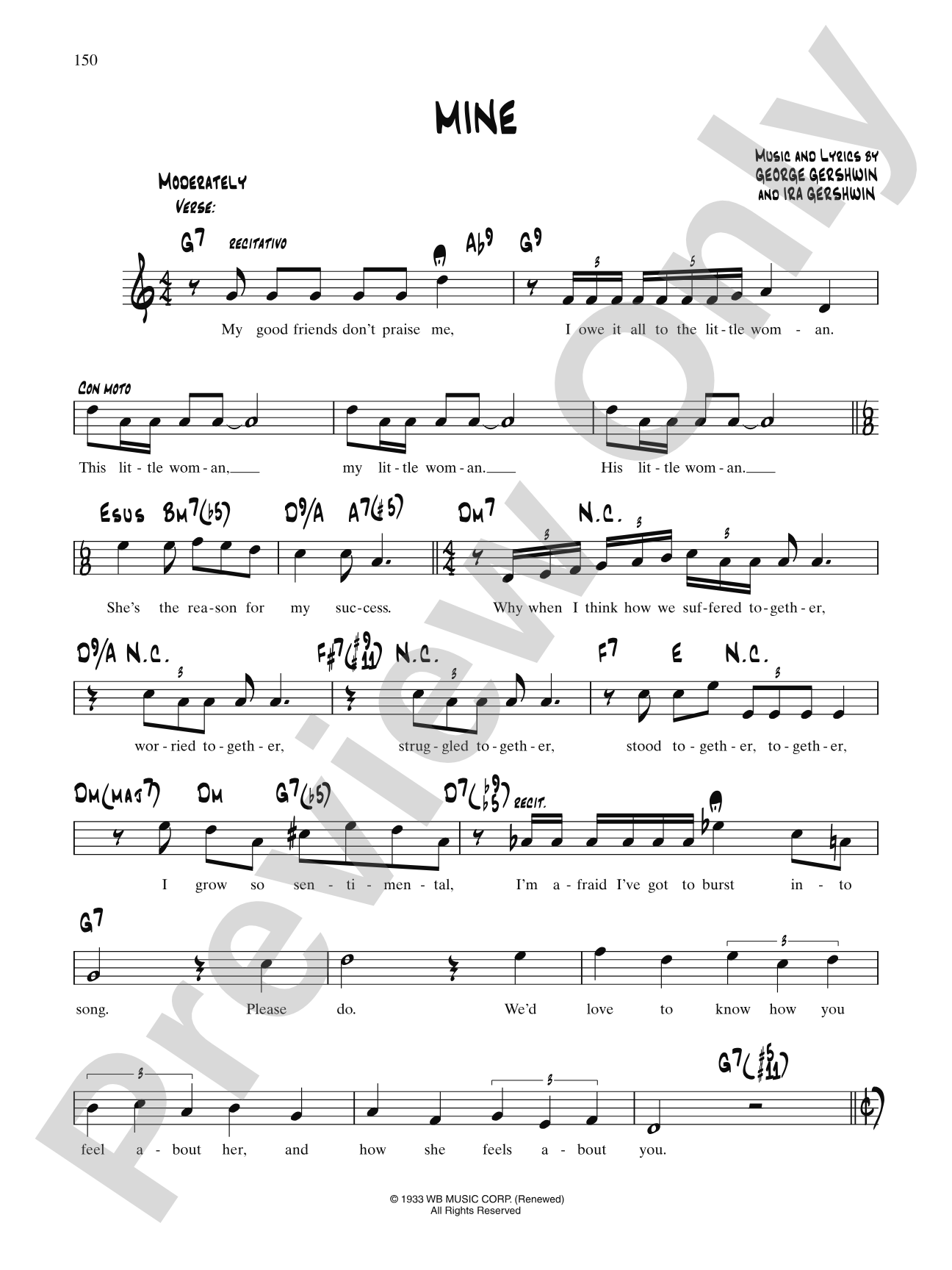

Mine (From "Let 'em Eat Cake"): Lead Sheet
George and Ira Gershwin
Item: 00-PSL-000798
$4.99
One moment…
Related Items
I Loves You, Porgy (From "Porgy And Bess"): Lead Sheet |
$4.99
|
View | |
Bess You Is My Woman Now (From "Porgy And Bess"): Lead Sheet |
$4.99
|
View | |
It Ain't Necessarily So (From "Porgy And Bess"): Lead Sheet |
$4.99
|
View | |
Let's Call The Whole Thing Off (From "Shall We Dance"): Lead Sheet |
$4.99
|
View | |
Bidin' My Time: Lead Sheet |
$4.99
|
View | |
Fascinating Rhythm: Lead Sheet |
$4.99
|
View | |
The Man That Got Away (From "A Star Is Born"): Lead Sheet |
$4.99
|
View | |
What Causes That?: Lead Sheet |
$4.99
|
View | |
For You, For Me, Forever More: Lead Sheet |
$4.99
|
View | |
Aren't You Kind Of Glad We Did?: Lead Sheet |
$4.99
|
View | |
Long Ago And Far Away (From "Cover Girl"): Lead Sheet |
$4.99
|
View | |
Boy! What Love Has Done To Me!: Lead Sheet |
$4.99
|
View | |
Woman Is A Sometime Thing (Porgy & Bess): Lead Sheet |
$4.99
|
View | |
By Strauss (From "The Show Is On"): Lead Sheet |
$4.99
|
View | |
Changing My Tune: Lead Sheet |
$4.99
|
View | |
I Can't Be Bothered Now: Lead Sheet |
$4.99
|
View | |
I Got Plenty O' Nuttin' (From "Porgy And Bess"): Lead Sheet |
$4.99
|
View | |
I Was Doing All Right: Lead Sheet |
$4.99
|
View | |
I've Got Beginner's Luck: Lead Sheet |
$4.99
|
View | |
Just Another Rhumba: Lead Sheet |
$4.99
|
View | |
Hi Ho: Lead Sheet |
$4.99
|
View | |
My Man's Gone Now (From "Porgy And Bess"): Lead Sheet |
$4.99
|
View | |
Real American Folk Song (Is A Rag): Lead Sheet |
$4.99
|
View | |
Shall We Dance? (From "Shall We Dance"): Lead Sheet |
$4.99
|
View | |
Slap That Bass (From "Shall We Dance"): Lead Sheet |
$4.99
|
View | |
Stiff Upper Lip: Lead Sheet |
$4.99
|
View | |
There's A Boat Dats Leavin' Soon For New York (From "Porgy And Bess®"): Lead Sheet |
$4.99
|
View | |
Things Are Looking Up: Lead Sheet |
$4.99
|
View | |
Home Blues: Lead Sheet |
$4.99
|
View | |
Could You Use Me?: Lead Sheet |
$4.99
|
View | |
Sam And Delilah: Lead Sheet |
$4.99
|
View | |
Strike Up The Band! (From "Strike Up The Band"): Lead Sheet |
$4.99
|
View | |
Soon: Lead Sheet |
$4.99
|
View | |
My One And Only: Lead Sheet |
$4.99
|
View | |
Liza (All The Clouds'll Roll Away): Lead Sheet |
$4.99
|
View | |
Funny Face (overture): Lead Sheet |
$4.99
|
View | |
High Hat: Lead Sheet |
$4.99
|
View | |
World Is Mine: Lead Sheet |
$4.99
|
View | |
Let's Kiss And Make Up: Lead Sheet |
$4.99
|
View | |
Yankee Doodle Rhythm: Lead Sheet |
$4.99
|
View | |
Oh Gee! - Oh Joy!: Lead Sheet |
$4.99
|
View | |
K-ra-zy For You: Lead Sheet |
$4.99
|
View | |
Oh, So Nice: Lead Sheet |
$4.99
|
View | |
How Long Has This Been Going On? (From "Rosalie"): Lead Sheet |
$4.99
|
View | |
Feeling I'm Falling: Lead Sheet |
$4.99
|
View | |
Feeling Sentimental: Lead Sheet |
$4.99
|
View | |
Of Thee I Sing: Lead Sheet |
$4.99
|
View | |
Who Cares? (So Long As You Care For Me) (From "Of Thee I Sing"): Lead Sheet |
$4.99
|
View | |
Delishious: Lead Sheet |
$4.99
|
View | |
Somebody From Somewhere: Lead Sheet |
$4.99
|
View |
Description
This is the first "Artist Edition" in our bestselling Just . . . Real Book series. Containing well over 100 songs from George and Ira Gershwin, this is an invaluable resource for all musicians and fans of the Gershwin legacy. As with all books in the Just Real Book series, each arrangement is done to the highest standards. This new edition was produced with the full cooperation and approval of the Gershwin estate. Comb bound.


Mine (From "Let 'em Eat Cake"): Lead Sheet isn't in MakeMusic Cloud just yet...but it could be. Let us know you'd like to see it, and you'll help shape what comes next. In the meantime, start a free trial and dive into thousands of interactive titles your students can play along with today.
Request This Title
Tell us you want it.
Start Your Free Trial
Explore everything that's ready to play right now.
Sample Audio
No sample audio found.
Sample Video
No sample videos found.
Additional Details
Series:
Just Real Books Series
Publisher:
Alfred Music
Page Count:
248
SKU:
00-PSL-000798
More about this title
About the Composer: George Gershwin
George Gershwin (1898-1937) bridged classical and popular music with an ease few composers have achieved. His melodies became synonymous with American optimism and jazz-inflected sophistication, and his harmonic language shaped how generations of musicians understood the intersection of concert music and vernacular song.
Gershwin's output spanned musical theater, orchestral works, and instrumental standards. He wrote "Mine" for the 1933 musical "Let 'em Eat Cake," a political satire co-created with his brother Ira. The song exemplifies Gershwin's gift for writing graceful, singable lines over urbane chords—music that demands both melodic sensitivity and harmonic awareness from anyone learning it.
Why we love this
This lead sheet gives guitarists direct access to one of Gershwin's most elegant theater songs, complete with the harmonic sophistication that makes his work rewarding to study and perform. The clean, readable notation in this Gershwin estate-approved edition lets you focus on interpreting the melody and voicings rather than deciphering unclear transcriptions. For jazz guitarists and musicians mining the standard repertoire, having this particular piece alongside 100+ others in one resource means less time hunting for charts and more time woodshedding.
What to expect
The song carries the urbane charm of 1930s musical theater—elegant, a touch wry, and built on the kind of melody that lingers after one hearing. The harmonic language moves with sophistication without ever feeling strained, and the form invites both straightforward interpretation and creative reharmonization.
Who it's for
This lead sheet serves guitarists working in jazz ensembles, guitarists backing vocalists, and musicians deepening their knowledge of American standards and Gershwin's catalog. It's equally useful for self-directed study and for performance contexts where you're comping or soloing over a well-known melody.
How to get the most out of it
- Pay attention to the harmonic rhythm beneath the melody. Gershwin's chord changes often move quickly in the bridge, and anchoring your accompaniment to those changes will clarify the form for listeners and any singers or horns playing the melody.
- Approach the melody with a singing tone, not as a chordal guitar piece. Even when comping behind a vocalist or soloist, let the lead line breathe; Gershwin wrote beautiful, song-like phrases that deserve space.
- Experiment with voicing density. A clean, sparse interpretation during the first chorus can give you room to add upper extensions and rhythmic activity on repeats without losing clarity.
How to use it
Program this alongside other Gershwin standards in a jazz or American songbook recital to showcase the composer's theatrical gift. It also works well as a vehicle for featuring a vocalist in an ensemble setting, where the lead sheet gives your guitar players a clear roadmap for supportive accompaniment. Consider pairing it with other "Let 'em Eat Cake" songs if you have access to them, or use it as an anchor point in a chronological program exploring Gershwin's career.
Skills your students will build
- Reading lead sheet notation and chord symbols with accuracy
- Harmonic analysis of 1930s jazz-influenced song forms (AABA structure)
- Voice leading and smooth chord transitions on guitar
- Melodic phrasing and interpretive choices over written changes
- Accompaniment and comping techniques for standards