
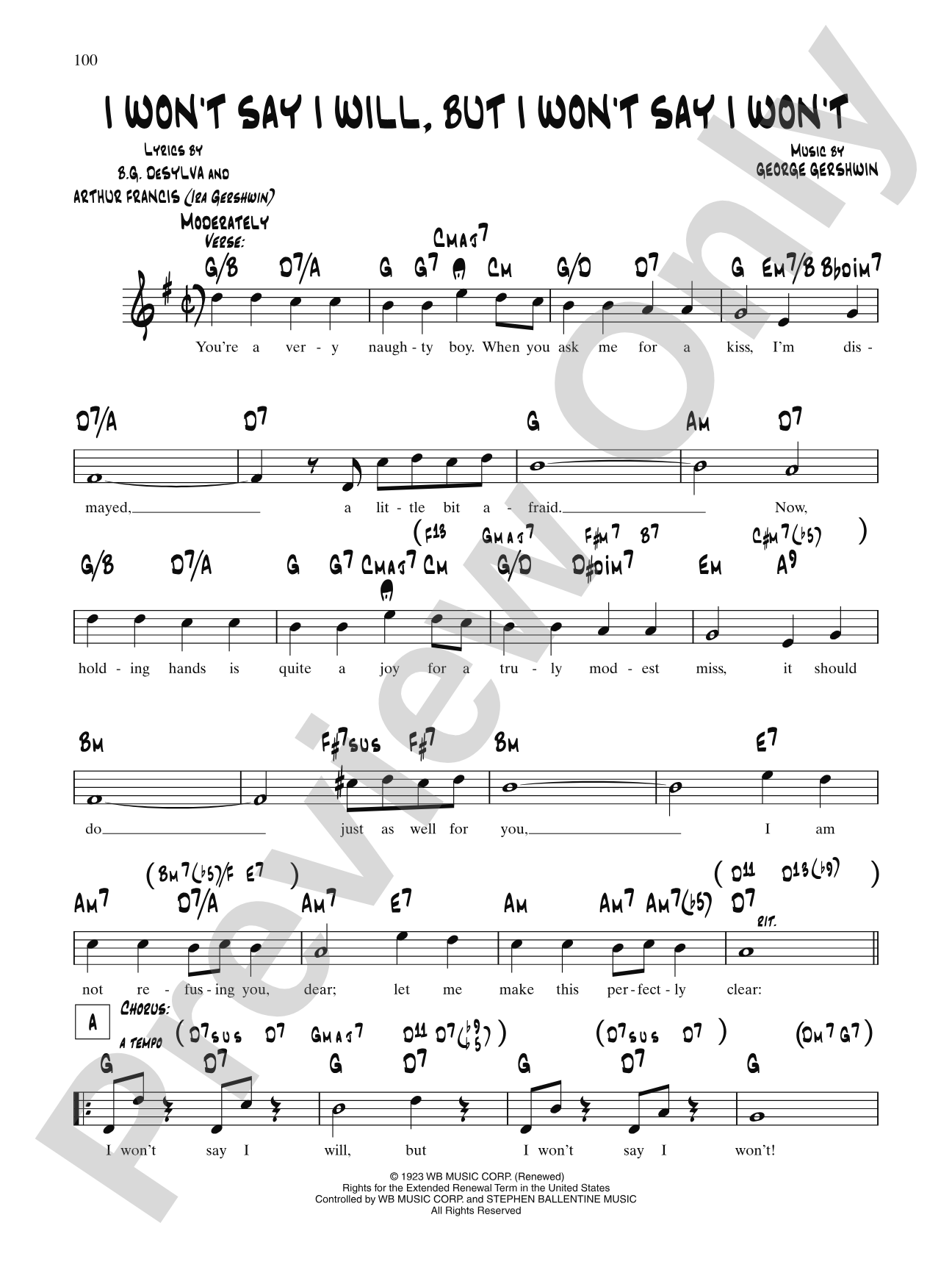

I Won't Say I Will, But I Won't Say I Won't: Lead Sheet
George and Ira Gershwin
Item: 00-PSL-000807
$4.99
One moment…
Related Items
I Loves You, Porgy (From "Porgy And Bess"): Lead Sheet |
$4.99
|
View | |
Bess You Is My Woman Now (From "Porgy And Bess"): Lead Sheet |
$4.99
|
View | |
It Ain't Necessarily So (From "Porgy And Bess"): Lead Sheet |
$4.99
|
View | |
Let's Call The Whole Thing Off (From "Shall We Dance"): Lead Sheet |
$4.99
|
View | |
Bidin' My Time: Lead Sheet |
$4.99
|
View | |
Fascinating Rhythm: Lead Sheet |
$4.99
|
View | |
The Man That Got Away (From "A Star Is Born"): Lead Sheet |
$4.99
|
View | |
What Causes That?: Lead Sheet |
$4.99
|
View | |
For You, For Me, Forever More: Lead Sheet |
$4.99
|
View | |
Aren't You Kind Of Glad We Did?: Lead Sheet |
$4.99
|
View | |
Long Ago And Far Away (From "Cover Girl"): Lead Sheet |
$4.99
|
View | |
Boy! What Love Has Done To Me!: Lead Sheet |
$4.99
|
View | |
Woman Is A Sometime Thing (Porgy & Bess): Lead Sheet |
$4.99
|
View | |
By Strauss (From "The Show Is On"): Lead Sheet |
$4.99
|
View | |
Changing My Tune: Lead Sheet |
$4.99
|
View | |
I Can't Be Bothered Now: Lead Sheet |
$4.99
|
View | |
I Got Plenty O' Nuttin' (From "Porgy And Bess"): Lead Sheet |
$4.99
|
View | |
I Was Doing All Right: Lead Sheet |
$4.99
|
View | |
I've Got Beginner's Luck: Lead Sheet |
$4.99
|
View | |
Just Another Rhumba: Lead Sheet |
$4.99
|
View | |
Hi Ho: Lead Sheet |
$4.99
|
View | |
My Man's Gone Now (From "Porgy And Bess"): Lead Sheet |
$4.99
|
View | |
Real American Folk Song (Is A Rag): Lead Sheet |
$4.99
|
View | |
Shall We Dance? (From "Shall We Dance"): Lead Sheet |
$4.99
|
View | |
Slap That Bass (From "Shall We Dance"): Lead Sheet |
$4.99
|
View | |
Stiff Upper Lip: Lead Sheet |
$4.99
|
View | |
There's A Boat Dats Leavin' Soon For New York (From "Porgy And Bess®"): Lead Sheet |
$4.99
|
View | |
Things Are Looking Up: Lead Sheet |
$4.99
|
View | |
Home Blues: Lead Sheet |
$4.99
|
View | |
Could You Use Me?: Lead Sheet |
$4.99
|
View | |
Sam And Delilah: Lead Sheet |
$4.99
|
View | |
Strike Up The Band! (From "Strike Up The Band"): Lead Sheet |
$4.99
|
View | |
Soon: Lead Sheet |
$4.99
|
View | |
My One And Only: Lead Sheet |
$4.99
|
View | |
Liza (All The Clouds'll Roll Away): Lead Sheet |
$4.99
|
View | |
Funny Face (overture): Lead Sheet |
$4.99
|
View | |
High Hat: Lead Sheet |
$4.99
|
View | |
World Is Mine: Lead Sheet |
$4.99
|
View | |
Let's Kiss And Make Up: Lead Sheet |
$4.99
|
View | |
Yankee Doodle Rhythm: Lead Sheet |
$4.99
|
View | |
Oh Gee! - Oh Joy!: Lead Sheet |
$4.99
|
View | |
K-ra-zy For You: Lead Sheet |
$4.99
|
View | |
Oh, So Nice: Lead Sheet |
$4.99
|
View | |
How Long Has This Been Going On? (From "Rosalie"): Lead Sheet |
$4.99
|
View | |
Feeling I'm Falling: Lead Sheet |
$4.99
|
View | |
Feeling Sentimental: Lead Sheet |
$4.99
|
View | |
Of Thee I Sing: Lead Sheet |
$4.99
|
View | |
Who Cares? (So Long As You Care For Me) (From "Of Thee I Sing"): Lead Sheet |
$4.99
|
View | |
Delishious: Lead Sheet |
$4.99
|
View | |
Somebody From Somewhere: Lead Sheet |
$4.99
|
View |
Description
This is the first "Artist Edition" in our bestselling Just . . . Real Book series. Containing well over 100 songs from George and Ira Gershwin, this is an invaluable resource for all musicians and fans of the Gershwin legacy. As with all books in the Just Real Book series, each arrangement is done to the highest standards. This new edition was produced with the full cooperation and approval of the Gershwin estate. Comb bound.


I Won't Say I Will, But I Won't Say I Won't: Lead Sheet isn't in MakeMusic Cloud just yet...but it could be. Let us know you'd like to see it, and you'll help shape what comes next. In the meantime, start a free trial and dive into thousands of interactive titles your students can play along with today.
Request This Title
Tell us you want it.
Start Your Free Trial
Explore everything that's ready to play right now.
Sample Audio
No sample audio found.
Sample Video
No sample videos found.
Additional Details
Series:
Just Real Books Series
Publisher:
Alfred Music
Page Count:
248
SKU:
00-PSL-000807
More about this title
About the Composer: George Gershwin
George Gershwin (1898-1937) bridged the worlds of concert music and popular song with unmatched fluency, composing some of the most recognizable melodies in American music. His harmonic language, drawing from jazz, blues, and European modernism, set a standard for songwriting that remains the foundation of the jazz standards repertoire and continues to challenge and inspire musicians across all genres and skill levels.
Working closely with his lyricist brother Ira, Gershwin created a catalog of theater songs, film scores, and concert works that defined an era. His influence on jazz pedagogy is profound: his songs appear in nearly every jazz fake book, and his harmonic sophistication makes them ideal vehicles for developing both melodic sensibility and harmonic understanding.
Why we love this
This collection gives guitar players direct access to the Gershwin songbook in a single, professionally curated resource. The lead sheet format demands real musicianship—you're reading melody, chord symbols, and lyrics simultaneously—making this book as valuable for developing sight-reading fluency as it is for building an enduring performance repertoire.
What to expect
Stepping through the Great American Songbook era in one sitting. These songs shimmer with sophisticated harmony, memorable melodies that sit beautifully on the guitar, and lyrics that reward careful listening. There's elegance and wit in nearly every page, paired with the harmonic surprises that made Gershwin's work stand out from his contemporaries.
Who it's for
Jazz guitarists building their standards knowledge, advanced students developing comping facility, and lead sheet readers at all levels who want a comprehensive, estate-approved Gershwin resource. This is equally valuable for accompanists working with vocalists and for soloists developing a personal repertoire.
How to get the most out of it
- Study the chord voicings in context before defaulting to open shapes; Gershwin's harmonic movement often rewards closed-position playing that highlights voice leading and smooth transitions between changes.
- Treat the melody as a singing line rather than a series of notes; phrasing and breath awareness are especially important when accompanying a vocalist or playing solo melody passages.
- Reference recorded versions sparingly at first. Work through the changes yourself, then listen to understand how different era interpret tempo, swing feel, and lyrical emphasis.
How to use it
Use this as a primary text in a jazz guitar curriculum focused on standards and comping. Individual songs work as standalone recital pieces or as duets with vocalists; longer practice sessions might involve working chronologically through a show or thematically connecting pieces by musical character or harmonic function.
Skills your students will build
- Reading lead sheets with melody, chord symbols, and lyrics simultaneously
- Voice leading and chord voicing choices on guitar
- Jazz harmonic analysis and harmonic substitution
- Swing comping and rhythmic flexibility
- Melodic phrasing and lyrical interpretation