
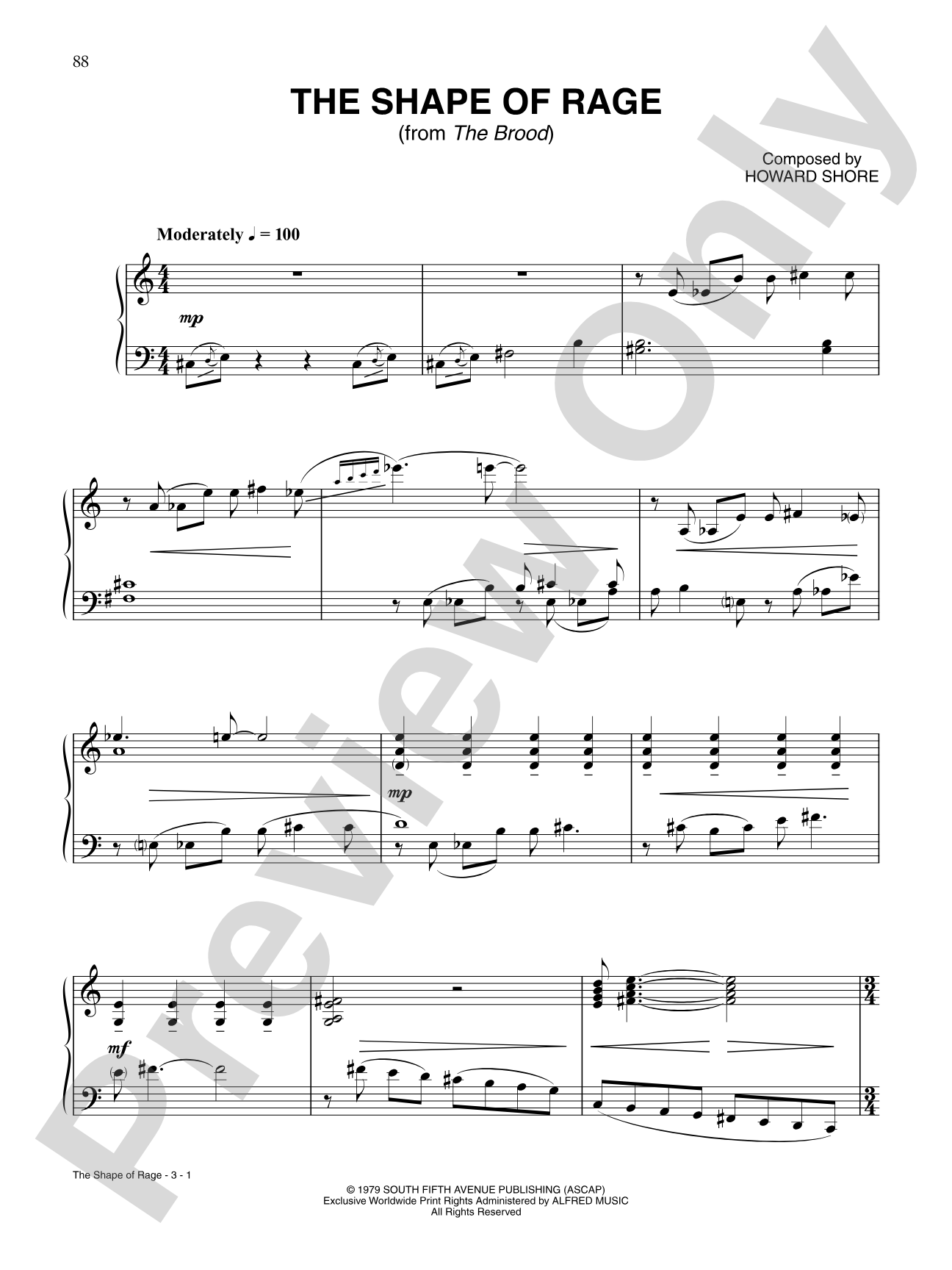

The Shape of Rage: Piano
Composed by Howard Shore
Item: 00-PS-0015747
$4.99
Pickup currently not available
Related Items
Eclipse (All Yours): Piano/Vocal/Chords |
$4.99
|
View | |
Jacob's Theme: Piano |
$4.99
|
View | |
Portrait of John Doe: Piano |
$4.99
|
View | |
Portrait of Edie: Piano |
$4.99
|
View | |
Catania: Piano |
$4.99
|
View | |
Piano Four: Piano |
$4.99
|
View | |
Brooklyn Heights 3: Piano |
$4.99
|
View | |
Love Will Find Out the Way: Piano/Vocal/Chords |
$4.99
|
View | |
Dead Ringers (Main Title): Piano |
$4.99
|
View | |
Miss Spielrein: Piano |
$4.99
|
View | |
Richard, Duke of York: Piano/Vocal/Chords |
$5.99
|
View | |
Your Flesh: Piano/Vocal/Chords |
$5.99
|
View | |
Birthday March: Piano/Vocal/Chords |
$4.99
|
View | |
Beyond the Forest: Piano/Vocal/Chords |
$5.99
|
View | |
The Dream: Piano/Vocal/Chords |
$5.99
|
View | |
The Howard Shore Collection, Volume 2: Piano/Vocal/Chords Book |
$19.99
|
View |
Description
Academy Award®-winner Howard Shore is best known for his elegant and eclectic film scores, including the soundtracks for Peter Jackson's The Lord of the Rings and The Hobbit trilogies. This collection features faithful arrangements of some of the best known titles by this brilliant composer. Titles: Birthday March (Big) * Brooklyn Heights 3 (Gangs of New York) * Calliope (Big) * Catania * Coeur Volant (Hugo) * Dead Ringers (Main Title) (Dead Ringers) * The Dream (from the opera The Fly) * Dreaming of Bag End (The Hobbit: An Unexpected Journey) * The Dwarf Lords (The Hobbit: An Unexpected Journey) * Eclipse (All Yours) (The Twilight Saga: Eclipse) * The End of All Things (The Lord of the Rings: The Return of the King) * Erebor (The Hobbit: An Unexpected Journey) * Jacob's Theme (The Twilight Saga: Eclipse) * Love Will Find Out the Way (Spider) * Miss Spielrein (A Dangerous Method) * Piano Four * Portrait of Edie (A History of Violence) * Portrait of John Doe (Se7en) * Richard, Duke of York (Looking for Richard) * The Shape of Rage (The Brood) * The Thief (Hugo) * Your Flesh (from the opera The Fly) * Zoltar (Big).


The Shape of Rage: Piano isn't in MakeMusic Cloud just yet...but it could be. Let us know you'd like to see it, and you'll help shape what comes next. In the meantime, start a free trial and dive into thousands of interactive titles your students can play along with today.
Request This Title
Tell us you want it.
Start Your Free Trial
Explore everything that's ready to play right now.
Sample Audio
No sample audio found.
Sample Video
No sample videos found.
Additional Details
Publisher:
Alfred Music
Page Count:
112
SKU:
00-PS-0015747
More about this title
About the Composer: Howard Shore
Howard Shore has established himself as one of contemporary film music's most versatile composers, crafting scores that range from intimate character studies to epic fantasy worlds. His work across Peter Jackson's The Lord of the Rings and The Hobbit trilogies earned him three Academy Awards and demonstrated his ability to sustain complex musical narratives across multiple films while maintaining thematic coherence and emotional depth.
Why we love this
Shore's arrangements for solo piano capture the harmonic sophistication and emotional architecture of his film scores without requiring ensemble forces. These pieces offer intermediate to advanced pianists access to some of cinema's most beloved and musically substantial themes, from the sweeping fantasy epics to the tightly woven psychological dramas that showcase his range.
What to expect
These arrangements encompass Shore's full emotional palette: some pieces unfold with the sweeping grandeur of fantasy adventure, while others inhabit the darker, more introspective spaces of psychological thrillers and character dramas. Whether you're playing a gentle theme from Hugo or navigating the dissonant tension in a piece from The Brood, Shore's orchestral thinking translates remarkably well to the piano.
Who it's for
Intermediate to advanced pianists seeking substantial repertoire beyond standard classical collections will find this volume essential. Teachers programming recitals or studio performances can draw on Shore's recognizable titles for students who respond well to film music while still developing interpretive and technical skills.
How to get the most out of it
- Pay attention to the harmonic progressions Shore favors; many pieces contain rich chromatic movement and unexpected chord changes that need clear voice leading rather than rushed tempos.
- Approach the dynamic contrasts as if you're painting scenes from the films; Shore's scores rely heavily on subtle shifts in color and intensity to convey emotional states.
- Research the film context for unfamiliar titles (Dead Ringers, A Dangerous Method, The Brood) to understand the psychological or dramatic weight each piece carries.
How to use it
Use selections from this collection to bridge concert programs that might otherwise feel stylistically fragmented; Shore's voice is distinctive enough to unify pieces from different films into a coherent recital arc. The variety of moods and lengths makes it easy to program individual pieces in student recitals or as encores.
Skills your students will build
- Interpreting film-inspired harmonic language and chromatic voice leading
- Managing dynamic contrast and emotional shaping without conductor or ensemble support
- Sight-reading from vocal/chord notation and adapting orchestral writing to keyboard voicing
- Building interpretive understanding through film and dramatic context