
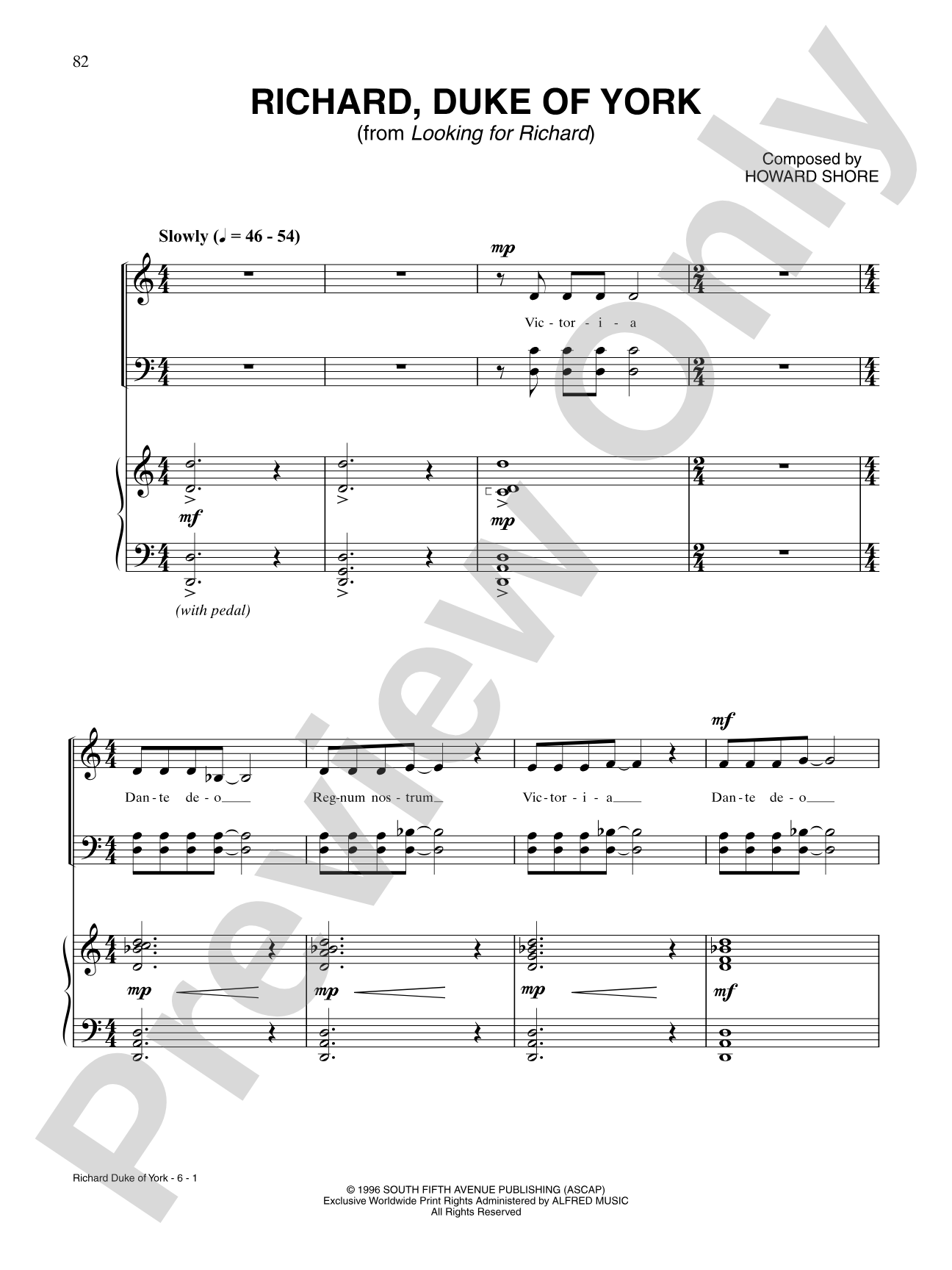
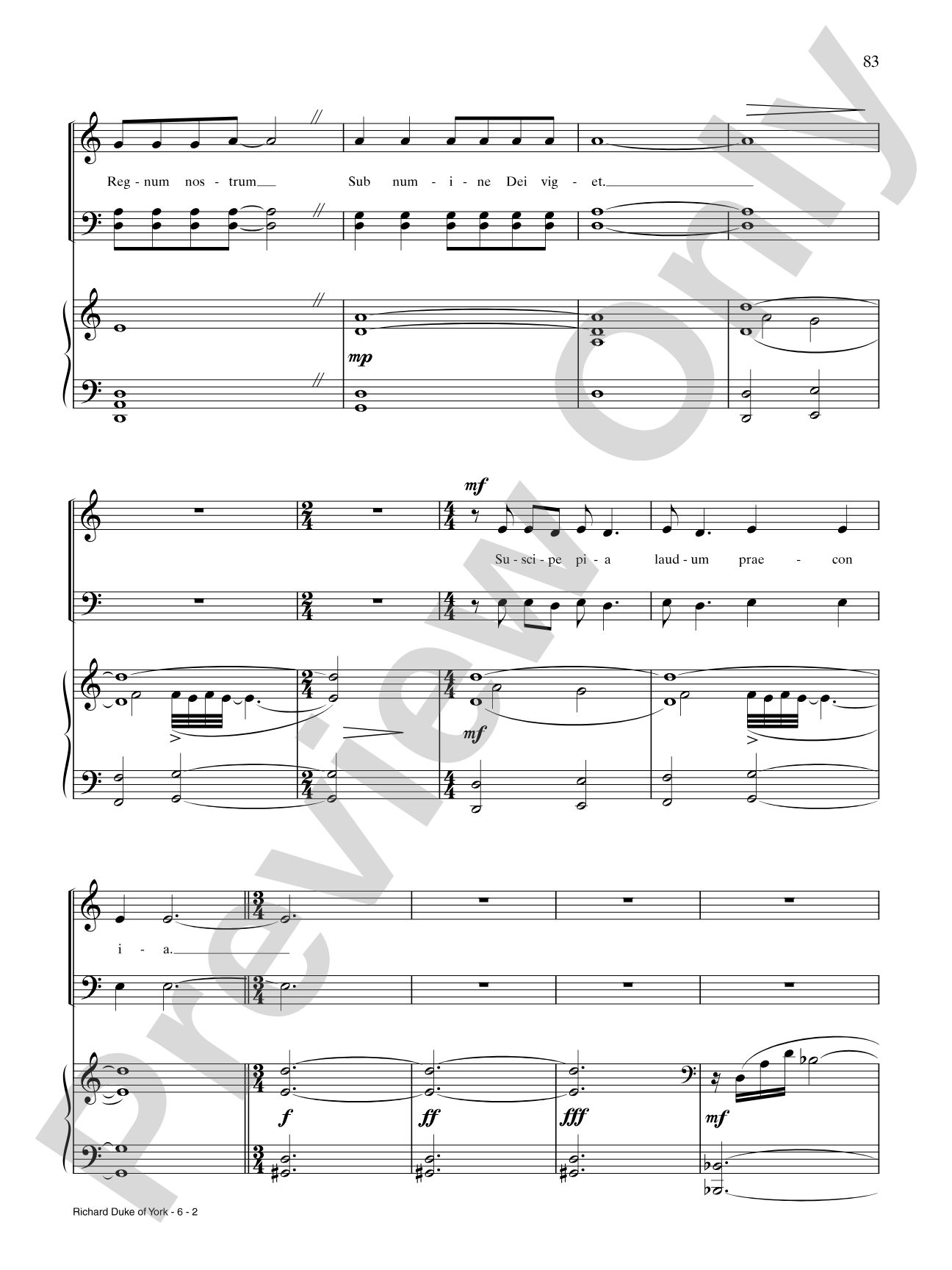

Richard, Duke of York: Piano/Vocal/Chords
Composed by Howard Shore
Item: 00-PS-0015745
$5.99
Pickup currently not available
Related Items
Eclipse (All Yours): Piano/Vocal/Chords |
$4.99
|
View | |
Jacob's Theme: Piano |
$4.99
|
View | |
Portrait of John Doe: Piano |
$4.99
|
View | |
Portrait of Edie: Piano |
$4.99
|
View | |
Catania: Piano |
$4.99
|
View | |
Piano Four: Piano |
$4.99
|
View | |
Brooklyn Heights 3: Piano |
$4.99
|
View | |
Love Will Find Out the Way: Piano/Vocal/Chords |
$4.99
|
View | |
Dead Ringers (Main Title): Piano |
$4.99
|
View | |
Miss Spielrein: Piano |
$4.99
|
View | |
Your Flesh: Piano/Vocal/Chords |
$5.99
|
View | |
The Shape of Rage: Piano |
$4.99
|
View | |
Birthday March: Piano/Vocal/Chords |
$4.99
|
View | |
Beyond the Forest: Piano/Vocal/Chords |
$5.99
|
View | |
The Dream: Piano/Vocal/Chords |
$5.99
|
View | |
The Howard Shore Collection, Volume 2: Piano/Vocal/Chords Book |
$19.99
|
View |
Description
Academy Award®-winner Howard Shore is best known for his elegant and eclectic film scores, including the soundtracks for Peter Jackson's The Lord of the Rings and The Hobbit trilogies. This collection features faithful arrangements of some of the best known titles by this brilliant composer. Titles: Birthday March (Big) * Brooklyn Heights 3 (Gangs of New York) * Calliope (Big) * Catania * Coeur Volant (Hugo) * Dead Ringers (Main Title) (Dead Ringers) * The Dream (from the opera The Fly) * Dreaming of Bag End (The Hobbit: An Unexpected Journey) * The Dwarf Lords (The Hobbit: An Unexpected Journey) * Eclipse (All Yours) (The Twilight Saga: Eclipse) * The End of All Things (The Lord of the Rings: The Return of the King) * Erebor (The Hobbit: An Unexpected Journey) * Jacob's Theme (The Twilight Saga: Eclipse) * Love Will Find Out the Way (Spider) * Miss Spielrein (A Dangerous Method) * Piano Four * Portrait of Edie (A History of Violence) * Portrait of John Doe (Se7en) * Richard, Duke of York (Looking for Richard) * The Shape of Rage (The Brood) * The Thief (Hugo) * Your Flesh (from the opera The Fly) * Zoltar (Big).


Richard, Duke of York: Piano/Vocal/Chords isn't in MakeMusic Cloud just yet...but it could be. Let us know you'd like to see it, and you'll help shape what comes next. In the meantime, start a free trial and dive into thousands of interactive titles your students can play along with today.
Request This Title
Tell us you want it.
Start Your Free Trial
Explore everything that's ready to play right now.
Sample Audio
No sample audio found.
Sample Video
No sample videos found.
Additional Details
Publisher:
Alfred Music
Page Count:
112
SKU:
00-PS-0015745
More about this title
About the Composer: Howard Shore
Howard Shore has established himself as one of contemporary film's most accomplished composers, earning three Academy Awards for his work across multiple genres and storytelling styles. His approach to film scoring blends orchestral sophistication with emotional directness, creating music that enhances narrative without overwhelming it. Shore's extended collaborations with director Peter Jackson on The Lord of the Rings and The Hobbit trilogies demonstrate his ability to build complex musical worlds across vast storytelling landscapes.
Beyond fantasy epics, Shore has composed for psychological thrillers, period dramas, and character studies, showing remarkable range in adapting his voice to each project's demands. His willingness to explore operatic composition (evident in The Fly) alongside mainstream film work reflects a serious engagement with classical forms. For music educators, Shore's catalog offers accessible entry points into film scoring while maintaining genuine compositional craft.
Why we love this
This collection captures Shore's gift for melody and harmonic color across his most recognizable work, giving pianists and singers direct access to music they already know and love from cinema. The 22 selections span decades of Shore's career and multiple film contexts, making this book valuable both for performance and for understanding how a single composer adapts his voice across different narrative worlds. Piano/vocal/chord arrangements at this level balance accessibility with the sophisticated harmonic language that makes Shore's orchestrations so compelling.
What to expect
These pieces carry the epic scope and emotional intimacy Shore brings to film, translating orchestral grandeur into keyboard and voice textures that feel both personal and cinematic. You'll move between moments of quiet lyricism (the delicate beauty of "Dreaming of Bag End") and passages of dramatic intensity ("The End of All Things"), discovering how melody and harmony can evoke entire worlds on a concert stage. The music invites you into stories you know while revealing depths in Shore's compositional choices you may not have noticed on screen.
Who it's for
Pianists and singer-pianists who want to explore film music beyond pop standards and feel confident performing recognizable material from beloved movies. Music teachers seeking repertoire that engages students through familiar stories while introducing them to the compositional craft of a major contemporary voice. Performers preparing recitals centered on film scores or artists exploring how to program Shore's work alongside classical or art song repertoire.
How to get the most out of it
- Study the film context before rehearsing. Shore's melodic phrasing often follows dialogue rhythms and emotional beats in ways that become clear only after seeing the scene. Understanding when the orchestra swells or pulls back will shape your rubato and dynamic choices.
- Honor the emotional architecture of each piece rather than rushing through it. These arrangements condense orchestral scoring into a smaller format, so every chord change and melodic contour carries weight. Let silence and space breathe.
- Treat the vocal line as a storytelling element, not a display vehicle. Whether singing "The End of All Things" or "Dreaming of Bag End," Shore's melodies serve the narrative. Clarity and warmth matter more than virtuosity.
- Use the chord symbols as a harmonic roadmap, but listen to how Shore's voice leading creates movement. The chords tell you what to play; the voice leading tells you how to shape it musically.
How to use it
Program individual selections from this book as thematic bookends to concert sets or as transitions between contrasting pieces. A recital centered on Shore's work offers natural storytelling momentum across multiple styles and emotional registers. These arrangements also work well in educational settings where you're teaching students about film music composition, orchestration reduction, or the relationship between music and narrative.
Skills your students will build
- Reading chord symbols and realizing harmonies in real-time
- Balancing melodic expression with harmonic accompaniment in piano/vocal writing
- Understanding how orchestral scoring translates to keyboard textures
- Interpreting and shaping film music for live performance contexts
- Recognizing Shore's harmonic language across different film genres and emotional registers