
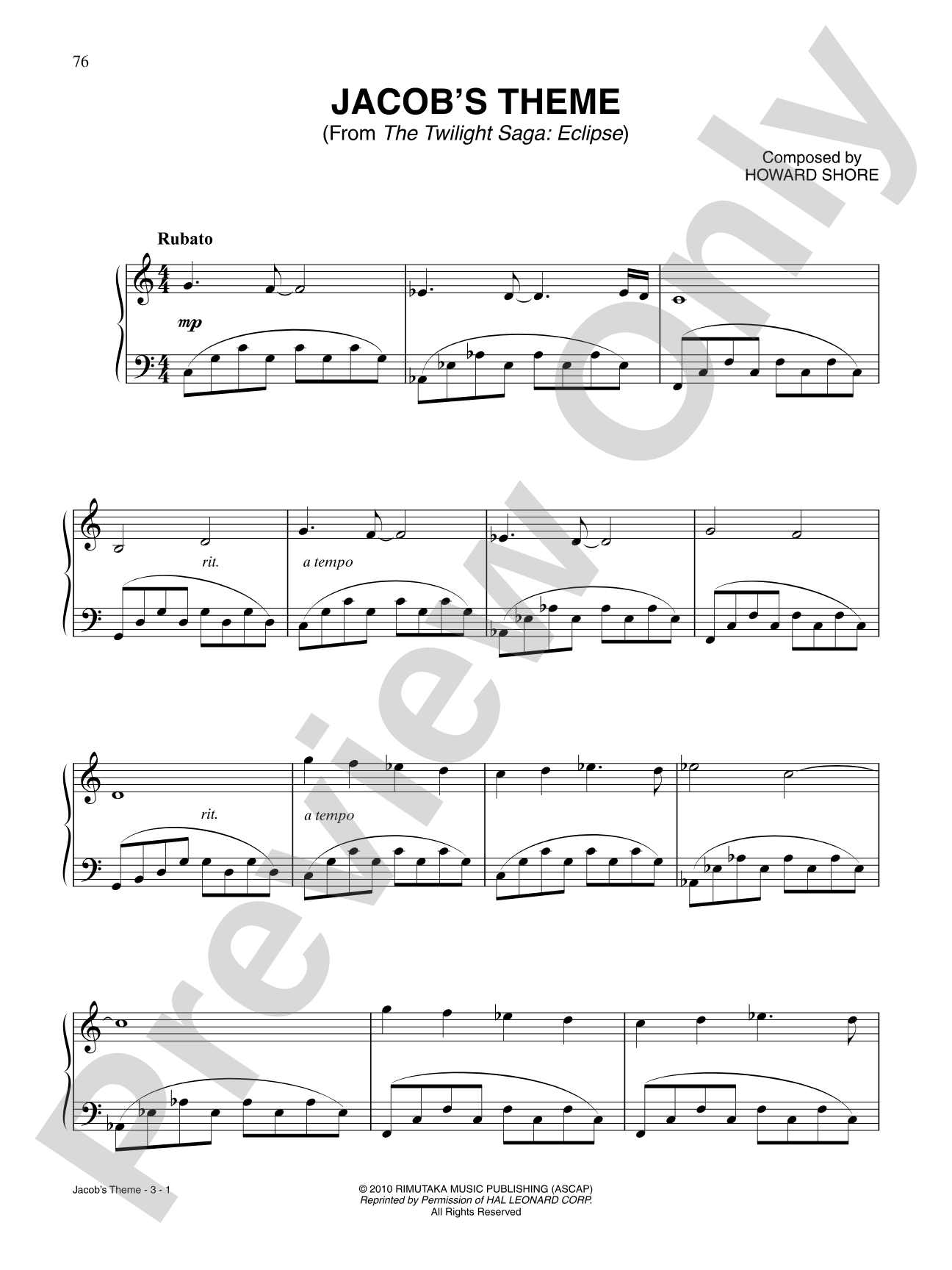

Jacob's Theme: Piano
Composed by Howard Shore
Item: 00-PS-0015736
$4.99
One moment…
Related Items
Eclipse (All Yours): Piano/Vocal/Chords |
$4.99
|
View | |
Portrait of John Doe: Piano |
$4.99
|
View | |
Portrait of Edie: Piano |
$4.99
|
View | |
Catania: Piano |
$4.99
|
View | |
Piano Four: Piano |
$4.99
|
View | |
Brooklyn Heights 3: Piano |
$4.99
|
View | |
Love Will Find Out the Way: Piano/Vocal/Chords |
$4.99
|
View | |
Dead Ringers (Main Title): Piano |
$4.99
|
View | |
Miss Spielrein: Piano |
$4.99
|
View | |
Richard, Duke of York: Piano/Vocal/Chords |
$5.99
|
View | |
Your Flesh: Piano/Vocal/Chords |
$5.99
|
View | |
The Shape of Rage: Piano |
$4.99
|
View | |
Birthday March: Piano/Vocal/Chords |
$4.99
|
View | |
Beyond the Forest: Piano/Vocal/Chords |
$5.99
|
View | |
The Dream: Piano/Vocal/Chords |
$5.99
|
View | |
The Howard Shore Collection, Volume 2: Piano/Vocal/Chords Book |
$19.99
|
View |
Description
Academy Award®-winner Howard Shore is best known for his elegant and eclectic film scores, including the soundtracks for Peter Jackson's The Lord of the Rings and The Hobbit trilogies. This collection features faithful arrangements of some of the best known titles by this brilliant composer. Titles: Birthday March (Big) * Brooklyn Heights 3 (Gangs of New York) * Calliope (Big) * Catania * Coeur Volant (Hugo) * Dead Ringers (Main Title) (Dead Ringers) * The Dream (from the opera The Fly) * Dreaming of Bag End (The Hobbit: An Unexpected Journey) * The Dwarf Lords (The Hobbit: An Unexpected Journey) * Eclipse (All Yours) (The Twilight Saga: Eclipse) * The End of All Things (The Lord of the Rings: The Return of the King) * Erebor (The Hobbit: An Unexpected Journey) * Jacob's Theme (The Twilight Saga: Eclipse) * Love Will Find Out the Way (Spider) * Miss Spielrein (A Dangerous Method) * Piano Four * Portrait of Edie (A History of Violence) * Portrait of John Doe (Se7en) * Richard, Duke of York (Looking for Richard) * The Shape of Rage (The Brood) * The Thief (Hugo) * Your Flesh (from the opera The Fly) * Zoltar (Big).


Jacob's Theme: Piano isn't in MakeMusic Cloud just yet...but it could be. Let us know you'd like to see it, and you'll help shape what comes next. In the meantime, start a free trial and dive into thousands of interactive titles your students can play along with today.
Request This Title
Tell us you want it.
Start Your Free Trial
Explore everything that's ready to play right now.
Sample Audio
No sample audio found.
Sample Video
No sample videos found.
Additional Details
Publisher:
Alfred Music
Page Count:
112
SKU:
00-PS-0015736
More about this title
About the Composer: Howard Shore
Howard Shore is an Academy Award-winning composer whose film scores have defined cinematic storytelling for decades. His work spans from intimate character studies (A Dangerous Method, Dead Ringers) to epic fantasy worlds (The Lord of the Rings and The Hobbit trilogies), revealing a composer equally fluent in minimalist orchestration and grand orchestral writing. Shore's music demonstrates sophisticated harmonic language and memorable thematic material, making his work both cinematically powerful and rewarding for musicians to perform.
Beyond film, Shore has composed for opera, concert hall, and television, earning three Academy Awards and numerous Grammy nominations. His versatility and meticulous craftsmanship have made him a model for composers working in media, and his scores remain essential listening for anyone studying how music shapes narrative and emotion in visual storytelling.
Why we love this
Shore's themes are singularly memorable and pianistically grateful, with each piece offering immediate dramatic payoff without requiring orchestral resources. The collection spans his most recognizable work, giving pianists access to film music that audiences genuinely know and respond to, which transforms solo recital programming from niche territory into something that connects with listeners beyond the traditional concert hall. The piano arrangements honor Shore's compositional voice while making his orchestral concepts playable and expressive at the keyboard.
What to expect
These pieces evoke cinematic intimacy at the piano. Whether exploring the quiet mystery of a minor-key character theme or building toward a triumphant melodic arrival, Shore's writing feels immediate and personal rather than shrunk-down from the orchestra. There's elegance in the restraint, and emotional directness in the melodic ideas that makes each piece feel essential rather than decorative.
Who it's for
Pianists preparing recital repertoire drawn from film scores will find familiar, emotionally resonant material that audiences recognize and enjoy. Intermediate to advanced players looking to expand beyond classical tradition will appreciate Shore's sophisticated harmonic language and structural clarity. Students of film music composition and orchestration can study how Shore's thematic work translates across different instrumental contexts.
How to get the most out of it
- Pay attention to Shore's use of silence and space; resist the urge to fill rhythmic gaps with unnecessary pedal or movement. The spare passages are often the most dramatically effective moments.
- Lean into the melodic lines rather than treating accompaniment figures as mere background. Shore's harmonic writing supports the themes, so clear voicing of both melody and harmony creates depth without muddiness.
- Treat tempo markings as architectural guidelines, not metronome commands. Shore's film music breathes; allow rubato in legato passages while maintaining rhythmic clarity in rhythmic figures.
- Use the dynamic range fully. The collection includes intimate character themes and sweeping orchestral moments; the contrast between quiet introspection and full keyboard voice creates the emotional arc Shore intended.
How to use it
Film music recitals have become legitimate programming territory in concert settings; this collection allows you to build a thematic program around Shore's most celebrated moments. Consider pairing selections from different films to create a narrative arc within the recital, or program a few pieces alongside classical repertoire to demonstrate how Shore's compositional techniques connect to earlier traditions. The accessibility and recognizability of these themes also makes them effective as teaching tools for intermediate students exploring how melody, harmony, and orchestration function in narrative contexts.
Skills your students will build
- Reading complex harmonic progressions and unusual chord voicings at the keyboard
- Balancing lyrical melody lines with non-traditional accompaniment figures
- Interpreting rubato and tempo flexibility within structured harmonic frameworks
- Translating orchestral scoring concepts (doubling, voice leading, textural layers) into single-instrument performance
- Sustaining emotional narrative across longer single-theme pieces without text or additional performers