
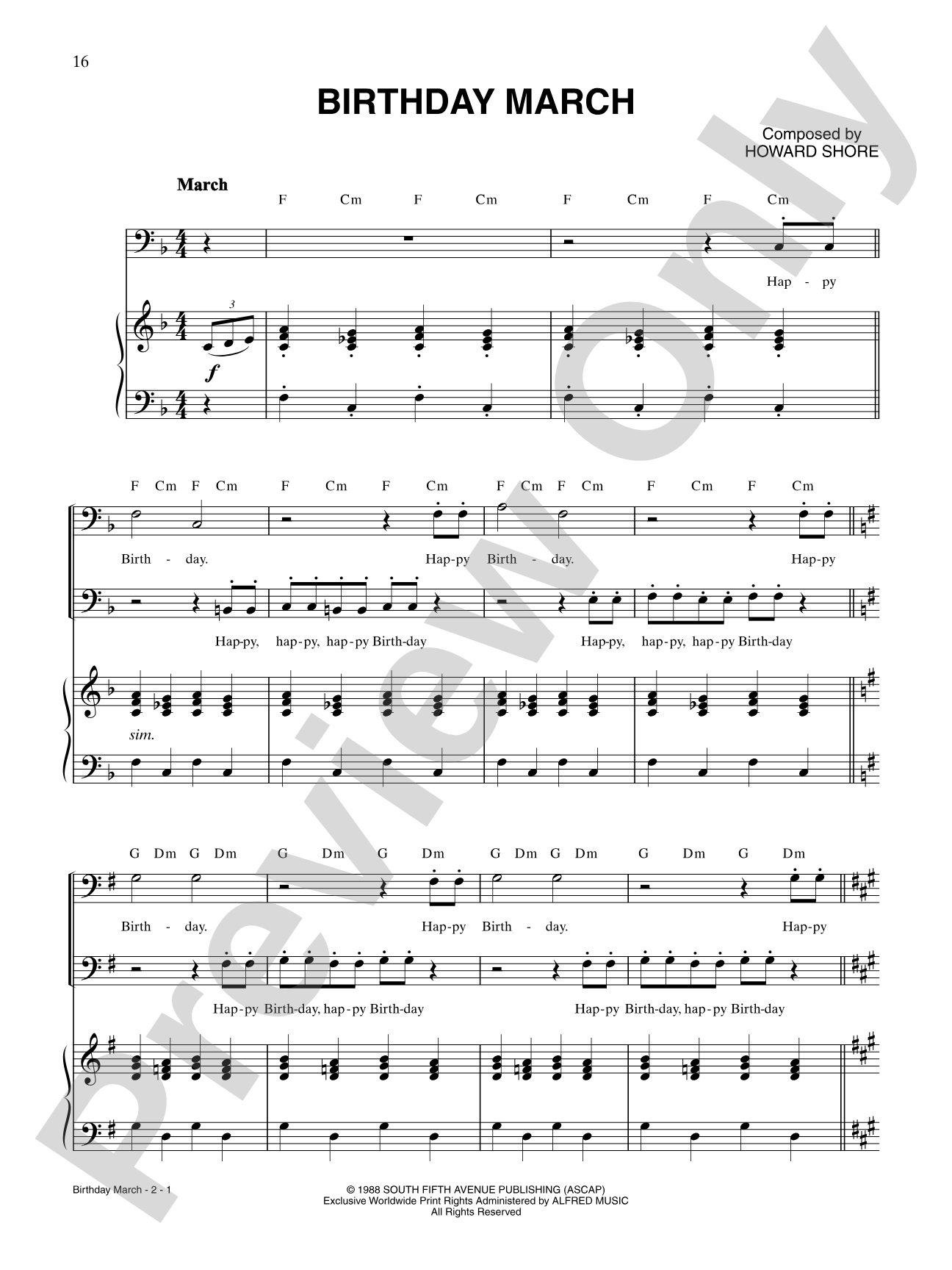

Birthday March: Piano/Vocal/Chords
Composed by Howard Shore
Item: 00-PS-0015748
$4.99
Pickup currently not available
Related Items
Eclipse (All Yours): Piano/Vocal/Chords |
$4.99
|
View | |
Jacob's Theme: Piano |
$4.99
|
View | |
Portrait of John Doe: Piano |
$4.99
|
View | |
Portrait of Edie: Piano |
$4.99
|
View | |
Catania: Piano |
$4.99
|
View | |
Piano Four: Piano |
$4.99
|
View | |
Brooklyn Heights 3: Piano |
$4.99
|
View | |
Love Will Find Out the Way: Piano/Vocal/Chords |
$4.99
|
View | |
Dead Ringers (Main Title): Piano |
$4.99
|
View | |
Miss Spielrein: Piano |
$4.99
|
View | |
Richard, Duke of York: Piano/Vocal/Chords |
$5.99
|
View | |
Your Flesh: Piano/Vocal/Chords |
$5.99
|
View | |
The Shape of Rage: Piano |
$4.99
|
View | |
Beyond the Forest: Piano/Vocal/Chords |
$5.99
|
View | |
The Dream: Piano/Vocal/Chords |
$5.99
|
View | |
The Howard Shore Collection, Volume 2: Piano/Vocal/Chords Book |
$19.99
|
View |
Description
Academy Award®-winner Howard Shore is best known for his elegant and eclectic film scores, including the soundtracks for Peter Jackson's The Lord of the Rings and The Hobbit trilogies. This collection features faithful arrangements of some of the best known titles by this brilliant composer. Titles: Birthday March (Big) * Brooklyn Heights 3 (Gangs of New York) * Calliope (Big) * Catania * Coeur Volant (Hugo) * Dead Ringers (Main Title) (Dead Ringers) * The Dream (from the opera The Fly) * Dreaming of Bag End (The Hobbit: An Unexpected Journey) * The Dwarf Lords (The Hobbit: An Unexpected Journey) * Eclipse (All Yours) (The Twilight Saga: Eclipse) * The End of All Things (The Lord of the Rings: The Return of the King) * Erebor (The Hobbit: An Unexpected Journey) * Jacob's Theme (The Twilight Saga: Eclipse) * Love Will Find Out the Way (Spider) * Miss Spielrein (A Dangerous Method) * Piano Four * Portrait of Edie (A History of Violence) * Portrait of John Doe (Se7en) * Richard, Duke of York (Looking for Richard) * The Shape of Rage (The Brood) * The Thief (Hugo) * Your Flesh (from the opera The Fly) * Zoltar (Big).


Birthday March: Piano/Vocal/Chords isn't in MakeMusic Cloud just yet...but it could be. Let us know you'd like to see it, and you'll help shape what comes next. In the meantime, start a free trial and dive into thousands of interactive titles your students can play along with today.
Request This Title
Tell us you want it.
Start Your Free Trial
Explore everything that's ready to play right now.
Sample Audio
No sample audio found.
Sample Video
No sample videos found.
Additional Details
Publisher:
Alfred Music
Page Count:
112
SKU:
00-PS-0015748
More about this title
About the Composer: Howard Shore
Howard Shore has composed and orchestrated music for over 80 films, earning three Academy Awards for his work on Peter Jackson's The Lord of the Rings trilogy. His approach to film scoring combines classical orchestral writing with modern sensibilities, drawing equally from operatic tradition and contemporary concert music. Shore's scores are known for their thematic coherence and emotional specificity, often functioning as characters in their own right within the narratives they support.
Why we love this
Shore's film themes translate beautifully to the piano/vocal/chords format, preserving the melodic richness and harmonic sophistication that made these scores resonate with audiences worldwide. The collection spans multiple genres and emotional territories, from the intimate character studies of his Cronenberg work to the epic sweep of Middle-earth, giving pianists and singers genuine variety within a single collection. These are pieces that reward careful listening and invite expressive interpretation without demanding virtuosic display.
What to expect
These arrangements capture the emotional depth that made Shore's original scores memorable, whether evoking the warmth of a character moment, the tension of a dramatic turning point, or the grandeur of an epic landscape. The piano and vocal parts work together to create intimate yet cinematic moments, transporting listeners into the worlds these pieces originally inhabited.
Who it's for
Pianists and singers preparing recital material that reaches beyond standard classical repertoire, as well as music students seeking sophisticated yet accessible arrangements of contemporary film music. Teachers looking for engaging pieces that develop harmonic awareness and expressive phrasing in students who connect with film scores.
How to get the most out of it
- Shape the melody generously across entire phrases rather than emphasizing individual notes; Shore's themes breathe and evolve over longer musical spans.
- Balance the vocal line with harmonic support in the accompaniment rather than burying it; the chords are designed to enhance, not compete with, the singer.
- Pay attention to the dramatic context of each piece as a guide to tempo and pacing; a theme from a tense thriller calls for a different approach than one from a character moment.
- Use the chord symbols as a springboard for voicing decisions; Shore's harmonies often suggest specific colors, so explore different inversions and registers to capture the intended mood.
How to use it
Program individual pieces as recital selections that appeal to audiences familiar with film music, or group several thematically related selections for a concert focused on Shore's approach to character and narrative. This collection also works well in interdisciplinary settings where music, film, and literature are studied together, or as supplementary material for advanced pianists seeking expressive challenges beyond traditional classical literature.
Skills your students will build
- Interpreting film music and understanding how thematic material serves narrative purpose
- Reading and voicing chord symbols in a variety of harmonic contexts
- Balancing melody and accompaniment in piano/vocal arrangements
- Sustaining phrase shapes across longer melodic lines
- Adapting tempo and character interpretation based on dramatic context