
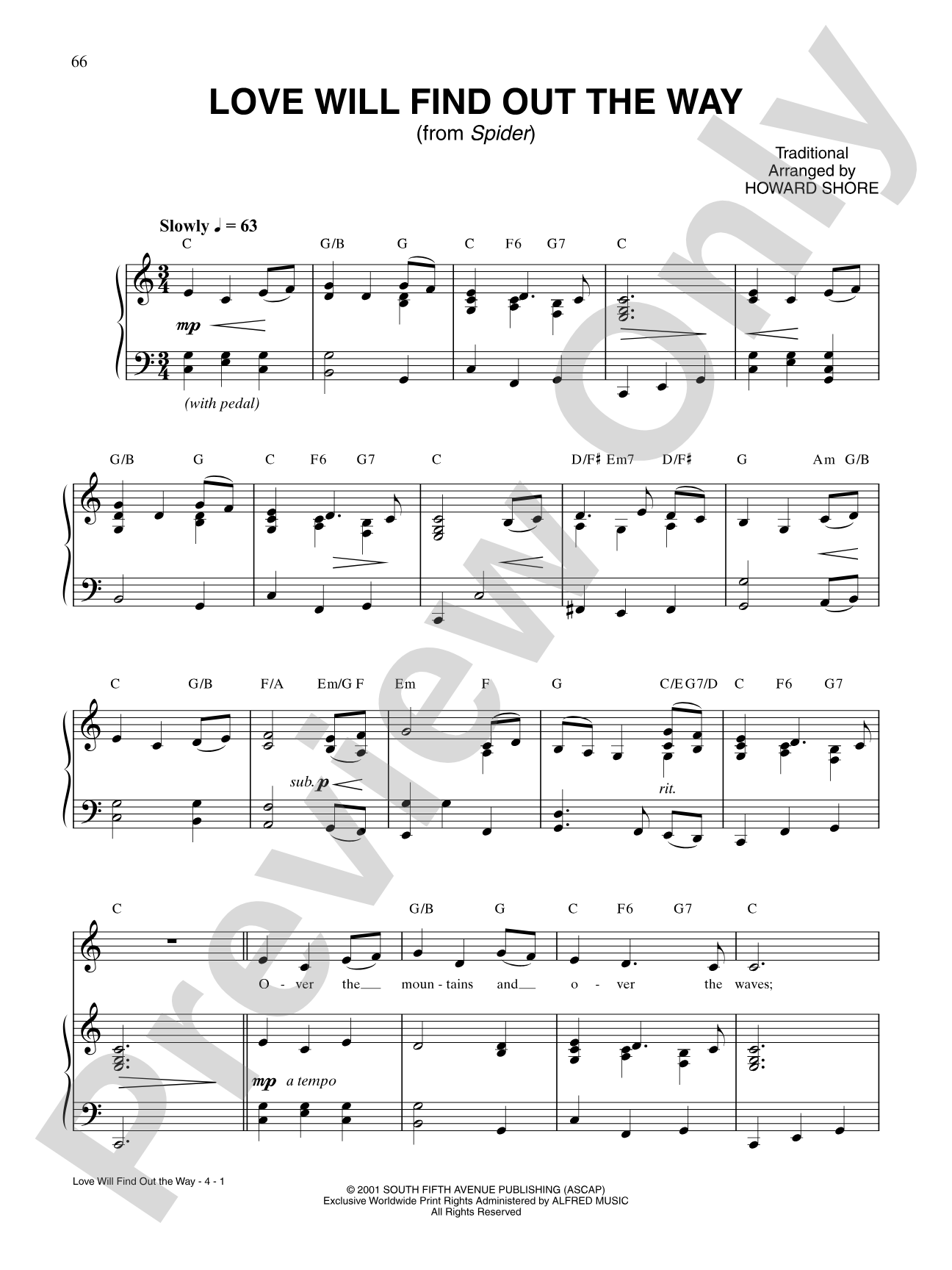

Love Will Find Out the Way: Piano/Vocal/Chords
Composed by Howard Shore
Item: 00-PS-0015742
$4.99
Pickup currently not available
Related Items
Eclipse (All Yours): Piano/Vocal/Chords |
$4.99
|
View | |
Jacob's Theme: Piano |
$4.99
|
View | |
Portrait of John Doe: Piano |
$4.99
|
View | |
Portrait of Edie: Piano |
$4.99
|
View | |
Catania: Piano |
$4.99
|
View | |
Piano Four: Piano |
$4.99
|
View | |
Brooklyn Heights 3: Piano |
$4.99
|
View | |
Dead Ringers (Main Title): Piano |
$4.99
|
View | |
Miss Spielrein: Piano |
$4.99
|
View | |
Richard, Duke of York: Piano/Vocal/Chords |
$5.99
|
View | |
Your Flesh: Piano/Vocal/Chords |
$5.99
|
View | |
The Shape of Rage: Piano |
$4.99
|
View | |
Birthday March: Piano/Vocal/Chords |
$4.99
|
View | |
Beyond the Forest: Piano/Vocal/Chords |
$5.99
|
View | |
The Dream: Piano/Vocal/Chords |
$5.99
|
View | |
The Howard Shore Collection, Volume 2: Piano/Vocal/Chords Book |
$19.99
|
View |
Description
Academy Award®-winner Howard Shore is best known for his elegant and eclectic film scores, including the soundtracks for Peter Jackson's The Lord of the Rings and The Hobbit trilogies. This collection features faithful arrangements of some of the best known titles by this brilliant composer. Titles: Birthday March (Big) * Brooklyn Heights 3 (Gangs of New York) * Calliope (Big) * Catania * Coeur Volant (Hugo) * Dead Ringers (Main Title) (Dead Ringers) * The Dream (from the opera The Fly) * Dreaming of Bag End (The Hobbit: An Unexpected Journey) * The Dwarf Lords (The Hobbit: An Unexpected Journey) * Eclipse (All Yours) (The Twilight Saga: Eclipse) * The End of All Things (The Lord of the Rings: The Return of the King) * Erebor (The Hobbit: An Unexpected Journey) * Jacob's Theme (The Twilight Saga: Eclipse) * Love Will Find Out the Way (Spider) * Miss Spielrein (A Dangerous Method) * Piano Four * Portrait of Edie (A History of Violence) * Portrait of John Doe (Se7en) * Richard, Duke of York (Looking for Richard) * The Shape of Rage (The Brood) * The Thief (Hugo) * Your Flesh (from the opera The Fly) * Zoltar (Big).


Love Will Find Out the Way: Piano/Vocal/Chords isn't in MakeMusic Cloud just yet...but it could be. Let us know you'd like to see it, and you'll help shape what comes next. In the meantime, start a free trial and dive into thousands of interactive titles your students can play along with today.
Request This Title
Tell us you want it.
Start Your Free Trial
Explore everything that's ready to play right now.
Sample Audio
No sample audio found.
Sample Video
No sample videos found.
Additional Details
Publisher:
Alfred Music
Page Count:
112
SKU:
00-PS-0015742
More about this title
About the Composer: Howard Shore
Howard Shore has composed some of the most recognizable film scores of the past four decades, earning three Academy Awards for his work on Peter Jackson's The Lord of the Rings trilogy. His approach to orchestration and thematic development draws from classical composition traditions while serving the narrative and emotional arc of each film, making his scores equally powerful in concert settings and intimate listening contexts.
Beyond his Middle-earth work, Shore has created distinctive scores for filmmakers including David Cronenberg, Denis Villeneuve, and Martin Scorsese. His ability to craft memorable, singable melodies within complex harmonic frameworks has made his music particularly valued by musicians seeking substantive repertoire that connects popular culture to serious musical study.
Why we love this
Shore's melodies translate beautifully to the piano, and this collection captures the emotional depth of his film work without requiring full orchestral forces. Pianists and vocalists gain access to sophisticated harmonic language and genuine melodic substance, bridging the gap between popular appeal and musical literacy.
What to expect
These arrangements capture the cinematic sweep of Shore's original work: moments of intimate introspection give way to expansive, soaring passages. The harmonic language feels both modern and timeless, blending accessibility with genuine compositional depth. Whether you're playing a quiet character moment or a triumphant ensemble theme, Shore's music carries emotional clarity and orchestral imagination translated directly to the keyboard.
Who it's for
Pianists and singer-pianists seeking repertoire that offers both popular recognition and musical substance will find these arrangements immediately accessible yet rewarding to study. Teachers can use individual pieces to introduce students to film scoring conventions and harmonic sophistication without overwhelming technical demands. Vocalists preparing for auditions or recitals benefit from Shore's gift for memorable melody combined with the prestige of Oscar-winning material.
How to get the most out of it
- Study the harmonic progressions carefully before focusing on tempo; Shore's chord voicings often contain unexpected movement that rewards attention to voice leading.
- Recognize that these arrangements serve the vocal line; even in purely instrumental passages, maintain the singing quality Shore embedded in the original themes.
- Lean into the dramatic pauses and fermatas. Shore uses silence strategically to build emotional weight, so resist the urge to fill every moment with sound.
- Balance the chordal accompaniment with transparency; these pieces sit in contexts ranging from intimate to epic, and your touch should serve the mood of each section.
How to use it
This collection works beautifully in recitals organized by theme (fairy tale worlds, psychological drama, epic adventure) rather than chronologically by film, allowing you to curate meaningful artistic arcs. Film score medleys have genuine appeal for mixed audiences, and these individual pieces maintain enough sophistication to satisfy both casual listeners and serious musicians. Consider pairing movements from different films that share emotional territory to create a through-composed program narrative.
Skills your students will build
- Reading and interpreting chord symbols within a classical-music context
- Balancing melodic line with accompaniment texture in piano-vocal writing
- Understanding harmonic vocabulary in film scoring (extended harmonies, modal mixture, unexpected cadential motion)
- Stylistic interpretation of music rooted in orchestral color translated to piano
- Sight-reading across multiple staves with vocal and instrumental elements simultaneously