
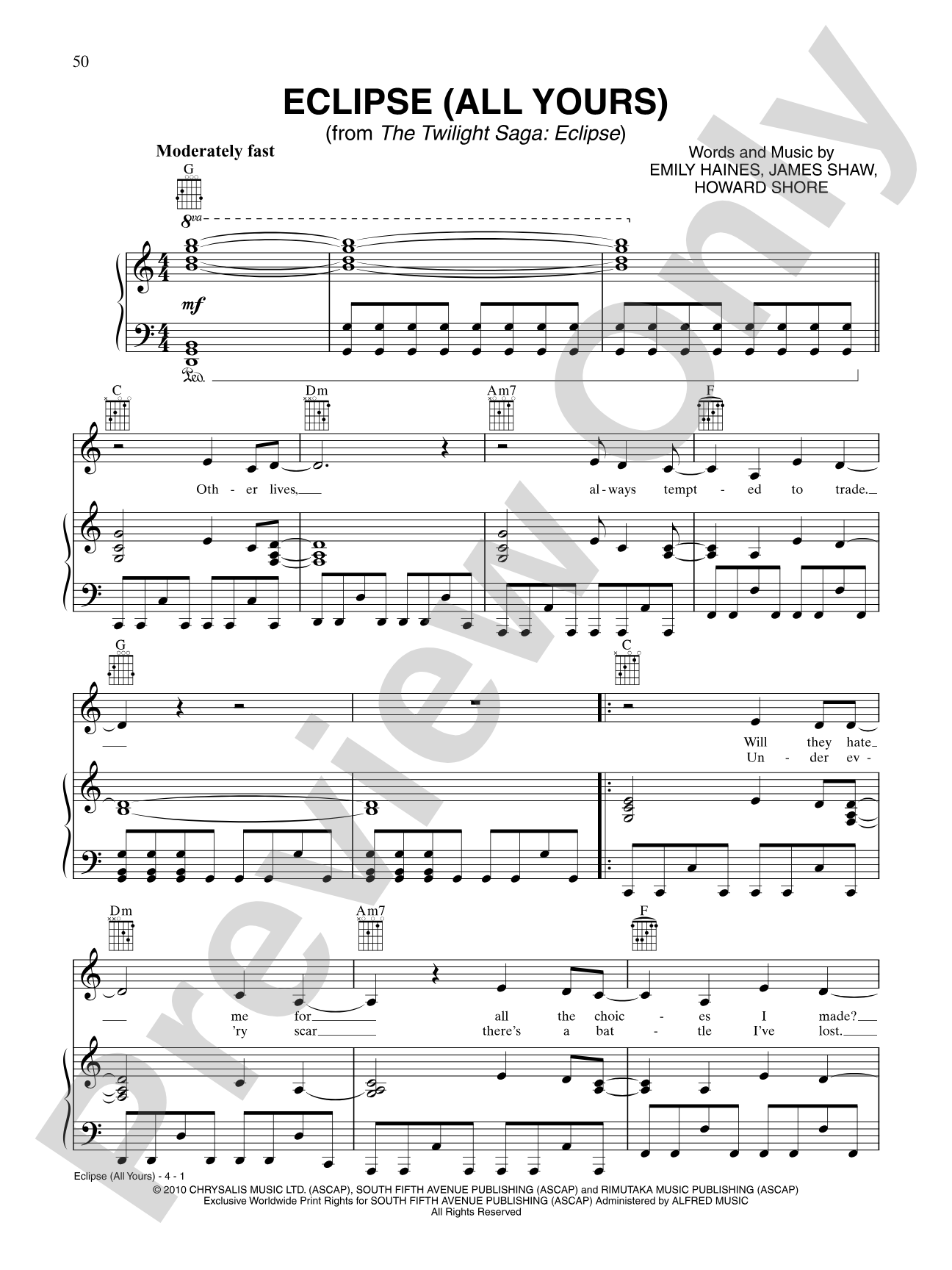

Eclipse (All Yours): Piano/Vocal/Chords
Composed by Howard Shore
Item: 00-PS-0015735
$4.99
Pickup currently not available
Related Items
Jacob's Theme: Piano |
$4.99
|
View | |
Portrait of John Doe: Piano |
$4.99
|
View | |
Portrait of Edie: Piano |
$4.99
|
View | |
Catania: Piano |
$4.99
|
View | |
Piano Four: Piano |
$4.99
|
View | |
Brooklyn Heights 3: Piano |
$4.99
|
View | |
Love Will Find Out the Way: Piano/Vocal/Chords |
$4.99
|
View | |
Dead Ringers (Main Title): Piano |
$4.99
|
View | |
Miss Spielrein: Piano |
$4.99
|
View | |
Richard, Duke of York: Piano/Vocal/Chords |
$5.99
|
View | |
Your Flesh: Piano/Vocal/Chords |
$5.99
|
View | |
The Shape of Rage: Piano |
$4.99
|
View | |
Birthday March: Piano/Vocal/Chords |
$4.99
|
View | |
Beyond the Forest: Piano/Vocal/Chords |
$5.99
|
View | |
The Dream: Piano/Vocal/Chords |
$5.99
|
View | |
The Howard Shore Collection, Volume 2: Piano/Vocal/Chords Book |
$19.99
|
View |
Description
Academy Award®-winner Howard Shore is best known for his elegant and eclectic film scores, including the soundtracks for Peter Jackson's The Lord of the Rings and The Hobbit trilogies. This collection features faithful arrangements of some of the best known titles by this brilliant composer. Titles: Birthday March (Big) * Brooklyn Heights 3 (Gangs of New York) * Calliope (Big) * Catania * Coeur Volant (Hugo) * Dead Ringers (Main Title) (Dead Ringers) * The Dream (from the opera The Fly) * Dreaming of Bag End (The Hobbit: An Unexpected Journey) * The Dwarf Lords (The Hobbit: An Unexpected Journey) * Eclipse (All Yours) (The Twilight Saga: Eclipse) * The End of All Things (The Lord of the Rings: The Return of the King) * Erebor (The Hobbit: An Unexpected Journey) * Jacob's Theme (The Twilight Saga: Eclipse) * Love Will Find Out the Way (Spider) * Miss Spielrein (A Dangerous Method) * Piano Four * Portrait of Edie (A History of Violence) * Portrait of John Doe (Se7en) * Richard, Duke of York (Looking for Richard) * The Shape of Rage (The Brood) * The Thief (Hugo) * Your Flesh (from the opera The Fly) * Zoltar (Big).


Eclipse (All Yours): Piano/Vocal/Chords isn't in MakeMusic Cloud just yet...but it could be. Let us know you'd like to see it, and you'll help shape what comes next. In the meantime, start a free trial and dive into thousands of interactive titles your students can play along with today.
Request This Title
Tell us you want it.
Start Your Free Trial
Explore everything that's ready to play right now.
Sample Audio
No sample audio found.
Sample Video
No sample videos found.
Additional Details
Publisher:
Alfred Music
Page Count:
112
SKU:
00-PS-0015735
More about this title
Why we love this
This collection pairs Shore's instantly recognizable film themes with piano arrangements that preserve their harmonic depth and emotional arc without overwhelming pianists. The range of sources spanning The Lord of the Rings, The Hobbit, The Twilight Saga, and his earlier collaborations with David Cronenberg gives singers and pianists real variety in style and mood within a single book. It's the kind of repertoire that keeps students engaged because every piece tells a story they already know.
What to expect
Sweeping, cinematic, and deeply romantic. These arrangements capture the grandeur of epic fantasy, the intimacy of character moments, and the psychological tension of Shore's darker work. Melodies soar over rich harmonic progressions that evoke orchestral textures without relying on them.
Who it's for
Pianists and vocalist-pianist pairs seeking contemporary material with film and TV literacy, from intermediate to advanced amateurs and students preparing for auditions or recitals. Teachers building programs that blend classical training with recognizable scores will find students highly motivated by these particular titles.
How to get the most out of it
- Attend to the harmonic movement rather than rushing through runs; Shore's piano writing often carries the narrative weight in the accompaniment, so clarity of voicing matters more than speed.
- Use the chord symbols as guides for reharmonization and improvisation, especially in sections marked with sparse notation; they invite flexible interpretation while staying faithful to the film's emotional trajectory.
- Balance the vocal line against the accompaniment's cinematic moments. Some pieces feature lush orchestral textures translated to piano, so resist playing too heavily and let space breathe between phrases.
- Practice sections with key changes methodically. Several arrangements move between tonal centers to match the dramatic arc of their film contexts.
How to use it
Place this in a recital alongside contemporary or classical material to give audiences a familiar anchor; Shore's themes work equally well as program openers or closers depending on the emotional journey you're charting. It's also strong for benefit concerts, community events, or showcases where you want to blend accessible material with genuine compositional sophistication.
Skills your students will build
- Reading chord symbols and interpreting harmonic notation in contemporary contexts
- Translating orchestral textures to the piano keyboard
- Managing dramatic pacing and emotional arc within a single piece
- Balancing vocal line prominence with accompaniment that drives the narrative
- Sight-reading across multiple systems with varied key signatures