
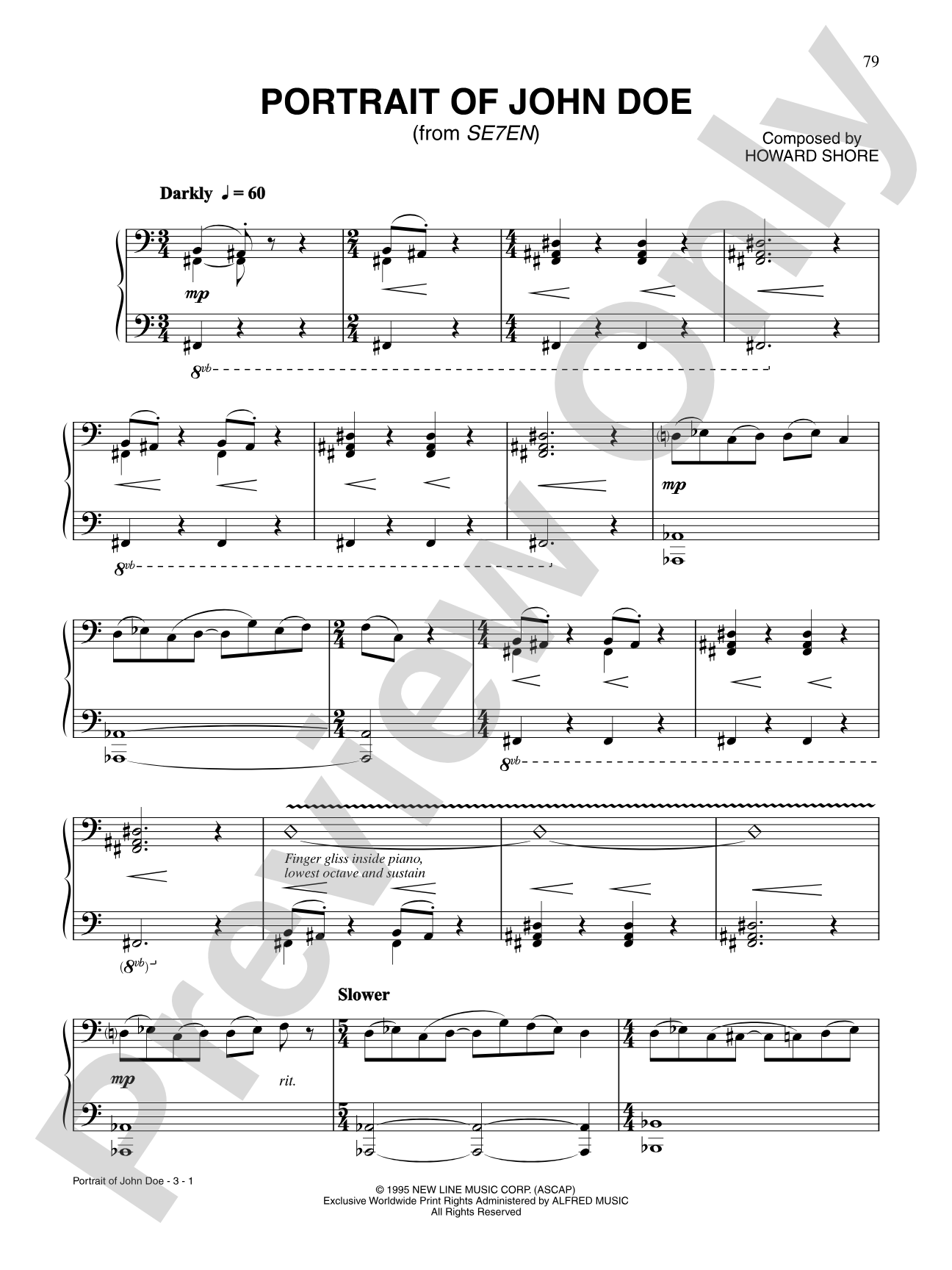

Portrait of John Doe: Piano
Composed by Howard Shore
Item: 00-PS-0015737
$4.99
Pickup currently not available
Related Items
Eclipse (All Yours): Piano/Vocal/Chords |
$4.99
|
View | |
Jacob's Theme: Piano |
$4.99
|
View | |
Portrait of Edie: Piano |
$4.99
|
View | |
Catania: Piano |
$4.99
|
View | |
Piano Four: Piano |
$4.99
|
View | |
Brooklyn Heights 3: Piano |
$4.99
|
View | |
Love Will Find Out the Way: Piano/Vocal/Chords |
$4.99
|
View | |
Dead Ringers (Main Title): Piano |
$4.99
|
View | |
Miss Spielrein: Piano |
$4.99
|
View | |
Richard, Duke of York: Piano/Vocal/Chords |
$5.99
|
View | |
Your Flesh: Piano/Vocal/Chords |
$5.99
|
View | |
The Shape of Rage: Piano |
$4.99
|
View | |
Birthday March: Piano/Vocal/Chords |
$4.99
|
View | |
Beyond the Forest: Piano/Vocal/Chords |
$5.99
|
View | |
The Dream: Piano/Vocal/Chords |
$5.99
|
View | |
The Howard Shore Collection, Volume 2: Piano/Vocal/Chords Book |
$19.99
|
View |
Description
Academy Award®-winner Howard Shore is best known for his elegant and eclectic film scores, including the soundtracks for Peter Jackson's The Lord of the Rings and The Hobbit trilogies. This collection features faithful arrangements of some of the best known titles by this brilliant composer. Titles: Birthday March (Big) * Brooklyn Heights 3 (Gangs of New York) * Calliope (Big) * Catania * Coeur Volant (Hugo) * Dead Ringers (Main Title) (Dead Ringers) * The Dream (from the opera The Fly) * Dreaming of Bag End (The Hobbit: An Unexpected Journey) * The Dwarf Lords (The Hobbit: An Unexpected Journey) * Eclipse (All Yours) (The Twilight Saga: Eclipse) * The End of All Things (The Lord of the Rings: The Return of the King) * Erebor (The Hobbit: An Unexpected Journey) * Jacob's Theme (The Twilight Saga: Eclipse) * Love Will Find Out the Way (Spider) * Miss Spielrein (A Dangerous Method) * Piano Four * Portrait of Edie (A History of Violence) * Portrait of John Doe (Se7en) * Richard, Duke of York (Looking for Richard) * The Shape of Rage (The Brood) * The Thief (Hugo) * Your Flesh (from the opera The Fly) * Zoltar (Big).


Portrait of John Doe: Piano isn't in MakeMusic Cloud just yet...but it could be. Let us know you'd like to see it, and you'll help shape what comes next. In the meantime, start a free trial and dive into thousands of interactive titles your students can play along with today.
Request This Title
Tell us you want it.
Start Your Free Trial
Explore everything that's ready to play right now.
Sample Audio
No sample audio found.
Sample Video
No sample videos found.
Additional Details
Publisher:
Alfred Music
Page Count:
112
SKU:
00-PS-0015737
More about this title
About the Composer: Howard Shore
Howard Shore has composed over 100 film and television scores, earning three Academy Awards for his work on Peter Jackson's The Lord of the Rings trilogy. His compositional voice blends orchestral sophistication with accessibility, drawing on classical traditions while creating themes that resonate far beyond the cinema. Shore's film scores have become standard repertoire in concert halls and practice rooms worldwide, proving that popular film music can sustain serious artistic scrutiny.
Why we love this
Shore's melodies translate beautifully to solo piano, preserving their emotional core while offering pianists material that feels both substantial and approachable. The breadth of sources here—from fantasy epics to character studies to horror films—gives students exposure to compositional variety within a single collection. These arrangements work equally well as recital repertoire or as stepping stones into film music composition.
What to expect
These pieces inhabit spaces between intimacy and grandeur. A moment of quiet reflection can shift into something sweeping and orchestral; delicate character portraits coexist with themes of epic scope. Shore's harmonic language feels modern without abandoning tonality, creating a listening experience that's accessible yet sophisticated.
Who it's for
Pianists seeking repertoire that combines contemporary film music with classical sensibilities will find substantial material here. Intermediate to advanced students and adult amateur players benefit from Shore's singable melodies and well-crafted arrangements that don't require virtuosic technique to sound compelling.
How to get the most out of it
- Attend to the harmonic color beneath the melody line; Shore often uses chromatic movement and unexpected chord progressions to deepen emotional resonance, so clarity of left-hand voicing matters as much as right-hand phrasing.
- Let the thematic material breathe without rushing. Many of these pieces unfold slowly and deliberately, rewarding patience and spatial awareness between phrases.
- Use dynamic contrast intentionally. Shore's film scoring background means these arrangements often benefit from subtle shifts in volume and texture that mirror cinematic pacing.
How to use it
Program selections from this collection on recitals devoted to film music, contemporary composers, or thematic concerts exploring how cinema shapes musical language. These arrangements also serve as bridges for students interested in exploring scoring and orchestration; studying how Shore adapted these pieces for solo piano illuminates orchestration principles.
Skills your students will build
- Reading piano/vocal/chord charts and understanding lead-sheet notation
- Interpreting and voicing chord symbols for expressive left-hand accompaniment
- Balancing melodic delivery with harmonic color in arrangements
- Phrasing longer lines that span multiple systems without losing direction
- Applying dynamic shaping to enhance emotional storytelling