
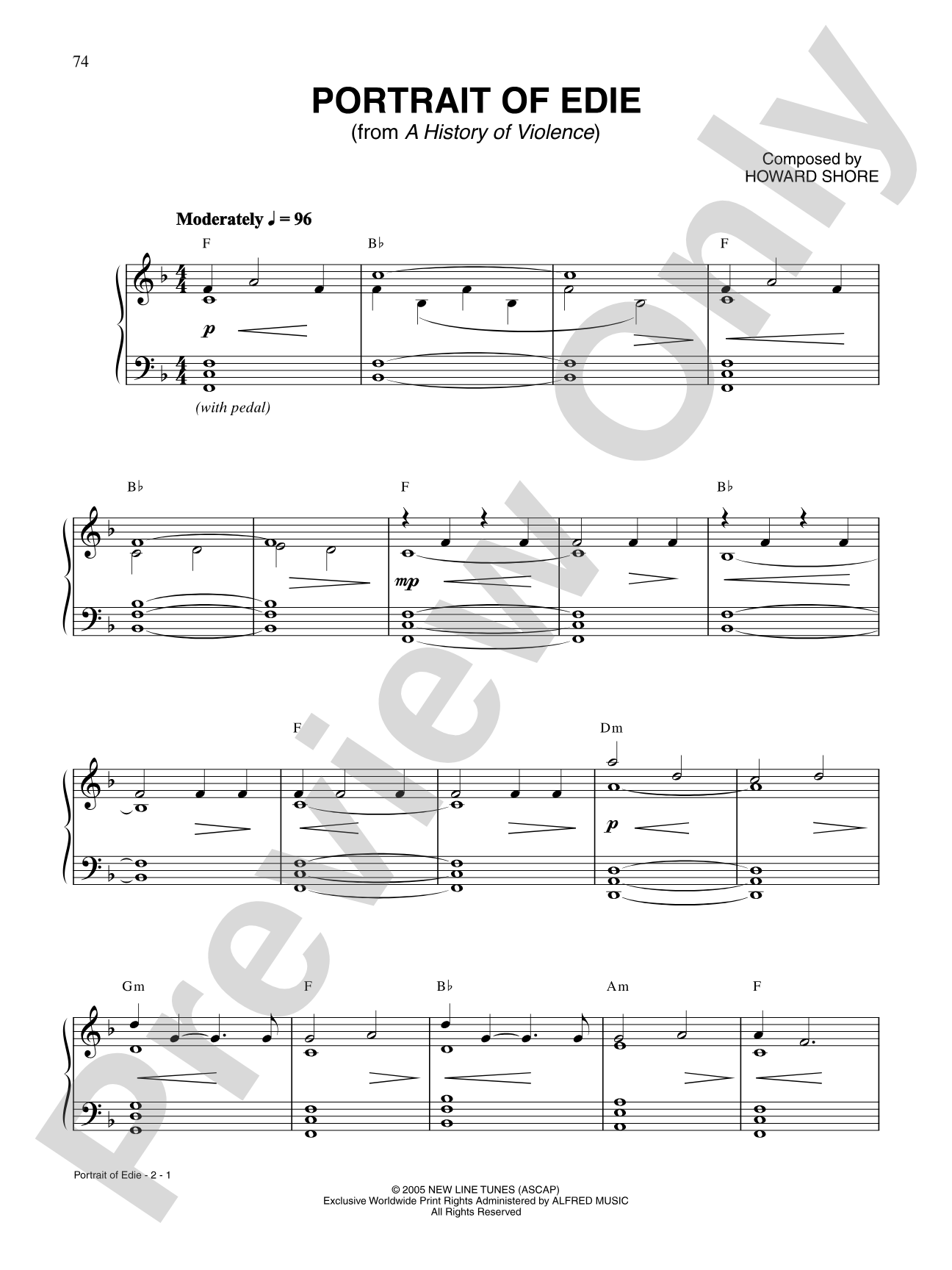

Portrait of Edie: Piano
Composed by Howard Shore
Item: 00-PS-0015738
$4.99
Pickup currently not available
Related Items
Eclipse (All Yours): Piano/Vocal/Chords |
$4.99
|
View | |
Jacob's Theme: Piano |
$4.99
|
View | |
Portrait of John Doe: Piano |
$4.99
|
View | |
Catania: Piano |
$4.99
|
View | |
Piano Four: Piano |
$4.99
|
View | |
Brooklyn Heights 3: Piano |
$4.99
|
View | |
Love Will Find Out the Way: Piano/Vocal/Chords |
$4.99
|
View | |
Dead Ringers (Main Title): Piano |
$4.99
|
View | |
Miss Spielrein: Piano |
$4.99
|
View | |
Richard, Duke of York: Piano/Vocal/Chords |
$5.99
|
View | |
Your Flesh: Piano/Vocal/Chords |
$5.99
|
View | |
The Shape of Rage: Piano |
$4.99
|
View | |
Birthday March: Piano/Vocal/Chords |
$4.99
|
View | |
Beyond the Forest: Piano/Vocal/Chords |
$5.99
|
View | |
The Dream: Piano/Vocal/Chords |
$5.99
|
View | |
The Howard Shore Collection, Volume 2: Piano/Vocal/Chords Book |
$19.99
|
View |
Description
Academy Award®-winner Howard Shore is best known for his elegant and eclectic film scores, including the soundtracks for Peter Jackson's The Lord of the Rings and The Hobbit trilogies. This collection features faithful arrangements of some of the best known titles by this brilliant composer. Titles: Birthday March (Big) * Brooklyn Heights 3 (Gangs of New York) * Calliope (Big) * Catania * Coeur Volant (Hugo) * Dead Ringers (Main Title) (Dead Ringers) * The Dream (from the opera The Fly) * Dreaming of Bag End (The Hobbit: An Unexpected Journey) * The Dwarf Lords (The Hobbit: An Unexpected Journey) * Eclipse (All Yours) (The Twilight Saga: Eclipse) * The End of All Things (The Lord of the Rings: The Return of the King) * Erebor (The Hobbit: An Unexpected Journey) * Jacob's Theme (The Twilight Saga: Eclipse) * Love Will Find Out the Way (Spider) * Miss Spielrein (A Dangerous Method) * Piano Four * Portrait of Edie (A History of Violence) * Portrait of John Doe (Se7en) * Richard, Duke of York (Looking for Richard) * The Shape of Rage (The Brood) * The Thief (Hugo) * Your Flesh (from the opera The Fly) * Zoltar (Big).


Portrait of Edie: Piano isn't in MakeMusic Cloud just yet...but it could be. Let us know you'd like to see it, and you'll help shape what comes next. In the meantime, start a free trial and dive into thousands of interactive titles your students can play along with today.
Request This Title
Tell us you want it.
Start Your Free Trial
Explore everything that's ready to play right now.
Sample Audio
No sample audio found.
Sample Video
No sample videos found.
Additional Details
Publisher:
Alfred Music
Page Count:
112
SKU:
00-PS-0015738
More about this title
About the Composer: Howard Shore
Howard Shore stands among the most accomplished film composers of the past four decades, with three Academy Awards and multiple Grammy Awards recognizing his distinctive voice across genres. His work spans intimate character studies (A History of Violence, The Fly) and epic fantasy worlds (The Lord of the Rings and The Hobbit trilogies), demonstrating his ability to compose music that serves narrative while standing on its own as concert material.
Shore's compositional approach balances orchestral grandeur with chamber-like intimacy. His pieces are structured for accessibility without sacrificing harmonic sophistication, making them valuable for pianists seeking film music that rewards both performers and audiences.
Why we love this
This collection captures Shore's gift for memorable melody paired with functional harmony that works beautifully on a solo piano. Teachers will appreciate the range of difficulty and mood represented across 22 pieces, from the whimsical simplicity of "Calliope" to the sophisticated narrative depth of "Portrait of Edie" itself. It's the kind of repertoire that keeps recital programs engaging and introduces students to a major contemporary voice in film composition.
What to expect
Shore's music on piano conveys cinematic narrative and emotional depth even in intimate arrangements. These pieces carry the weight of character and story, with harmonic language that feels modern yet rooted in classical tradition, creating a listening experience that rewards both casual listeners and attentive music students.
Who it's for
Intermediate to advanced pianists drawn to film music and contemporary composition will find substantial material here. This collection serves intermediate students developing interpretive skills and advanced players seeking accessible yet sophisticated concert repertoire beyond standard classical literature.
How to get the most out of it
- Approach the operatic pieces ("The Dream" and "Your Flesh" from The Fly) with sustained legato and careful attention to phrase direction, as these require vocal-line sensibility even in keyboard arrangement.
- Study the original films or listen to orchestral recordings to understand the harmonic context and emotional arc each piece supports; this will inform tempo choices and dynamic shaping.
- Balance melodic clarity with supporting harmonic texture, particularly in arrangements that reduce full orchestral textures to piano. Let the main theme breathe without overwhelming it.
- Use tempo variation thoughtfully in pieces like "The End of All Things," which benefits from slight rubato to highlight Shore's rich harmonic movement.
How to use it
Include selections from this collection in recitals exploring contemporary composers or film music as legitimate concert material. The variety of mood and length makes it practical for mixed-repertoire programs, and pieces like "Brooklyn Heights" or "Jacob's Theme" work well as encores or transitional pieces between contrasting classical works.
Skills your students will build
- Reading and performing contemporary harmonic language with chromatic voice leading
- Sustaining melodic lines while managing complex accompaniment texture
- Interpreting rubato and tempo flexibility in narrative-driven music
- Balancing orchestral reduction arrangements to maintain musical clarity on a single instrument