
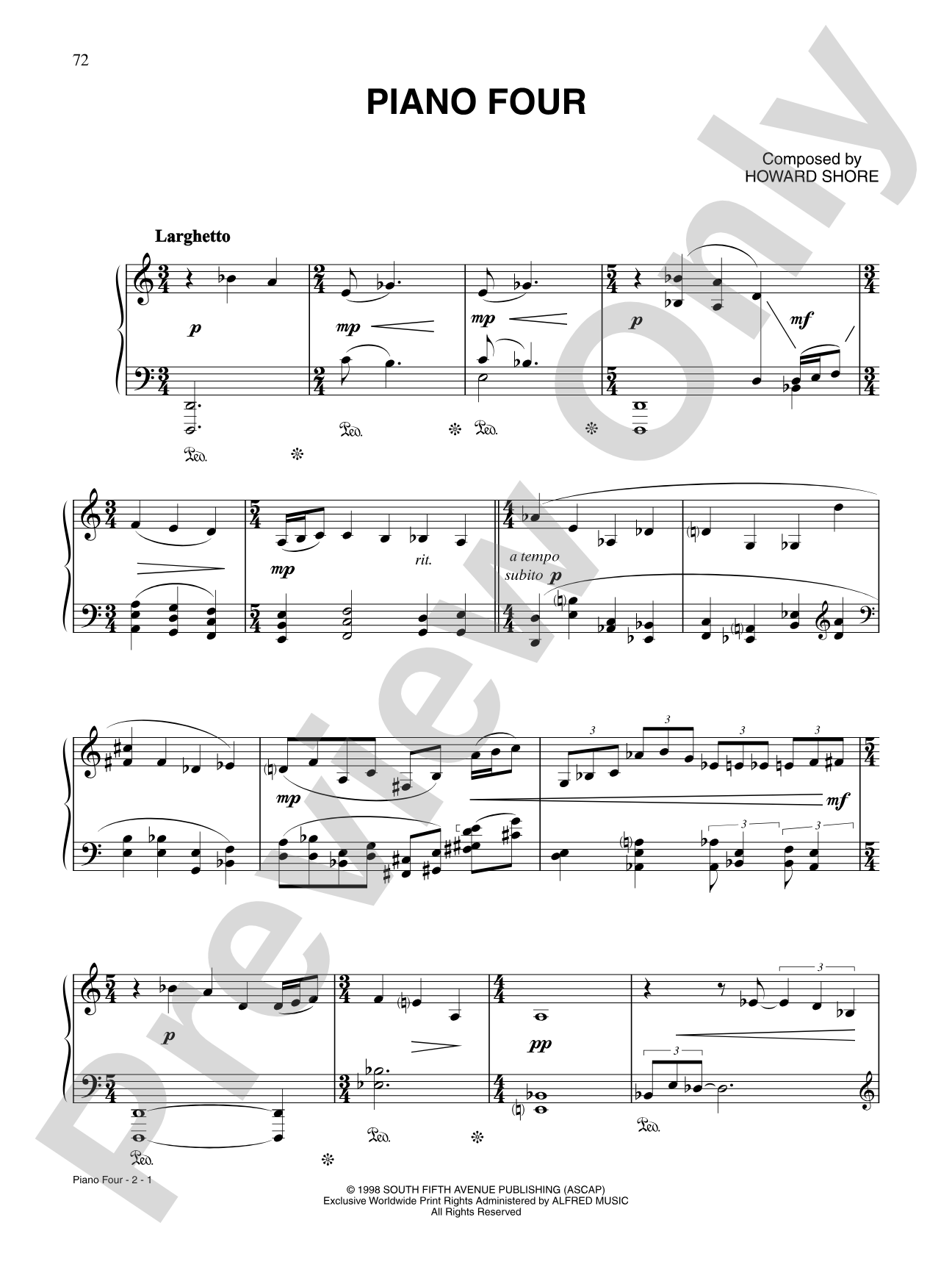

Piano Four: Piano
Composed by Howard Shore
Item: 00-PS-0015740
$4.99
Pickup currently not available
Related Items
Eclipse (All Yours): Piano/Vocal/Chords |
$4.99
|
View | |
Jacob's Theme: Piano |
$4.99
|
View | |
Portrait of John Doe: Piano |
$4.99
|
View | |
Portrait of Edie: Piano |
$4.99
|
View | |
Catania: Piano |
$4.99
|
View | |
Brooklyn Heights 3: Piano |
$4.99
|
View | |
Love Will Find Out the Way: Piano/Vocal/Chords |
$4.99
|
View | |
Dead Ringers (Main Title): Piano |
$4.99
|
View | |
Miss Spielrein: Piano |
$4.99
|
View | |
Richard, Duke of York: Piano/Vocal/Chords |
$5.99
|
View | |
Your Flesh: Piano/Vocal/Chords |
$5.99
|
View | |
The Shape of Rage: Piano |
$4.99
|
View | |
Birthday March: Piano/Vocal/Chords |
$4.99
|
View | |
Beyond the Forest: Piano/Vocal/Chords |
$5.99
|
View | |
The Dream: Piano/Vocal/Chords |
$5.99
|
View | |
The Howard Shore Collection, Volume 2: Piano/Vocal/Chords Book |
$19.99
|
View |
Description
Academy Award®-winner Howard Shore is best known for his elegant and eclectic film scores, including the soundtracks for Peter Jackson's The Lord of the Rings and The Hobbit trilogies. This collection features faithful arrangements of some of the best known titles by this brilliant composer. Titles: Birthday March (Big) * Brooklyn Heights 3 (Gangs of New York) * Calliope (Big) * Catania * Coeur Volant (Hugo) * Dead Ringers (Main Title) (Dead Ringers) * The Dream (from the opera The Fly) * Dreaming of Bag End (The Hobbit: An Unexpected Journey) * The Dwarf Lords (The Hobbit: An Unexpected Journey) * Eclipse (All Yours) (The Twilight Saga: Eclipse) * The End of All Things (The Lord of the Rings: The Return of the King) * Erebor (The Hobbit: An Unexpected Journey) * Jacob's Theme (The Twilight Saga: Eclipse) * Love Will Find Out the Way (Spider) * Miss Spielrein (A Dangerous Method) * Piano Four * Portrait of Edie (A History of Violence) * Portrait of John Doe (Se7en) * Richard, Duke of York (Looking for Richard) * The Shape of Rage (The Brood) * The Thief (Hugo) * Your Flesh (from the opera The Fly) * Zoltar (Big).


Piano Four: Piano isn't in MakeMusic Cloud just yet...but it could be. Let us know you'd like to see it, and you'll help shape what comes next. In the meantime, start a free trial and dive into thousands of interactive titles your students can play along with today.
Request This Title
Tell us you want it.
Start Your Free Trial
Explore everything that's ready to play right now.
Sample Audio
No sample audio found.
Sample Video
No sample videos found.
Additional Details
Publisher:
Alfred Music
Page Count:
112
SKU:
00-PS-0015740
More about this title
About the Composer: Howard Shore
Howard Shore has composed scores for over 100 films across five decades, earning three Academy Awards for his work on Peter Jackson's The Lord of the Rings trilogy. His compositional voice blends orchestral sophistication with memorable melodic lines, a skill he developed early through his work in television and progressive rock before establishing himself as one of cinema's most prolific and respected film composers.
Beyond his blockbuster franchises, Shore has written for intimate character studies and horror films, demonstrating a rare range. His operatic works, including The Fly and Sweeney Todd, showcase his ability to craft dramatic vocal writing. This versatility makes his catalog especially rich for arrangers seeking material that spans emotional registers and musical styles.
Why we love this
This collection captures Shore's gift for creating themes that live equally well in intimate piano settings as they do in full orchestral contexts. The range here is remarkable: from the whimsical "Calliope" to the haunting "The End of All Things," these arrangements preserve the emotional architecture of their film origins while giving pianists and singers genuine musicmaking opportunities. The inclusion of material from his operatic work alongside his most iconic film themes makes this a genuinely eclectic resource that rewards repeated exploration.
What to expect
These pieces carry the weight of cinematic storytelling into the piano. Whether you're exploring the misty introspection of Middle Earth or the psychological tension of a thriller, Shore's harmonic language pulls you into specific emotional landscapes. The collection feels like opening a book of film stills accompanied by the music that made them unforgettable.
Who it's for
Pianists and singers seeking film music that values musicality over entertainment spectacle will find this collection substantial and rewarding. It serves intermediate to advanced players and vocalists looking to expand their recital repertoire with contemporary material that resonates with general audiences without sacrificing artistic integrity.
How to get the most out of it
- Study the film scenes these themes accompany before performing; Shore's melodies were written to underscore specific emotional beats, and understanding that context deepens your interpretive choices.
- Balance lyricism with harmonic clarity in the arrangements. Shore's chord progressions often carry as much weight as the melody, so avoid letting accompaniment figures fade into the background.
- When performing vocal selections, approach them as character studies. Titles like "Portrait of Edie" and "Portrait of John Doe" suggest intimate character moments rather than grand vocal display.
- Respect the silences and sparse passages in these pieces. Shore frequently uses space as a compositional tool, and resisting the urge to fill every moment creates the architecture his music requires.
How to use it
Program individual selections as curated "film score interludes" within a recital, using them to create thematic bridges between classical and contemporary works. The variety here makes it possible to build a full solo or piano-vocal recital around Shore's catalog, or to select single pieces for concert programs that welcome crossover material.
Skills your students will build
- Reading and interpreting film-derived harmonic progressions
- Balancing melody with accompaniment in vocal-piano textures
- Sustaining emotional narrative across longer form arrangements
- Navigating modal and chromatic harmony typical of contemporary film scores
- Collaborating effectively between vocalist and pianist in duo repertoire