
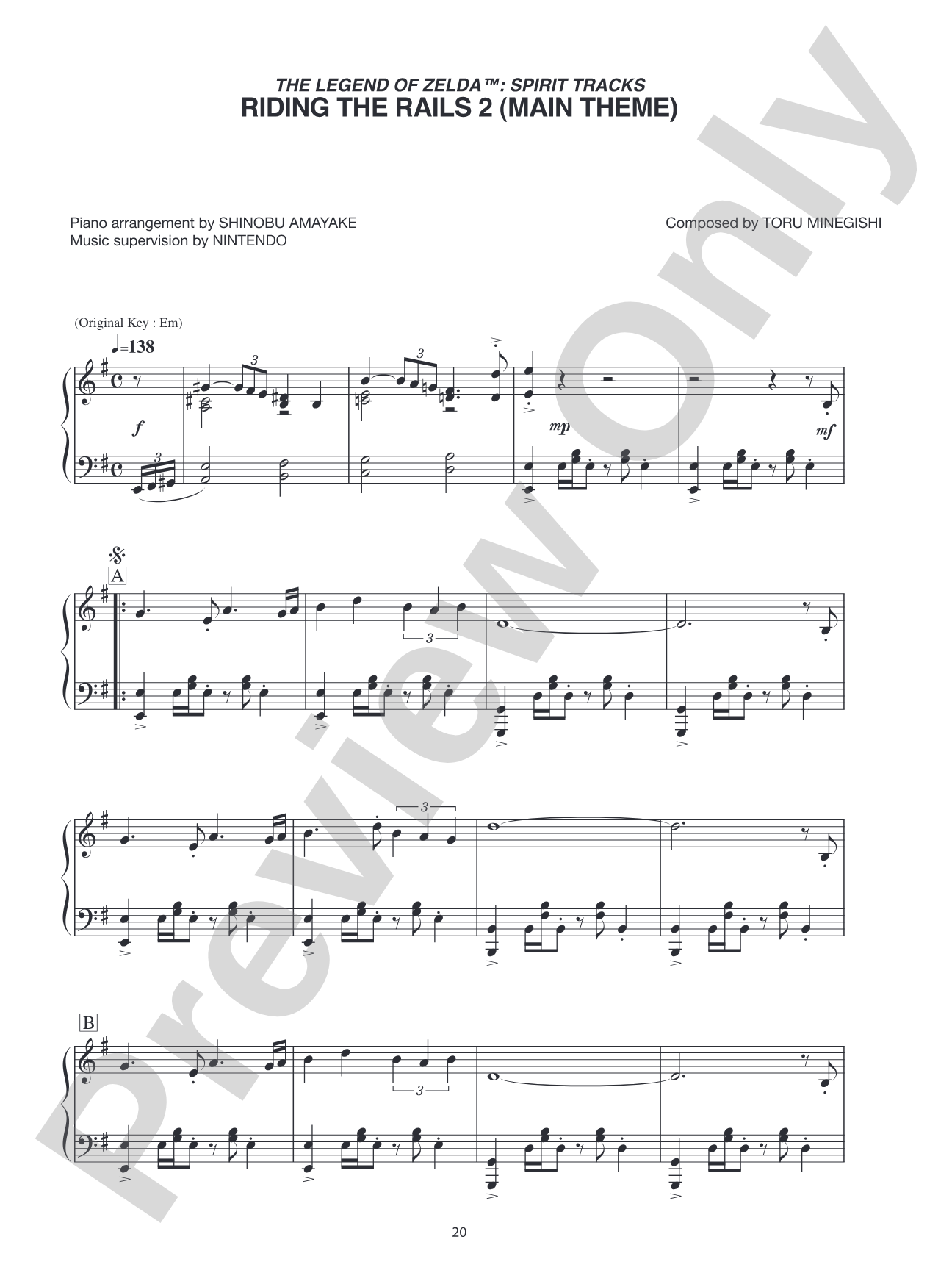

The Legend of Zelda™: Spirit Tracks Riding the Rails 2: Piano
Composed by Koji Kondo, Tominaga Mao, Toru Minegishi, and Asuka Ota
Level: Intermediate / Advanced
Item: 00-PS-0015450
$4.99
One moment…
Related Items
The Legend of Zelda™: Spirit Tracks Title Theme: Piano |
$4.99
|
View | |
The Legend of Zelda™: Spirit Tracks Aboda Village: Piano |
$4.99
|
View | |
The Legend of Zelda™: Spirit Tracks Chancellor Coles Theme: Piano |
$4.99
|
View | |
The Legend of Zelda™: Spirit Tracks Hyrule Castle: Piano |
$4.99
|
View | |
The Legend of Zelda™: Spirit Tracks Princess Zeldas Theme: Piano |
$4.99
|
View | |
The Legend of Zelda™: Spirit Tracks The Battle: Piano |
$4.99
|
View | |
The Legend of Zelda™: Spirit Tracks Anjeans Theme: Piano |
$4.99
|
View | |
The Legend of Zelda™: Spirit Tracks Adventuring: Piano |
$4.99
|
View | |
The Legend of Zelda™: Spirit Tracks The Tower of Spirits: Piano |
$4.99
|
View | |
The Legend of Zelda™: Spirit Tracks Linebecks Theme: Piano |
$4.99
|
View | |
The Legend of Zelda™: Spirit Tracks Byrnes Theme: Piano |
$4.99
|
View | |
The Legend of Zelda™: Spirit Tracks Seabed: Piano |
$4.99
|
View | |
The Legend of Zelda™: Spirit Tracks Hero of the Tracks: Piano |
$4.99
|
View | |
The Legend of Zelda™: Spirit Tracks Fighting: Piano |
$4.99
|
View | |
The Legend of Zelda™: Spirit Tracks Song of Awakening: Piano |
$4.99
|
View | |
The Legend of Zelda™: Spirit Tracks Song of Healing: Piano |
$4.99
|
View | |
The Legend of Zelda™: Spirit Tracks Song of Discovery: Piano |
$4.99
|
View | |
The Legend of Zelda™: Spirit Tracks Song of Birds: Piano |
$4.99
|
View | |
The Legend of Zelda™: Spirit Tracks Song of Light: Piano |
$4.99
|
View | |
The Legend of Zelda™: Spirit Tracks Fanfare of the Spirit Tracks: Piano |
$4.99
|
View | |
The Legend of Zelda™: Spirit Tracks Game Over: Piano |
$4.99
|
View |
Description
The soundtrack to Nintendo's The Legend of Zelda™: Spirit Tracks is packed with melodic, note-for-note transcriptions that sound great on the piano! With this officially licensed sheet music collection, intermediate to advanced pianists can dazzle friends and family by playing 22 themes from the popular video game. Titles: Title Theme * Aboda Village * Hyrule Castle * Anjean's Theme * Princess Zelda's Theme * The Tower of Spirits * Chancellor Cole's Theme * Riding the Rails 2 (Main Theme) * Seabed * The Battle * Adventuring * Linebeck's Theme * Byrne's Theme * Hero of the Tracks * Fighting * Song of Awakening * Song of Healing * Song of Discovery * Song of Birds * Song of Light * Fanfare of the Spirit Tracks * Game Over.


The Legend of Zelda™: Spirit Tracks Riding the Rails 2: Piano isn't in MakeMusic Cloud just yet...but it could be. Let us know you'd like to see it, and you'll help shape what comes next. In the meantime, start a free trial and dive into thousands of interactive titles your students can play along with today.
Request This Title
Tell us you want it.
Start Your Free Trial
Explore everything that's ready to play right now.
Sample Audio
No sample audio found.
Sample Video
No sample videos found.
Additional Details
Publisher:
Alfred Music
Page Count:
40
SKU:
00-PS-0015450
More about this title
About the Composer: Toru Minegishi
Toru Minegishi is a video game composer known for his work on the Legend of Zelda franchise, where he has crafted memorable orchestral and instrumental themes that balance melodic accessibility with harmonic depth. His music for Spirit Tracks demonstrates his skill at writing themes that work equally well in their original form and in solo instrumental arrangements, making his compositions natural candidates for sheet music transcription.
Why we love this
The character themes here are genuinely singable and pianistic, with clear harmonic progressions that intermediate pianists can grasp even as they navigate the intermediate-advanced technical demands. Twenty-two tracks from a beloved game gives you flexibility to program a single recital piece or build a thematic video game concert around a recognizable narrative arc, and the official Nintendo licensing guarantees accurate, playable transcriptions rather than fan recreations.
What to expect
A journey through a richly imagined world rendered in keyboard color. The themes range from intimate character moments (Anjean's Theme, Linebeck's Theme) to sweeping environmental passages (Seabed, The Tower of Spirits), with moments of action (The Battle) and reflection (the healing and discovery songs) that create a satisfying emotional arc when performed in sequence.
Who it's for
Intermediate to advanced pianists who want repertoire that feels fresh and contemporary, or students motivated by a soundtrack they already know and love. This collection also works well for pianists seeking programming material that allows them to showcase technical facility and musicality without requiring orchestral knowledge.
How to get the most out of it
- Treat the recurring themes (the three Songs) as studies in tempo and character variation; each appears in a different context, so use dynamics and pedaling to shift their emotional weight.
- Balance melodic clarity with accompaniment texture in tracks like Princess Zelda's Theme, where the right hand often carries a lyrical line over a fuller left-hand arrangement.
- Build stamina through the more propulsive pieces (The Battle, Fighting, Hero of the Tracks) by establishing a steady internal pulse before adding interpretive rubato.
- Use the fanfare and game-over cues as breathers in a larger program; their brevity makes them effective transition pieces between longer, more demanding movements.
How to use it
Program one or two standout themes as part of a recital focused on contemporary and popular music, or use a suite of four to six contrasting pieces to create a thematic intermission. The collection's breadth also makes it useful for students exploring different compositional approaches in a single composer's catalog.
Skills your students will build
- Pedaling for textural clarity and harmonic resonance across changing dynamics
- Balancing melodic voice independence in arrangements with complex left-hand accompaniment
- Interpretive choices around tempo, phrasing, and character in music with familiar emotional associations
- Sight-reading longer passages of moderate rhythmic and technical density
- Sustaining focus and technical control across extended recital programs