
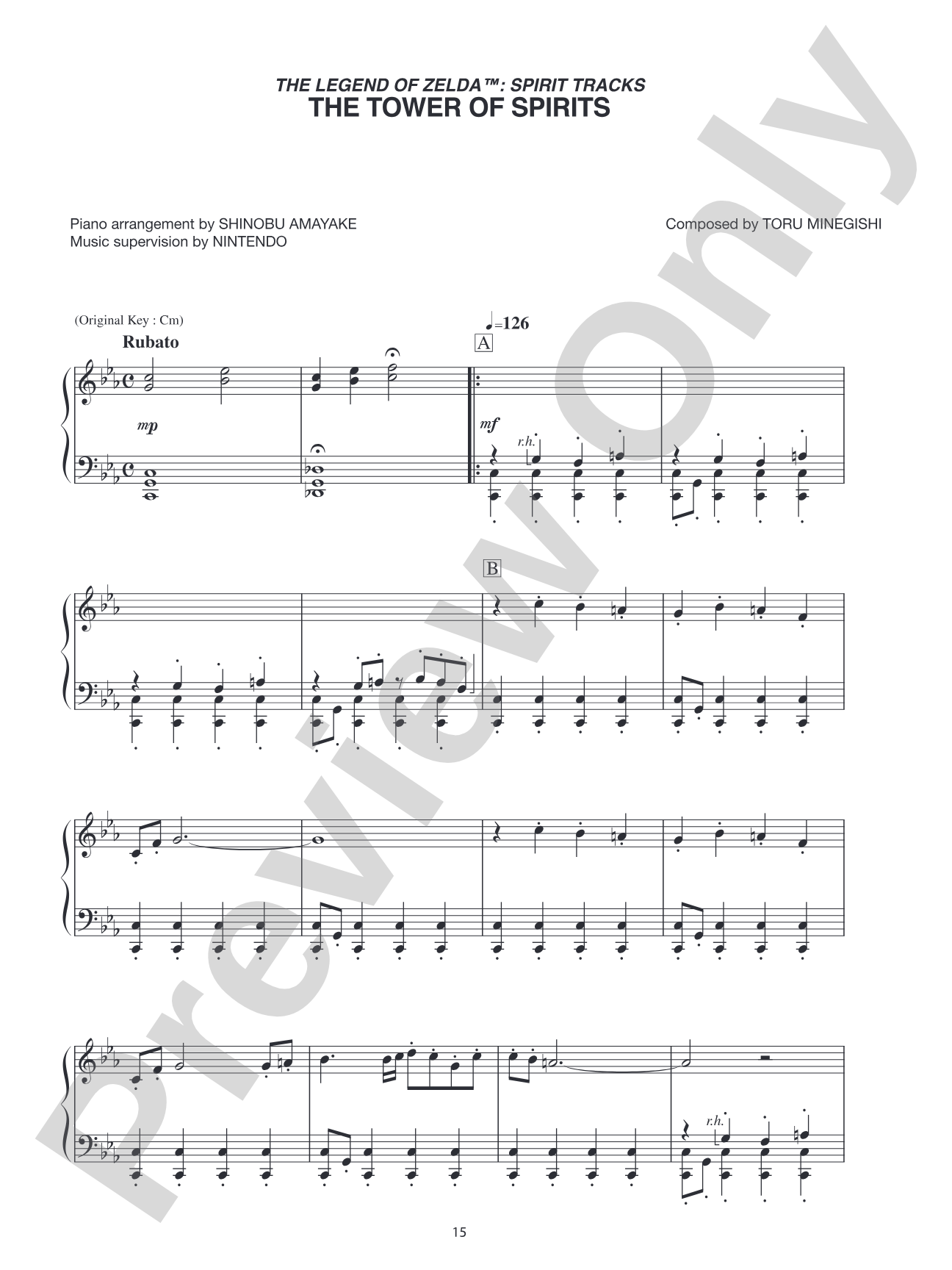

The Legend of Zelda™: Spirit Tracks The Tower of Spirits: Piano
Composed by Koji Kondo, Tominaga Mao, Toru Minegishi, and Asuka Ota
Level: Intermediate / Advanced
Item: 00-PS-0015449
$4.99
One moment…
Related Items
The Legend of Zelda™: Spirit Tracks Title Theme: Piano |
$4.99
|
View | |
The Legend of Zelda™: Spirit Tracks Aboda Village: Piano |
$4.99
|
View | |
The Legend of Zelda™: Spirit Tracks Chancellor Coles Theme: Piano |
$4.99
|
View | |
The Legend of Zelda™: Spirit Tracks Hyrule Castle: Piano |
$4.99
|
View | |
The Legend of Zelda™: Spirit Tracks Princess Zeldas Theme: Piano |
$4.99
|
View | |
The Legend of Zelda™: Spirit Tracks The Battle: Piano |
$4.99
|
View | |
The Legend of Zelda™: Spirit Tracks Anjeans Theme: Piano |
$4.99
|
View | |
The Legend of Zelda™: Spirit Tracks Adventuring: Piano |
$4.99
|
View | |
The Legend of Zelda™: Spirit Tracks Riding the Rails 2: Piano |
$4.99
|
View | |
The Legend of Zelda™: Spirit Tracks Linebecks Theme: Piano |
$4.99
|
View | |
The Legend of Zelda™: Spirit Tracks Byrnes Theme: Piano |
$4.99
|
View | |
The Legend of Zelda™: Spirit Tracks Seabed: Piano |
$4.99
|
View | |
The Legend of Zelda™: Spirit Tracks Hero of the Tracks: Piano |
$4.99
|
View | |
The Legend of Zelda™: Spirit Tracks Fighting: Piano |
$4.99
|
View | |
The Legend of Zelda™: Spirit Tracks Song of Awakening: Piano |
$4.99
|
View | |
The Legend of Zelda™: Spirit Tracks Song of Healing: Piano |
$4.99
|
View | |
The Legend of Zelda™: Spirit Tracks Song of Discovery: Piano |
$4.99
|
View | |
The Legend of Zelda™: Spirit Tracks Song of Birds: Piano |
$4.99
|
View | |
The Legend of Zelda™: Spirit Tracks Song of Light: Piano |
$4.99
|
View | |
The Legend of Zelda™: Spirit Tracks Fanfare of the Spirit Tracks: Piano |
$4.99
|
View | |
The Legend of Zelda™: Spirit Tracks Game Over: Piano |
$4.99
|
View |
Description
The soundtrack to Nintendo's The Legend of Zelda™: Spirit Tracks is packed with melodic, note-for-note transcriptions that sound great on the piano! With this officially licensed sheet music collection, intermediate to advanced pianists can dazzle friends and family by playing 22 themes from the popular video game. Titles: Title Theme * Aboda Village * Hyrule Castle * Anjean's Theme * Princess Zelda's Theme * The Tower of Spirits * Chancellor Cole's Theme * Riding the Rails 2 (Main Theme) * Seabed * The Battle * Adventuring * Linebeck's Theme * Byrne's Theme * Hero of the Tracks * Fighting * Song of Awakening * Song of Healing * Song of Discovery * Song of Birds * Song of Light * Fanfare of the Spirit Tracks * Game Over.


Discover MakeMusic Cloud: thousands of interactive titles your students can play along with today.
Sample Audio
No sample audio found.
Sample Video
No sample videos found.
Additional Details
Publisher:
Alfred Music
Page Count:
40
SKU:
00-PS-0015449
More about this title
About the Composer: Toru Minegishi
Toru Minegishi has composed music for Nintendo games across multiple decades, bringing melodic sophistication and emotional depth to interactive storytelling. His work on The Legend of Zelda series demonstrates a gift for crafting memorable themes that serve both gameplay and narrative, making his compositions ideal material for pianists seeking music that rewards careful interpretation.
Why we love this
These transcriptions honor the original compositions while giving intermediate-advanced pianists immediate access to music they already know and love. The 22-track collection provides enough variety to sustain engagement across a full practice season, and the melodic clarity of Minegishi's writing means rewarding performances emerge even during early rehearsals.
What to expect
These themes balance the whimsy and adventure of the Spirit Tracks setting with moments of genuine emotional weight. You'll move from the rhythmic momentum of train-based themes to quieter, introspective passages that demand sensitive touch work, creating a satisfying arc across your practice.
Who it's for
Intermediate to advanced pianists who want to expand their recital repertoire with music that excites both performer and audience. Students and adult learners already familiar with the game will find motivation in recognizable material, while pianists new to these themes will discover well-crafted melodies that sit naturally under the hands.
How to get the most out of it
- Study the original soundtrack alongside the sheet music to internalize the harmonic color and pacing; the piano arrangement preserves the emotional arc of each theme, and your interpretation will deepen when you remember its context in the game.
- Balance technical precision with narrative phrasing. These melodies are storytelling devices first, so shape phrases around the themes' emotional peaks rather than treating rhythmic figures as mere technical hurdles.
- Explore dynamic contrast within single phrases. The arrangement often doubles melody lines in the left hand or inner voices; bringing out these counter-melodies enriches texture and prevents long sections from sounding monochromatic.
- Use the full range of the keyboard. Several themes span multiple octaves; commit to smooth transitions across register changes so melodic continuity remains clear even when moving between treble and bass.
How to use it
A recital centered on video game music allows you to program shorter, contrasting pieces without resorting to miniatures from the classical canon. Pair selections from this collection with orchestral or chamber arrangements of other game soundtracks for a cohesive thematic concert, or intersperse individual themes throughout a longer program as appealing interludes between traditional classical works.
Skills your students will build
- Voice leading across multiple registers
- Harmonic analysis of functional versus modal progressions
- Sight-reading extended-range piano textures
- Pedal technique for sustained harmonic color
- Phrasing and interpretation of melody-driven composition
- Tempo flexibility and rhythmic clarity in accompaniment patterns