
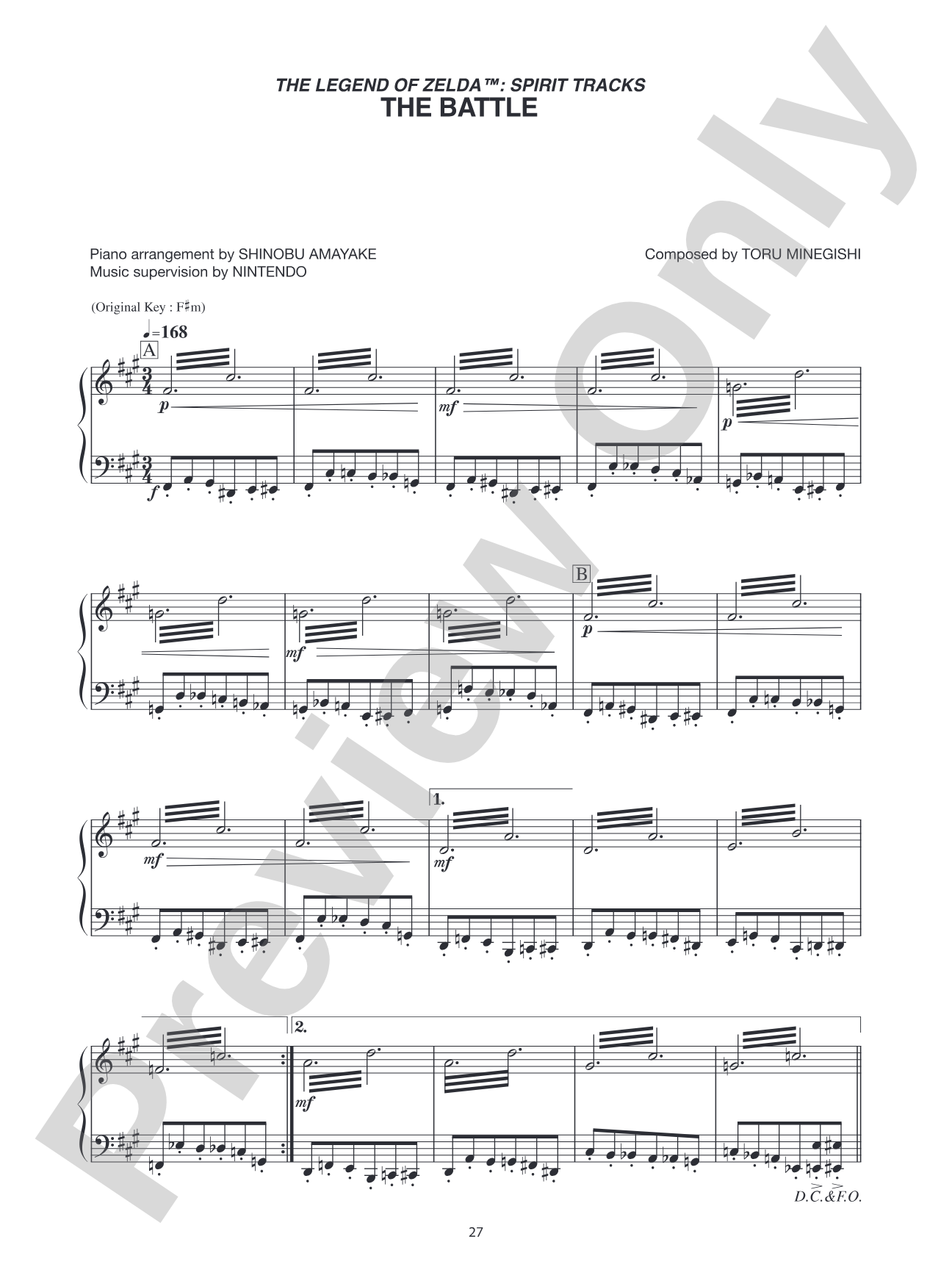

The Legend of Zelda™: Spirit Tracks The Battle: Piano
Composed by Koji Kondo, Tominaga Mao, Toru Minegishi, and Asuka Ota
Level: Intermediate / Advanced
Item: 00-PS-0015446
$4.99
One moment…
Related Items
The Legend of Zelda™: Spirit Tracks Title Theme: Piano |
$4.99
|
View | |
The Legend of Zelda™: Spirit Tracks Aboda Village: Piano |
$4.99
|
View | |
The Legend of Zelda™: Spirit Tracks Chancellor Coles Theme: Piano |
$4.99
|
View | |
The Legend of Zelda™: Spirit Tracks Hyrule Castle: Piano |
$4.99
|
View | |
The Legend of Zelda™: Spirit Tracks Princess Zeldas Theme: Piano |
$4.99
|
View | |
The Legend of Zelda™: Spirit Tracks Anjeans Theme: Piano |
$4.99
|
View | |
The Legend of Zelda™: Spirit Tracks Adventuring: Piano |
$4.99
|
View | |
The Legend of Zelda™: Spirit Tracks The Tower of Spirits: Piano |
$4.99
|
View | |
The Legend of Zelda™: Spirit Tracks Riding the Rails 2: Piano |
$4.99
|
View | |
The Legend of Zelda™: Spirit Tracks Linebecks Theme: Piano |
$4.99
|
View | |
The Legend of Zelda™: Spirit Tracks Byrnes Theme: Piano |
$4.99
|
View | |
The Legend of Zelda™: Spirit Tracks Seabed: Piano |
$4.99
|
View | |
The Legend of Zelda™: Spirit Tracks Hero of the Tracks: Piano |
$4.99
|
View | |
The Legend of Zelda™: Spirit Tracks Fighting: Piano |
$4.99
|
View | |
The Legend of Zelda™: Spirit Tracks Song of Awakening: Piano |
$4.99
|
View | |
The Legend of Zelda™: Spirit Tracks Song of Healing: Piano |
$4.99
|
View | |
The Legend of Zelda™: Spirit Tracks Song of Discovery: Piano |
$4.99
|
View | |
The Legend of Zelda™: Spirit Tracks Song of Birds: Piano |
$4.99
|
View | |
The Legend of Zelda™: Spirit Tracks Song of Light: Piano |
$4.99
|
View | |
The Legend of Zelda™: Spirit Tracks Fanfare of the Spirit Tracks: Piano |
$4.99
|
View | |
The Legend of Zelda™: Spirit Tracks Game Over: Piano |
$4.99
|
View |
Description
The soundtrack to Nintendo's The Legend of Zelda™: Spirit Tracks is packed with melodic, note-for-note transcriptions that sound great on the piano! With this officially licensed sheet music collection, intermediate to advanced pianists can dazzle friends and family by playing 22 themes from the popular video game. Titles: Title Theme * Aboda Village * Hyrule Castle * Anjean's Theme * Princess Zelda's Theme * The Tower of Spirits * Chancellor Cole's Theme * Riding the Rails 2 (Main Theme) * Seabed * The Battle * Adventuring * Linebeck's Theme * Byrne's Theme * Hero of the Tracks * Fighting * Song of Awakening * Song of Healing * Song of Discovery * Song of Birds * Song of Light * Fanfare of the Spirit Tracks * Game Over.


Discover MakeMusic Cloud: thousands of interactive titles your students can play along with today.
Sample Audio
No sample audio found.
Sample Video
No sample videos found.
Additional Details
Publisher:
Alfred Music
Page Count:
40
SKU:
00-PS-0015446
More about this title
About the Composer: Toru Minegishi
Toru Minegishi has been a core composer for Nintendo since the early 2000s, crafting music for major franchises including The Legend of Zelda, Kirby, and Fire Emblem. His work demonstrates a gift for melodic writing that serves narrative and gameplay simultaneously, creating themes that are immediately recognizable yet structurally rich enough to reward close listening and repeated playthrough.
Minegishi's approach to video game composition balances accessibility with musical sophistication. His melodies sit naturally under the fingers, his harmonic progressions support thematic development, and his orchestral intuition translates effectively to solo piano, making his work particularly valuable for pianists seeking contemporary repertoire that connects to broader popular culture.
Why we love this
These transcriptions preserve Minegishi's gift for memorable melody while presenting genuine intermediate to advanced technical challenges. The collection spans dramatic battle music, introspective character themes, and triumphant fanfares, giving pianists substantial material to explore different moods and technical approaches within a single, cohesive score.
What to expect
The music shifts between rousing adventure and intimate character study. Battle themes surge with driving rhythms and dramatic harmonic movement, while character pieces offer lyrical melody lines and introspective harmonic color. Throughout, Minegishi's gift for singable, memorable writing makes every piece feel both approachable and rewarding to perform.
Who it's for
Intermediate to advanced pianists who want contemporary, engaging repertoire with recognizable melodies and real technical substance. This collection appeals to game music enthusiasts, pianists seeking accessible but musically sophisticated transcriptions, and performers who want pieces that resonate with audiences beyond traditional classical concert halls.
How to get the most out of it
- Study the thematic relationships between tracks. Several pieces share melodic DNA or harmonic language; recognizing these connections deepens your understanding of the score's architecture and enriches phrasing choices.
- Balance the orchestral layering in your mind. These are transcriptions, not original piano compositions, so identifying which lines carry melody, harmony, and inner voice detail helps you voice chords transparently and maintain clarity across registers.
- Use the video game context as a performance tool. Watching brief gameplay clips or cutscenes before learning a theme informs tempo choices, emotional weight, and interpretive decisions that extend beyond the notation.
- Layer repetition into your practice strategy. Many pieces use repeated sections; learn them well enough to add subtle variation on repeats rather than playing them identically, which maintains listener interest across the collection.
How to use it
Program individual pieces as standalone recital selections or weave several thematic tracks into a thematic concert exploring music for different game scenarios. The collection works particularly well for studio recitals where diverse audiences appreciate connection between music, narrative, and contemporary culture, or as a closing concert item that acknowledges students' broader musical interests.
Skills your students will build
- Voicing chords idiomatically for piano based on orchestral source material
- Managing hand crossing and register shifts in transcribed orchestral textures
- Building narrative arc within short thematic pieces
- Executing rapid figuration passages with clarity and control
- Sustaining lyrical phrasing across longer melodic lines