
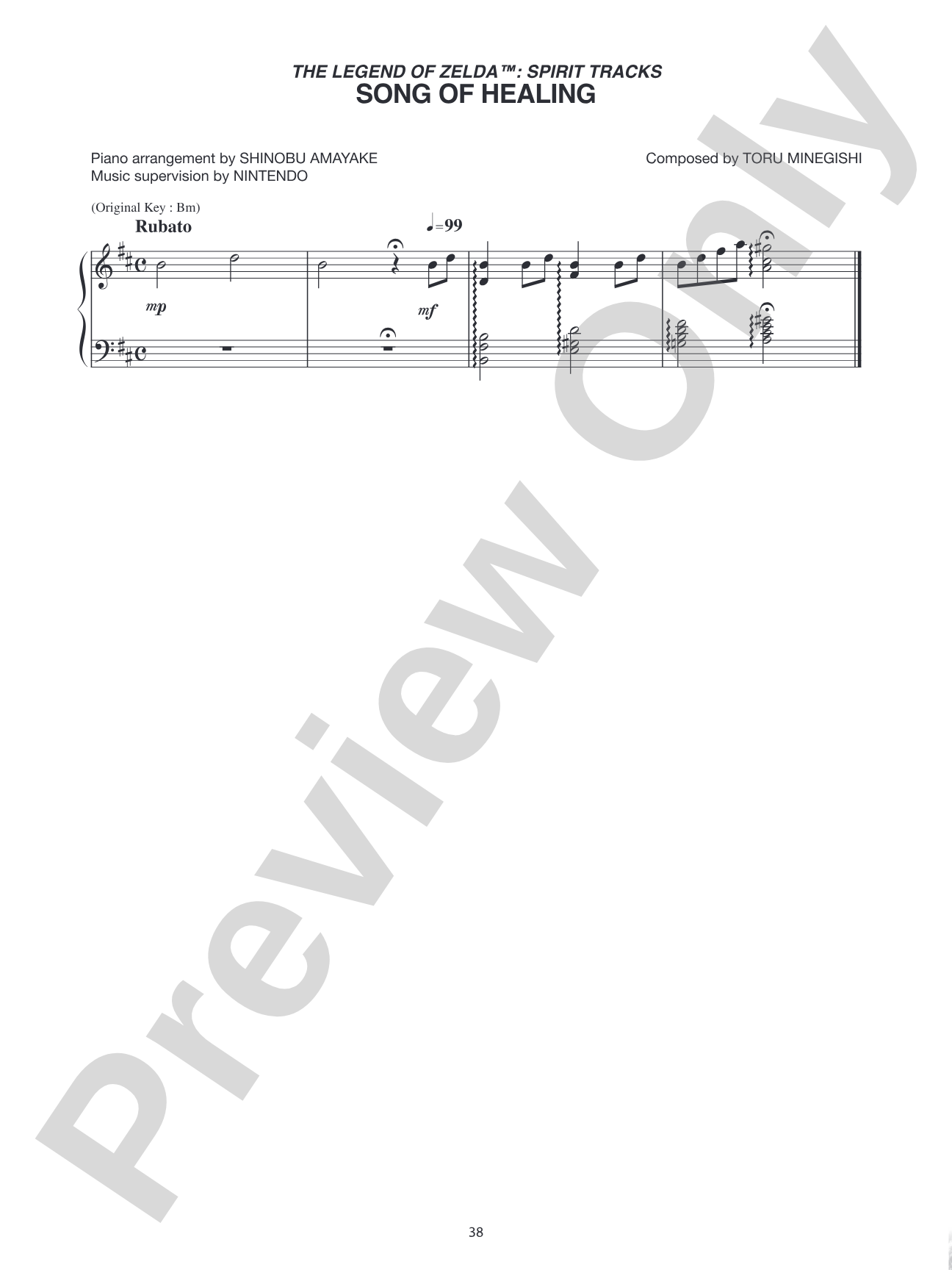

The Legend of Zelda™: Spirit Tracks Song of Healing: Piano
Composed by Koji Kondo, Tominaga Mao, Toru Minegishi, and Asuka Ota
Level: Intermediate / Advanced
Item: 00-PS-0015457
$4.99
One moment…
Related Items
The Legend of Zelda™: Spirit Tracks Title Theme: Piano |
$4.99
|
View | |
The Legend of Zelda™: Spirit Tracks Aboda Village: Piano |
$4.99
|
View | |
The Legend of Zelda™: Spirit Tracks Chancellor Coles Theme: Piano |
$4.99
|
View | |
The Legend of Zelda™: Spirit Tracks Hyrule Castle: Piano |
$4.99
|
View | |
The Legend of Zelda™: Spirit Tracks Princess Zeldas Theme: Piano |
$4.99
|
View | |
The Legend of Zelda™: Spirit Tracks The Battle: Piano |
$4.99
|
View | |
The Legend of Zelda™: Spirit Tracks Anjeans Theme: Piano |
$4.99
|
View | |
The Legend of Zelda™: Spirit Tracks Adventuring: Piano |
$4.99
|
View | |
The Legend of Zelda™: Spirit Tracks The Tower of Spirits: Piano |
$4.99
|
View | |
The Legend of Zelda™: Spirit Tracks Riding the Rails 2: Piano |
$4.99
|
View | |
The Legend of Zelda™: Spirit Tracks Linebecks Theme: Piano |
$4.99
|
View | |
The Legend of Zelda™: Spirit Tracks Byrnes Theme: Piano |
$4.99
|
View | |
The Legend of Zelda™: Spirit Tracks Seabed: Piano |
$4.99
|
View | |
The Legend of Zelda™: Spirit Tracks Hero of the Tracks: Piano |
$4.99
|
View | |
The Legend of Zelda™: Spirit Tracks Fighting: Piano |
$4.99
|
View | |
The Legend of Zelda™: Spirit Tracks Song of Awakening: Piano |
$4.99
|
View | |
The Legend of Zelda™: Spirit Tracks Song of Discovery: Piano |
$4.99
|
View | |
The Legend of Zelda™: Spirit Tracks Song of Birds: Piano |
$4.99
|
View | |
The Legend of Zelda™: Spirit Tracks Song of Light: Piano |
$4.99
|
View | |
The Legend of Zelda™: Spirit Tracks Fanfare of the Spirit Tracks: Piano |
$4.99
|
View | |
The Legend of Zelda™: Spirit Tracks Game Over: Piano |
$4.99
|
View |
Description
The soundtrack to Nintendo's The Legend of Zelda™: Spirit Tracks is packed with melodic, note-for-note transcriptions that sound great on the piano! With this officially licensed sheet music collection, intermediate to advanced pianists can dazzle friends and family by playing 22 themes from the popular video game. Titles: Title Theme * Aboda Village * Hyrule Castle * Anjean's Theme * Princess Zelda's Theme * The Tower of Spirits * Chancellor Cole's Theme * Riding the Rails 2 (Main Theme) * Seabed * The Battle * Adventuring * Linebeck's Theme * Byrne's Theme * Hero of the Tracks * Fighting * Song of Awakening * Song of Healing * Song of Discovery * Song of Birds * Song of Light * Fanfare of the Spirit Tracks * Game Over.


Discover MakeMusic Cloud: thousands of interactive titles your students can play along with today.
Sample Audio
No sample audio found.
Sample Video
No sample videos found.
Additional Details
Publisher:
Alfred Music
Page Count:
40
SKU:
00-PS-0015457
More about this title
About the Composer: Toru Minegishi
Toru Minegishi has served as a lead composer for Nintendo's game music department, crafting scores for major franchises across multiple console generations. His work on The Legend of Zelda series demonstrates a sophisticated approach to leitmotif development and thematic orchestration, skills that translate powerfully to solo piano arrangements.
Why we love this
These transcriptions capture the harmonic sophistication and emotional range of the Spirit Tracks soundtrack without oversimplifying the original orchestral writing. The collection balances melody-forward pieces like "Song of Healing" with rhythmically engaging themes such as "Riding the Rails 2," giving pianists substantial musical material that feels substantial and rewarding to perform.
What to expect
This collection radiates the warmth and adventure characteristic of the Zelda universe. From the contemplative beauty of the healing and awakening songs to the kinetic energy of battle themes, these 22 pieces create a narrative arc that feels both familiar and fresh on the piano.
Who it's for
Intermediate to advanced pianists looking for engaging popular music that showcases technical growth and musical depth. Video game music enthusiasts and students seeking contemporary repertoire that connects to their interests outside the classical canon will find substantial material here.
How to get the most out of it
- Pay attention to the dynamic shape of each theme, especially in pieces like "Princess Zelda's Theme" where subtle crescendos and diminuendos define the character. Resist the urge to maintain a uniform volume.
- Approach the battle and action themes with clarity in your articulation. These pieces rely on precise rhythmic definition to capture the energy of their original context.
- Experiment with pedal usage to enhance the atmospheric quality of songs like "Seabed" and "The Tower of Spirits," where sustained harmonic colors strengthen the sense of place.
- Balance the melody with inner voices in pieces like "Anjean's Theme," where countermelodic lines contribute significantly to the overall texture.
How to use it
Feature individual themes in student recitals to demonstrate range across different moods and technical demands. The fanfare and battle pieces work well as standalone encores or as transitions between more traditional classical programming, inviting audiences to experience how video game music operates as genuine composition.
Skills your students will build
- Maintaining melodic clarity over varied harmonic accompaniment patterns
- Controlling dynamic contrast in thematic development across different musical styles
- Pedal technique for atmospheric effects in slower, impressionistic pieces
- Rhythmic precision in energetic and syncopated sections
- Stylistic flexibility moving between reflective, action-oriented, and fanfare-style writing