
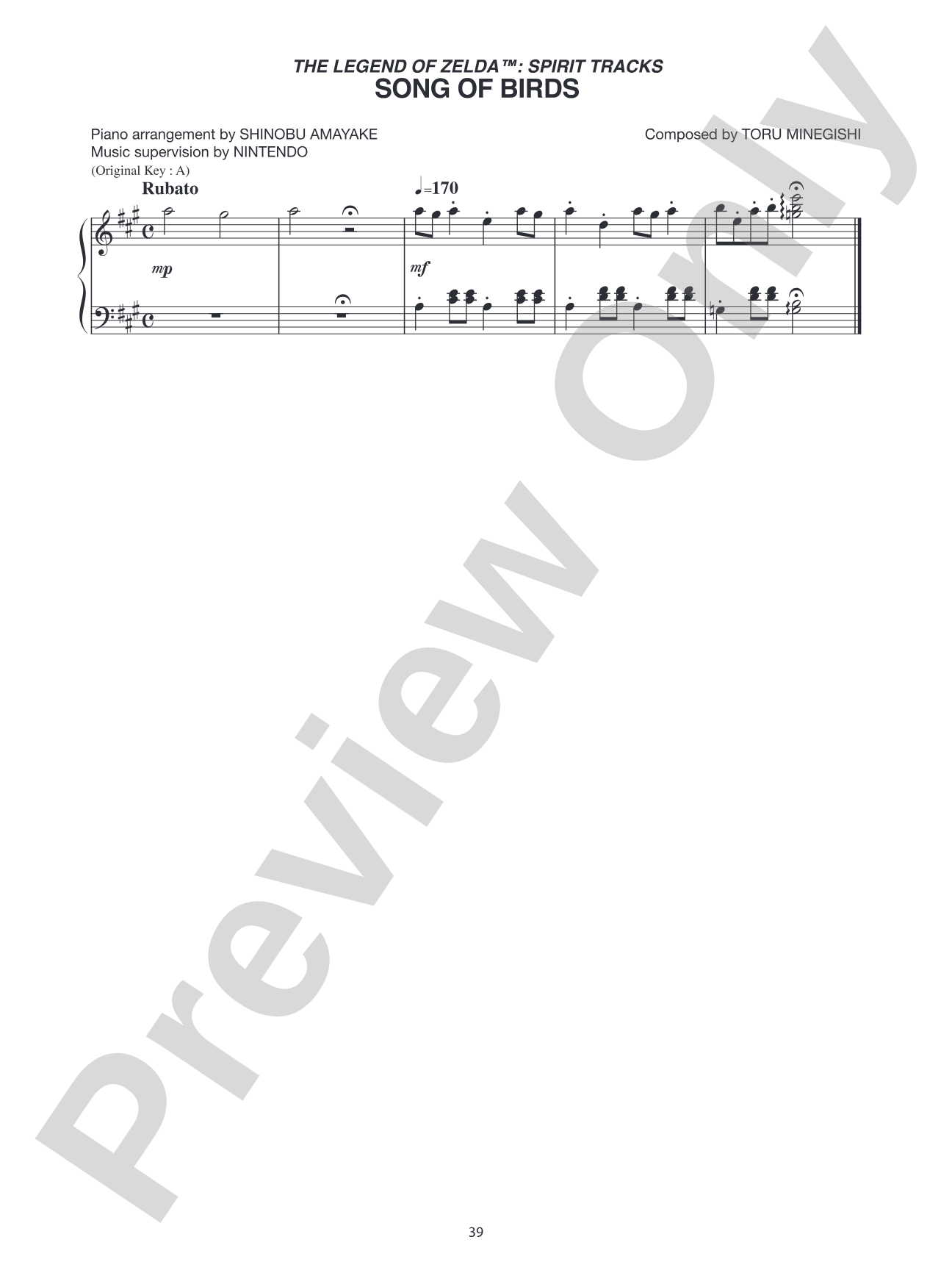

The Legend of Zelda™: Spirit Tracks Song of Birds: Piano
Composed by Koji Kondo, Tominaga Mao, Toru Minegishi, and Asuka Ota
Level: Intermediate / Advanced
Item: 00-PS-0015459
$4.99
One moment…
Related Items
The Legend of Zelda™: Spirit Tracks Title Theme: Piano |
$4.99
|
View | |
The Legend of Zelda™: Spirit Tracks Aboda Village: Piano |
$4.99
|
View | |
The Legend of Zelda™: Spirit Tracks Chancellor Coles Theme: Piano |
$4.99
|
View | |
The Legend of Zelda™: Spirit Tracks Hyrule Castle: Piano |
$4.99
|
View | |
The Legend of Zelda™: Spirit Tracks Princess Zeldas Theme: Piano |
$4.99
|
View | |
The Legend of Zelda™: Spirit Tracks The Battle: Piano |
$4.99
|
View | |
The Legend of Zelda™: Spirit Tracks Anjeans Theme: Piano |
$4.99
|
View | |
The Legend of Zelda™: Spirit Tracks Adventuring: Piano |
$4.99
|
View | |
The Legend of Zelda™: Spirit Tracks The Tower of Spirits: Piano |
$4.99
|
View | |
The Legend of Zelda™: Spirit Tracks Riding the Rails 2: Piano |
$4.99
|
View | |
The Legend of Zelda™: Spirit Tracks Linebecks Theme: Piano |
$4.99
|
View | |
The Legend of Zelda™: Spirit Tracks Byrnes Theme: Piano |
$4.99
|
View | |
The Legend of Zelda™: Spirit Tracks Seabed: Piano |
$4.99
|
View | |
The Legend of Zelda™: Spirit Tracks Hero of the Tracks: Piano |
$4.99
|
View | |
The Legend of Zelda™: Spirit Tracks Fighting: Piano |
$4.99
|
View | |
The Legend of Zelda™: Spirit Tracks Song of Awakening: Piano |
$4.99
|
View | |
The Legend of Zelda™: Spirit Tracks Song of Healing: Piano |
$4.99
|
View | |
The Legend of Zelda™: Spirit Tracks Song of Discovery: Piano |
$4.99
|
View | |
The Legend of Zelda™: Spirit Tracks Song of Light: Piano |
$4.99
|
View | |
The Legend of Zelda™: Spirit Tracks Fanfare of the Spirit Tracks: Piano |
$4.99
|
View | |
The Legend of Zelda™: Spirit Tracks Game Over: Piano |
$4.99
|
View |
Description
The soundtrack to Nintendo's The Legend of Zelda™: Spirit Tracks is packed with melodic, note-for-note transcriptions that sound great on the piano! With this officially licensed sheet music collection, intermediate to advanced pianists can dazzle friends and family by playing 22 themes from the popular video game. Titles: Title Theme * Aboda Village * Hyrule Castle * Anjean's Theme * Princess Zelda's Theme * The Tower of Spirits * Chancellor Cole's Theme * Riding the Rails 2 (Main Theme) * Seabed * The Battle * Adventuring * Linebeck's Theme * Byrne's Theme * Hero of the Tracks * Fighting * Song of Awakening * Song of Healing * Song of Discovery * Song of Birds * Song of Light * Fanfare of the Spirit Tracks * Game Over.


Discover MakeMusic Cloud: thousands of interactive titles your students can play along with today.
Sample Audio
No sample audio found.
Sample Video
No sample videos found.
Additional Details
Publisher:
Alfred Music
Page Count:
40
SKU:
00-PS-0015459
More about this title
About the Composer: Toru Minegishi
Toru Minegishi has composed music for Nintendo since the early 2000s, building a reputation for creating memorable, orchestral themes that enhance gameplay without overwhelming it. His work on The Legend of Zelda series demonstrates his ability to craft melodic lines that remain instantly recognizable while adapting to different musical styles and narrative moments.
Why we love this
These transcriptions capture the distinctive character of each theme while remaining idiomatically pianistic. The collection spans emotional range from contemplative village scenes to high-energy battle sequences, giving intermediate and advanced pianists meaningful material that audiences genuinely want to hear.
What to expect
These themes carry the spirit of adventure, mystery, and quiet reflection that defines the game. The music shifts from intimate character moments (Anjean's Theme, Chancellor Cole's Theme) to grand orchestral gestures (Hyrule Castle, The Tower of Spirits), creating a journey that feels epic even on a single instrument.
Who it's for
Intermediate to advanced pianists who want accessible yet musically substantial material beyond traditional classical repertoire. This collection works equally well for students seeking engaging recital pieces and for teachers building programs that reflect students' actual musical interests.
How to get the most out of it
- Pay attention to the harmonic movement underlying each melody. Minegishi often uses unexpected chord progressions that drive the emotional weight of a piece, so voicing these carefully will bring out the writing's sophistication.
- The battle and adventuring themes use rhythmic propulsion as their primary driver. Lock into the pulse early in rehearsal and maintain it consistently, letting the energy build naturally rather than forcing it.
- Several of the slower themes (Song of Healing, Song of Awakening) require patience with rubato. Resist rushing through the quiet passages; let the silence breathe and allow the melody room to resonate.
- Balance the melodic line against the accompaniment texture. In pieces like Hyrule Castle, the supporting material is intricate enough to obscure the main theme if the voicing isn't clear.
How to use it
Feature individual themes as recital pieces, or program a short suite of 3-4 contrasting selections to showcase the range within the collection. The material works particularly well in contexts where you're building bridges between classical traditions and contemporary musical culture.
Skills your students will build
- Sustained legato phrasing over extended harmonic changes
- Independence between hands in rhythmically layered accompaniment figures
- Dynamic contrast and emotional shaping in video game music context
- Pedal technique to sustain harmony without muddying rapid passagework
- Sight-reading and navigating larger formal structures (22 pieces, 40 pages)