
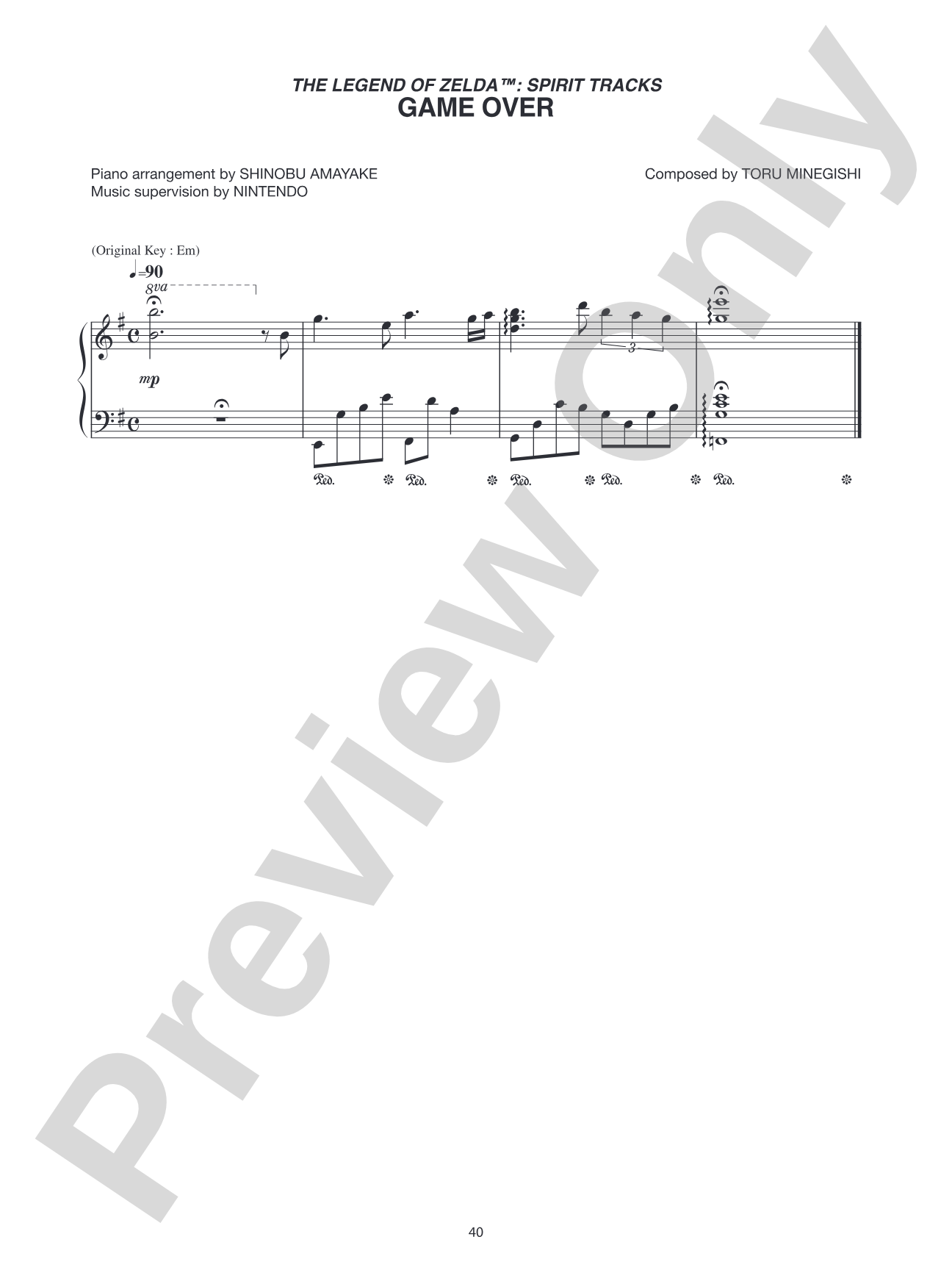

The Legend of Zelda™: Spirit Tracks Game Over: Piano
Composed by Koji Kondo, Tominaga Mao, Toru Minegishi, and Asuka Ota
Level: Intermediate / Advanced
Item: 00-PS-0015462
$4.99
One moment…
Related Items
The Legend of Zelda™: Spirit Tracks Title Theme: Piano |
$4.99
|
View | |
The Legend of Zelda™: Spirit Tracks Aboda Village: Piano |
$4.99
|
View | |
The Legend of Zelda™: Spirit Tracks Chancellor Coles Theme: Piano |
$4.99
|
View | |
The Legend of Zelda™: Spirit Tracks Hyrule Castle: Piano |
$4.99
|
View | |
The Legend of Zelda™: Spirit Tracks Princess Zeldas Theme: Piano |
$4.99
|
View | |
The Legend of Zelda™: Spirit Tracks The Battle: Piano |
$4.99
|
View | |
The Legend of Zelda™: Spirit Tracks Anjeans Theme: Piano |
$4.99
|
View | |
The Legend of Zelda™: Spirit Tracks Adventuring: Piano |
$4.99
|
View | |
The Legend of Zelda™: Spirit Tracks The Tower of Spirits: Piano |
$4.99
|
View | |
The Legend of Zelda™: Spirit Tracks Riding the Rails 2: Piano |
$4.99
|
View | |
The Legend of Zelda™: Spirit Tracks Linebecks Theme: Piano |
$4.99
|
View | |
The Legend of Zelda™: Spirit Tracks Byrnes Theme: Piano |
$4.99
|
View | |
The Legend of Zelda™: Spirit Tracks Seabed: Piano |
$4.99
|
View | |
The Legend of Zelda™: Spirit Tracks Hero of the Tracks: Piano |
$4.99
|
View | |
The Legend of Zelda™: Spirit Tracks Fighting: Piano |
$4.99
|
View | |
The Legend of Zelda™: Spirit Tracks Song of Awakening: Piano |
$4.99
|
View | |
The Legend of Zelda™: Spirit Tracks Song of Healing: Piano |
$4.99
|
View | |
The Legend of Zelda™: Spirit Tracks Song of Discovery: Piano |
$4.99
|
View | |
The Legend of Zelda™: Spirit Tracks Song of Birds: Piano |
$4.99
|
View | |
The Legend of Zelda™: Spirit Tracks Song of Light: Piano |
$4.99
|
View | |
The Legend of Zelda™: Spirit Tracks Fanfare of the Spirit Tracks: Piano |
$4.99
|
View |
Description
The soundtrack to Nintendo's The Legend of Zelda™: Spirit Tracks is packed with melodic, note-for-note transcriptions that sound great on the piano! With this officially licensed sheet music collection, intermediate to advanced pianists can dazzle friends and family by playing 22 themes from the popular video game. Titles: Title Theme * Aboda Village * Hyrule Castle * Anjean's Theme * Princess Zelda's Theme * The Tower of Spirits * Chancellor Cole's Theme * Riding the Rails 2 (Main Theme) * Seabed * The Battle * Adventuring * Linebeck's Theme * Byrne's Theme * Hero of the Tracks * Fighting * Song of Awakening * Song of Healing * Song of Discovery * Song of Birds * Song of Light * Fanfare of the Spirit Tracks * Game Over.


The Legend of Zelda™: Spirit Tracks Game Over: Piano isn't in MakeMusic Cloud just yet...but it could be. Let us know you'd like to see it, and you'll help shape what comes next. In the meantime, start a free trial and dive into thousands of interactive titles your students can play along with today.
Request This Title
Tell us you want it.
Start Your Free Trial
Explore everything that's ready to play right now.
Sample Audio
No sample audio found.
Sample Video
No sample videos found.
Additional Details
Publisher:
Alfred Music
Page Count:
40
SKU:
00-PS-0015462
More about this title
About the Composer: Toru Minegishi
Toru Minegishi is a video game composer and sound director at Nintendo who has shaped the audio identity of the Legend of Zelda franchise across multiple console generations. His work on Spirit Tracks demonstrates his ability to craft melodies that blend orchestral sensibility with the technical constraints and emotional storytelling demands of interactive media, creating themes that are instantly memorable and deeply rewarding to perform on acoustic instruments.
Minegishi's compositions for the Zelda series are rooted in thematic development and harmonic clarity, qualities that translate remarkably well to solo piano. His approach prioritizes singable, elegant melodic lines supported by functional harmony, making his video game scores exceptionally pianistic in character even before transcription.
Why we love this
These transcriptions capture the narrative and emotional arc of Spirit Tracks without sacrificing playability or musical substance. The collection spans intimate character themes, rousing action sequences, and ceremonial fanfares, giving intermediate to advanced pianists real variety in a single collection. What sets this apart from generic video game arrangements is how faithfully the piano writing honors both the original orchestration and the constraints of the keyboard, resulting in pieces that sound polished in a studio or living room recital.
What to expect
These pieces capture the sense of adventure and discovery that defines Spirit Tracks, with soaring melodies that open into lush harmonic textures and rhythmic drive that propels the narrative forward. The piano writing balances orchestral ambition with intimacy, creating arrangements that feel both grand and personal at once.
Who it's for
Intermediate and advanced pianists looking to build a repertoire of accessible yet musically substantial arrangements that engage both performer and listener. This collection works equally well for students interested in film and game music, advanced amateur pianists seeking new material, and teachers wanting to introduce popular music with real musical depth into their studios.
How to get the most out of it
- Treat the character themes as storytelling opportunities. Each track from Anjean to Linebeck has distinct musical personality; shape your phrasing to reveal the emotional subtext rather than rushing through decorative passages.
- Balance melody and accompaniment texture carefully, especially in the orchestral-style pieces. The arrangements often distribute harmonic and accompaniment material across both hands, requiring clear voice leading to avoid muddiness.
- Use the recorded accompaniment (available separately) to test your tempo relationships and rhythmic precision, particularly in the action-driven pieces like The Battle and Fighting.
- Pay special attention to the Song cycle (Awakening, Healing, Discovery, Birds, Light). These are thematically connected and benefit from consistent interpretive choices across the group.
How to use it
Feature this collection in recitals that celebrate video game music as a legitimate art form deserving serious performance practice. The shorter pieces work well as interludes or program openers, while the longer themes serve as substantial solo statements. Consider programming thematically connected pairs (the Songs, the character themes) to demonstrate compositional craft and continuity.
Skills your students will build
- Reading dense, multi-textured accompaniment patterns with independent hand coordination
- Executing rapid scalar passages and arpeggiations with musical intent rather than mechanical execution
- Shaping sustained melodic lines over active harmonic movement
- Managing the balance between foreground melody and background color in transcribed orchestral writing
- Interpreting thematic material across multiple variations and contexts