
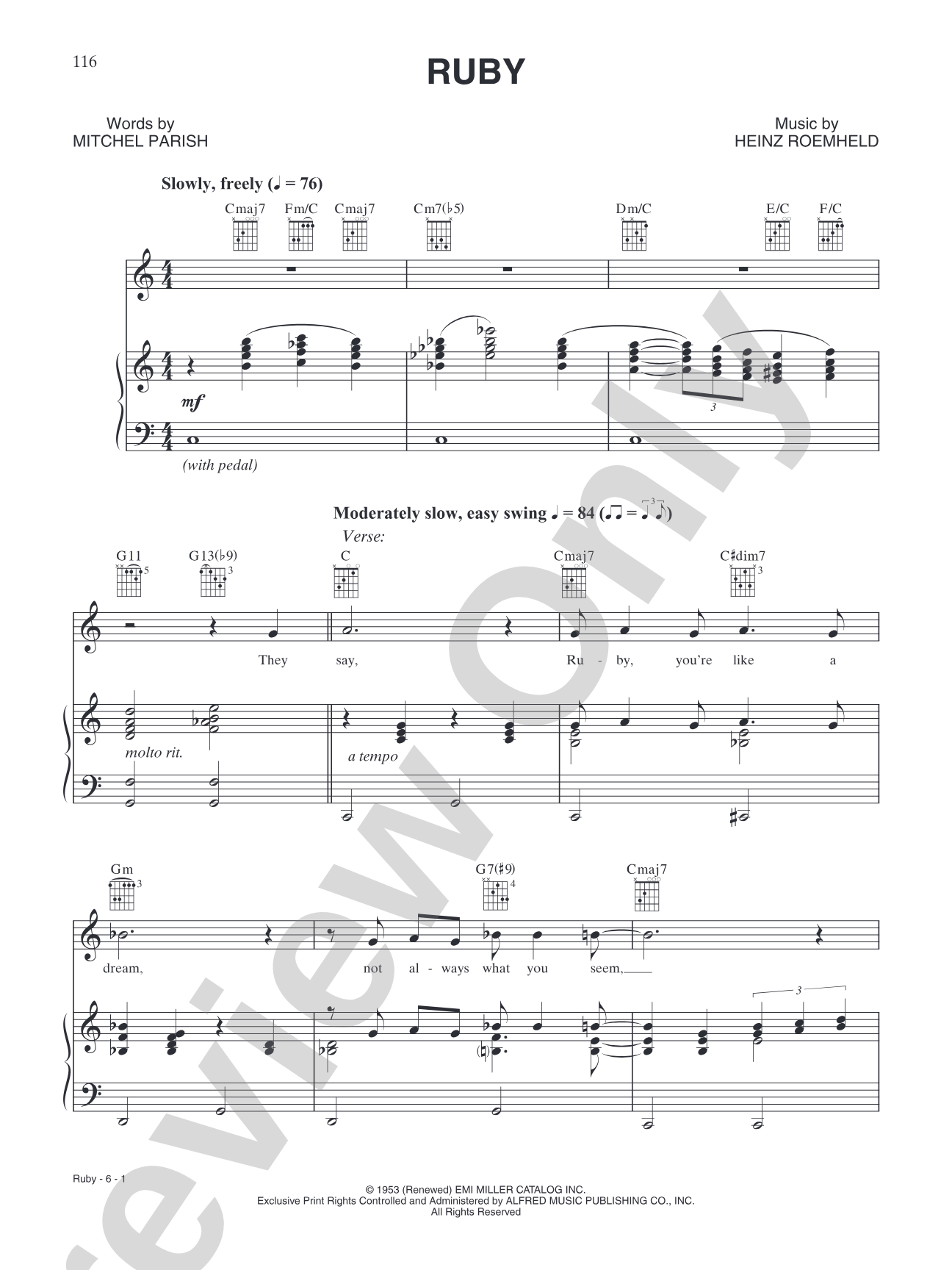
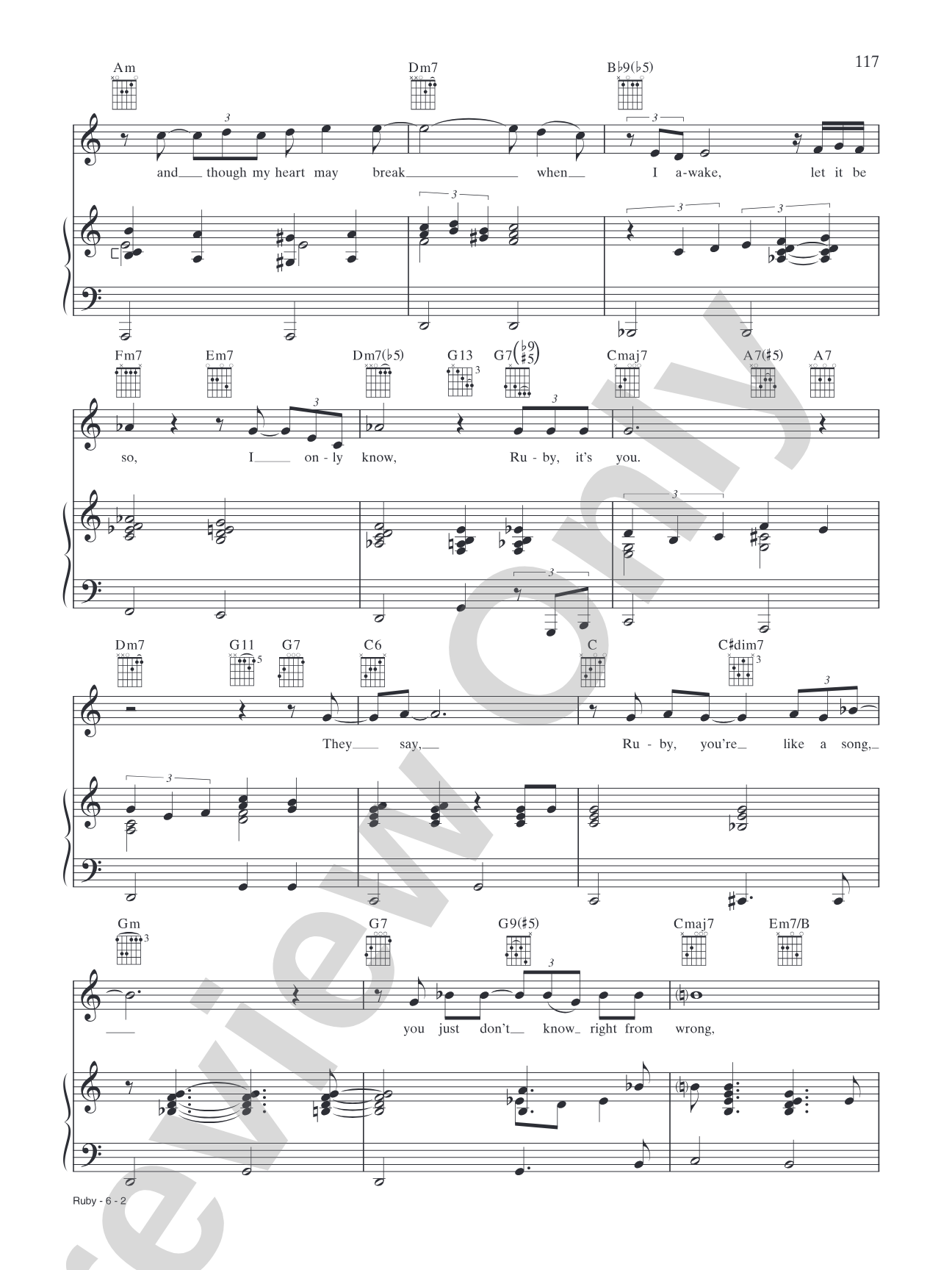

Ruby: Piano/Vocal/Chords
Ray Charles
Item: 00-PS-0013235
$5.99
One moment…
Related Items
Hallelujah I Love Her So: Piano/Vocal/Chords |
$5.99
|
View | |
That Lucky Old Sun: Piano/Vocal/Chords |
$5.99
|
View | |
What'd I Say: Piano/Vocal/Chords |
$9.99
|
View | |
Let the Good Times Roll: Piano/Vocal/Chords |
$5.99
|
View | |
Over the Rainbow: Piano/Vocal/Chords |
$4.99
|
View | |
Ain't That Love: Piano/Vocal/Chords |
$4.99
|
View | |
I've Got a Woman: Piano/Vocal/Chords |
$5.99
|
View | |
Mary Ann: Piano/Vocal/Chords |
$5.99
|
View | |
Mess Around: Piano/Vocal/Chords |
$5.99
|
View | |
One Mine Julep: Piano/Vocal/Chords |
$4.99
|
View | |
Sinner's Prayer: Piano/Vocal/Chords |
$5.99
|
View | |
This Little Girl of Mine: Piano/Vocal/Chords |
$5.99
|
View | |
Crazy Love: Piano/Vocal/Chords |
$5.99
|
View | |
Let's Go Get Stoned: Piano/Vocal/Chords |
$5.99
|
View | |
Seven Spanish Angels: Piano/Vocal/Chords |
$4.99
|
View | |
Come Rain Or Come Shine: Piano/Vocal/Chords |
$5.99
|
View | |
America the Beautful: Piano/Vocal/Chords |
$4.99
|
View |
Description
This collectible songbook celebrates the enduring legacy of Ray Charles at the 80th anniversary of his birth. Each sheet music transcription accurately renders his signature piano riffs and solos, and provides lyrics, vocal melodies, and chord changes. Ray Charles had three simple words of advice for achieving success: "Practice, practice, practice." With 28 fun and challenging transcriptions of some of popular music's most enduring standards, this collection gives pianists the opportunity to practice the techniques of the "Genius" himself. Titles: * Ain't That Love * America the Beautiful * Busted * Christmas in My Heart * Come Rain or Come Shine * Crazy Love * Georgia on My Mind * Hallelujah I Love Her So * Here We Go Again * Hit the Road Jack * I Can't Stop Loving You * I've Got a Woman * Let the Good Times Roll * Let's Go Get Stoned * Mary Ann * Mess Around * Night Time Is the Right Time * One Mint Julep * Over the Rainbow * Ruby * Seven Spanish Angels * Sinner's Prayer * That Lucky Old Sun * That Spirit of Christmas * This Little Girl of Mine * Unchain My Heart * What'd I Say * You Don't Know Me.


Ruby: Piano/Vocal/Chords isn't in MakeMusic Cloud just yet...but it could be. Let us know you'd like to see it, and you'll help shape what comes next. In the meantime, start a free trial and dive into thousands of interactive titles your students can play along with today.
Request This Title
Tell us you want it.
Start Your Free Trial
Explore everything that's ready to play right now.
Sample Audio
No sample audio found.
Sample Video
No sample videos found.
Additional Details
Publisher:
Alfred Music
Page Count:
180
SKU:
00-PS-0013235
More about this title
About the Composer: Heinz Roemheld
Heinz Roemheld was a prolific composer and arranger whose work shaped the sound of American popular music across multiple decades. Though often working behind the scenes, his arrangements and compositions provided the musical foundation for countless standards that defined jazz and blues repertoire.
Why we love this
Ray Charles's piano work demands serious technical facility, and this collection gives pianists direct access to his signature voicings, left-hand patterns, and the rhythmic precision that defined his sound. The transcriptions preserve what made his playing unmistakable: the gospel-inflected harmonies, the blues-based soloing, and the way he locked rhythm and melody together. Teaching from these arrangements means your students learn from one of popular music's greatest pianists, not simplified versions.
What to expect
Soulful, swinging, and deeply rooted in the blues. These songs carry the warmth of Ray Charles's voice and the sophistication of his harmonic thinking, moving between intimate ballads and driving rhythm-and-blues grooves with emotional authenticity. Playing through them means inhabiting a world where gospel, jazz, and popular song are inseparable.
Who it's for
Pianists with intermediate-to-advanced technique who want to explore jazz and blues standards through the lens of one of music's most influential stylists. This collection also serves singers, guitarists, and band musicians who need accurate lead sheets and chord voicings for ensemble contexts.
How to get the most out of it
- Study Charles's recorded versions alongside the transcriptions. His piano lines breathe and push the beat in ways notation alone cannot capture; hearing how he voices those chords and where he adds embellishments will transform your interpretation.
- Lock the left-hand foundation before adding the right-hand melody or solos. His bass lines and voicings anchor everything; rushing or losing clarity there undermines the whole performance.
- Pay close attention to the chord symbols for jazz reharmonization opportunities. Many of these songs sit in simple harmonic spaces, but Charles elevated them through substitutions and upper-structure voicings worth exploring.
- Balance the vocal line with the piano accompaniment. In many arrangements, you're playing both lead and support; resist the urge to overshadow the singer or reduce the piano to background comping.
How to use it
Build a recital around Charles's songbook as a thematic program, or draw individual titles as standalone pieces that pair well with other blues and jazz standards. The collection works equally well for a jazz ensemble featuring a vocalist or pianist soloist, or as a resource for private piano students studying American songwriting and jazz history through performance.
Skills your students will build
- Jazz voicings and reharmonization
- Blues-based improvisation and ornamentation
- Gospel-influenced harmonic movement
- Comping and accompaniment in jazz contexts
- Reading and interpreting chord charts
- Balancing solo and accompaniment roles on a single instrument
- Swing rhythm and triplet-based phrasing