
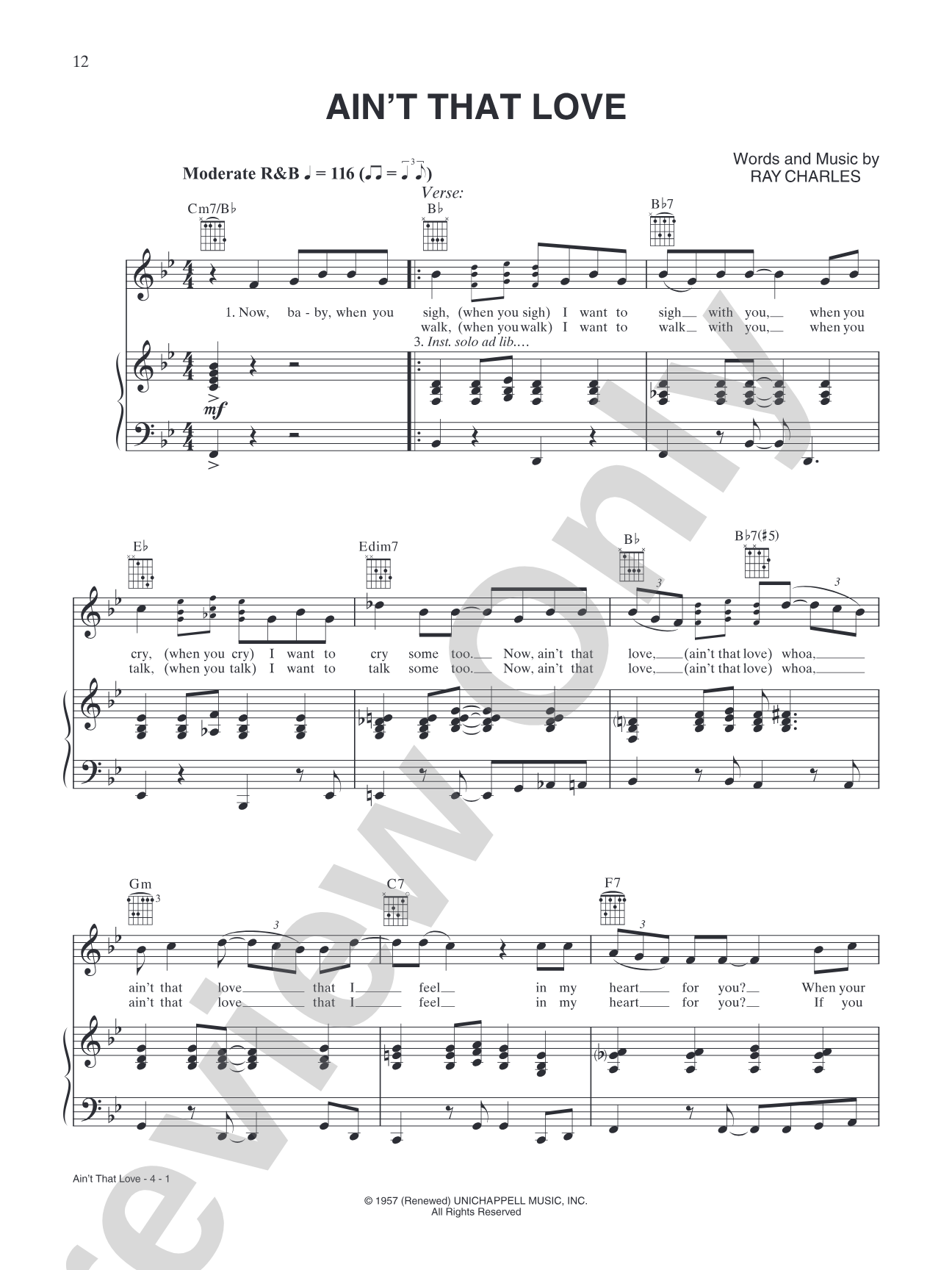

Ain't That Love: Piano/Vocal/Chords
Ray Charles
Item: 00-PS-0013236
$4.99
One moment…
Related Items
Hallelujah I Love Her So: Piano/Vocal/Chords |
$5.99
|
View | |
That Lucky Old Sun: Piano/Vocal/Chords |
$5.99
|
View | |
What'd I Say: Piano/Vocal/Chords |
$9.99
|
View | |
Let the Good Times Roll: Piano/Vocal/Chords |
$5.99
|
View | |
Over the Rainbow: Piano/Vocal/Chords |
$4.99
|
View | |
Ruby: Piano/Vocal/Chords |
$5.99
|
View | |
I've Got a Woman: Piano/Vocal/Chords |
$5.99
|
View | |
Mary Ann: Piano/Vocal/Chords |
$5.99
|
View | |
Mess Around: Piano/Vocal/Chords |
$5.99
|
View | |
One Mine Julep: Piano/Vocal/Chords |
$4.99
|
View | |
Sinner's Prayer: Piano/Vocal/Chords |
$5.99
|
View | |
This Little Girl of Mine: Piano/Vocal/Chords |
$5.99
|
View | |
Crazy Love: Piano/Vocal/Chords |
$5.99
|
View | |
Let's Go Get Stoned: Piano/Vocal/Chords |
$5.99
|
View | |
Seven Spanish Angels: Piano/Vocal/Chords |
$4.99
|
View | |
Come Rain Or Come Shine: Piano/Vocal/Chords |
$5.99
|
View | |
America the Beautful: Piano/Vocal/Chords |
$4.99
|
View |
Description
This collectible songbook celebrates the enduring legacy of Ray Charles at the 80th anniversary of his birth. Each sheet music transcription accurately renders his signature piano riffs and solos, and provides lyrics, vocal melodies, and chord changes. Ray Charles had three simple words of advice for achieving success: "Practice, practice, practice." With 28 fun and challenging transcriptions of some of popular music's most enduring standards, this collection gives pianists the opportunity to practice the techniques of the "Genius" himself. Titles: * Ain't That Love * America the Beautiful * Busted * Christmas in My Heart * Come Rain or Come Shine * Crazy Love * Georgia on My Mind * Hallelujah I Love Her So * Here We Go Again * Hit the Road Jack * I Can't Stop Loving You * I've Got a Woman * Let the Good Times Roll * Let's Go Get Stoned * Mary Ann * Mess Around * Night Time Is the Right Time * One Mint Julep * Over the Rainbow * Ruby * Seven Spanish Angels * Sinner's Prayer * That Lucky Old Sun * That Spirit of Christmas * This Little Girl of Mine * Unchain My Heart * What'd I Say * You Don't Know Me.


Ain't That Love: Piano/Vocal/Chords isn't in MakeMusic Cloud just yet...but it could be. Let us know you'd like to see it, and you'll help shape what comes next. In the meantime, start a free trial and dive into thousands of interactive titles your students can play along with today.
Request This Title
Tell us you want it.
Start Your Free Trial
Explore everything that's ready to play right now.
Sample Audio
No sample audio found.
Sample Video
No sample videos found.
Additional Details
Publisher:
Alfred Music
Page Count:
180
SKU:
00-PS-0013236
More about this title
About the Composer: Ray Charles
Ray Charles (1930-2004) fundamentally changed American music by erasing the boundaries between blues, jazz, gospel, and country. Born in Albany, Georgia, and blind from childhood, he developed an ear so acute and a musical imagination so expansive that he could inhabit any idiom authentically. His innovations in rhythm, harmony, and vocal expression influenced generations of musicians across every genre, earning him the title "The Genius."
Why we love this
Ray Charles's piano work bridges technical sophistication with genuine soulfulness. These 28 transcriptions capture his most recognizable recordings while giving pianists access to the exact voicings, riffs, and solo passages that defined his sound, making this collection invaluable for students who want to understand how jazz harmony actually functions in a blues context.
What to expect
These arrangements pulse with the warmth and swagger of Ray Charles's original recordings. You'll encounter gospel-influenced chord extensions, blues shuffle grooves, and moments of unadorned vulnerability alongside pure showmanship; the collection swings, it soars, it aches, and it never settles for simple.
Who it's for
Pianists seeking to expand beyond classical technique into blues and jazz vocabulary will find themselves challenged and rewarded by these transcriptions. Singers and guitarists can use this book to learn Ray's exact arrangements and discover how his piano voice drives the emotional shape of each song. Music directors programming jazz standards or classic American songbook material will appreciate having accurate, performance-ready transcriptions of definitive versions.
How to get the most out of it
- Study the chord symbols and Ray's reharmonizations carefully before diving into the written-out solo sections; his harmonic choices often defy convention and reward close listening.
- Approach the left-hand patterns as foundational grooves rather than fixed accompaniments; Ray's recordings show how to bend, shuffle, and breathe within the pulse.
- Balance fidelity to the transcription with your own voice; Ray built his artistry by learning deeply from others and then making every phrase unmistakably his own.
- Layer in the vocal melody even when playing piano solo; understanding the melody's relationship to the harmony will deepen your interpretation of the recorded arrangements.
How to use it
Program individual selections alongside standards from the Great American Songbook to show how Ray Charles's artistry transformed familiar material into something distinctly his own. Use the collection to build a jazz or blues-history unit in your curriculum, having students compare how different pianists approach the same tune. Include arrangements in recitals that celebrate influential Black composers and arrangers in American music.
Skills your students will build
- Reading jazz chord symbols and reharmonized progressions
- Recognizing blues and gospel harmonic vocabulary (dominant sevenths, passing chords, extended voicings)
- Interpreting written-out solos and understanding solo construction in blues and jazz
- Balancing melody, harmony, and left-hand groove in a single performance
- Adapting arrangements for different instrumental and vocal combinations