
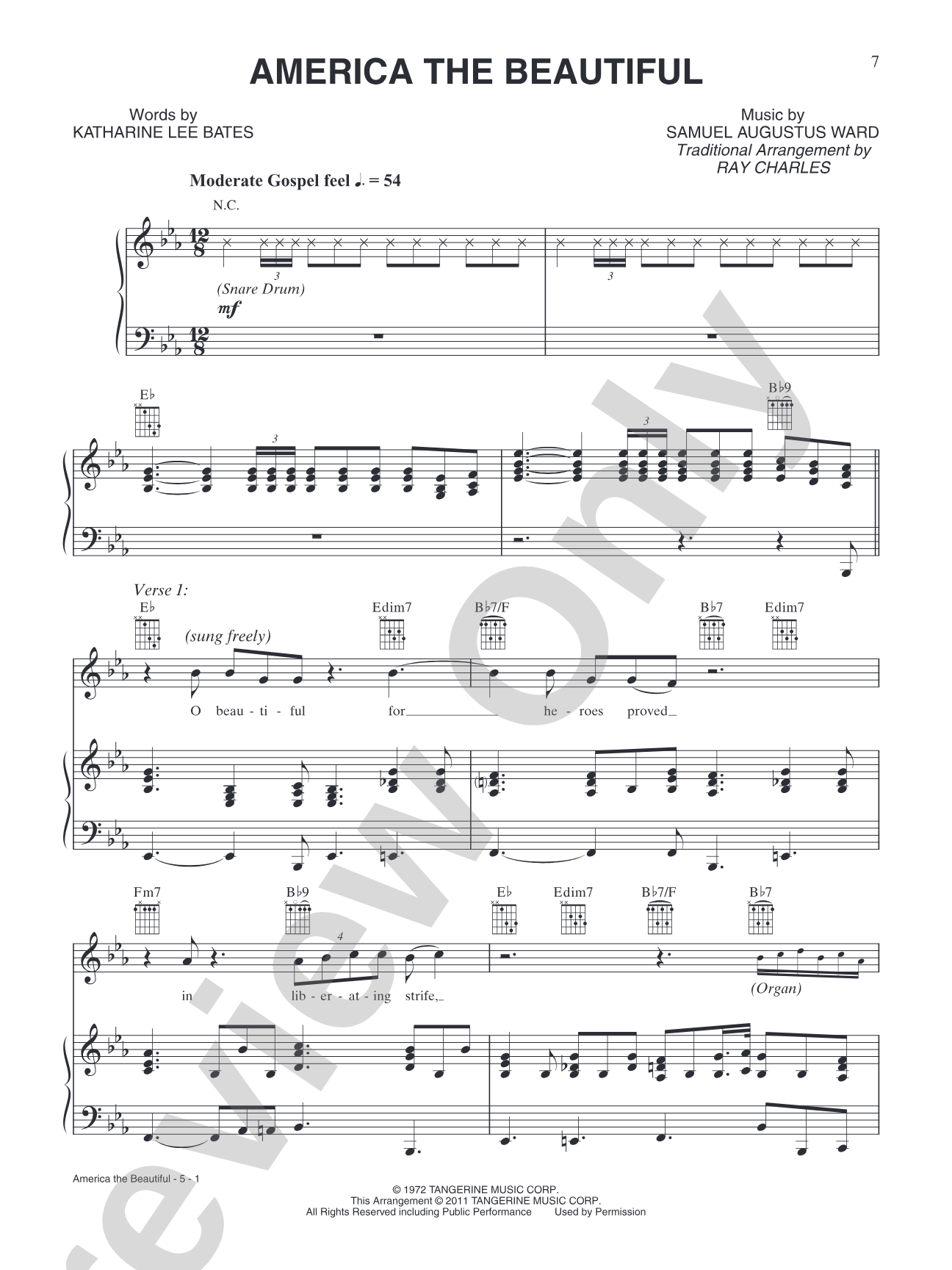

America the Beautful: Piano/Vocal/Chords
Ray Charles
Item: 00-PS-0013268
$4.99
Pickup currently not available
Related Items
Hallelujah I Love Her So: Piano/Vocal/Chords |
$5.99
|
View | |
That Lucky Old Sun: Piano/Vocal/Chords |
$5.99
|
View | |
What'd I Say: Piano/Vocal/Chords |
$9.99
|
View | |
Let the Good Times Roll: Piano/Vocal/Chords |
$5.99
|
View | |
Over the Rainbow: Piano/Vocal/Chords |
$4.99
|
View | |
Ruby: Piano/Vocal/Chords |
$5.99
|
View | |
Ain't That Love: Piano/Vocal/Chords |
$4.99
|
View | |
I've Got a Woman: Piano/Vocal/Chords |
$5.99
|
View | |
Mary Ann: Piano/Vocal/Chords |
$5.99
|
View | |
Mess Around: Piano/Vocal/Chords |
$5.99
|
View | |
One Mine Julep: Piano/Vocal/Chords |
$4.99
|
View | |
Sinner's Prayer: Piano/Vocal/Chords |
$5.99
|
View | |
This Little Girl of Mine: Piano/Vocal/Chords |
$5.99
|
View | |
Crazy Love: Piano/Vocal/Chords |
$5.99
|
View | |
Let's Go Get Stoned: Piano/Vocal/Chords |
$5.99
|
View | |
Seven Spanish Angels: Piano/Vocal/Chords |
$4.99
|
View | |
Come Rain Or Come Shine: Piano/Vocal/Chords |
$5.99
|
View |
Description
This collectible songbook celebrates the enduring legacy of Ray Charles at the 80th anniversary of his birth. Each sheet music transcription accurately renders his signature piano riffs and solos, and provides lyrics, vocal melodies, and chord changes. Ray Charles had three simple words of advice for achieving success: "Practice, practice, practice." With 28 fun and challenging transcriptions of some of popular music's most enduring standards, this collection gives pianists the opportunity to practice the techniques of the "Genius" himself. Titles: * Ain't That Love * America the Beautiful * Busted * Christmas in My Heart * Come Rain or Come Shine * Crazy Love * Georgia on My Mind * Hallelujah I Love Her So * Here We Go Again * Hit the Road Jack * I Can't Stop Loving You * I've Got a Woman * Let the Good Times Roll * Let's Go Get Stoned * Mary Ann * Mess Around * Night Time Is the Right Time * One Mint Julep * Over the Rainbow * Ruby * Seven Spanish Angels * Sinner's Prayer * That Lucky Old Sun * That Spirit of Christmas * This Little Girl of Mine * Unchain My Heart * What'd I Say * You Don't Know Me.


America the Beautful: Piano/Vocal/Chords isn't in MakeMusic Cloud just yet...but it could be. Let us know you'd like to see it, and you'll help shape what comes next. In the meantime, start a free trial and dive into thousands of interactive titles your students can play along with today.
Request This Title
Tell us you want it.
Start Your Free Trial
Explore everything that's ready to play right now.
Sample Audio
No sample audio found.
Sample Video
No sample videos found.
Additional Details
Publisher:
Alfred Music
Page Count:
180
SKU:
00-PS-0013268
More about this title
About the Composer: Samuel Agustus Ward
Samuel Agustus Ward (1848, 1900) composed "America the Beautiful" in 1882, setting Katharine Lee Bates's poem to music that has since become one of the most beloved songs in American culture. His hymn-like melody, rooted in 19th-century American musical traditions, proved remarkably durable, outlasting countless other patriotic compositions to claim a permanent place in the national consciousness.
Ward's gift was for simplicity and emotional directness. He understood that a great melody doesn't need to be complex; it needs to be memorable and singable. This same principle guided his work as a music educator and composer of church music, making him a figure of quiet but lasting influence in American musical life.
Why we love this
Ray Charles's interpretations of these standards reveal how a master pianist approaches phrasing, dynamics, and harmonic reharmonization. His transcriptions preserve the exact riffs and solo passages that made his recordings iconic, giving your students direct access to his musical thinking rather than simplified arrangements. Programming this collection means offering pianists a masterclass in how taste and constraint, working within the traditions of blues, soul, and jazz, can produce timeless music.
What to expect
These arrangements capture the warmth and swagger of Ray's playing, with blues riffs that swing hard alongside moments of genuine tenderness. The collection moves between uptempo shout-alongs and slow ballads with the ease of someone who owned these songs completely, bending standards into personal statements without losing their essential character.
Who it's for
Pianists serious about blues and jazz vocabulary will find 28 lessons in how to think harmonically and rhythmically like Ray Charles. This collection also works for any vocalist who wants to understand how these standards were reshaped by one of popular music's most influential interpreters. Both classical pianists expanding into vernacular music and jazz students deepening their stylistic range will find material that demands and rewards sustained practice.
How to get the most out of it
- Study the recorded versions first. Ray's touch, timing, and left-hand voicings are inseparable from the music itself; the transcriptions work best when you know what you're aiming for sonically.
- Pay close attention to the chord symbols and how Ray voices them. These aren't standard jazz voicings; they reflect his particular harmonic language shaped by blues and gospel traditions.
- Don't rush the rubato sections. Ray's freedom with tempo is earned through rhythmic confidence, not hesitation; lock the basic pulse before you start bending it.
- The piano riffs are the hook. Spend time on those signature patterns until they're automatic, so your phrasing and dynamics can breathe naturally over them.
How to use it
Feature individual transcriptions as solo recital pieces for advanced pianists, or use a small set of them as part of a jazz history concert focused on American song traditions. You might also assign selections from the collection across a semester or year as technique studies for piano students working on swing feel, blues harmony, and vocal accompaniment skills.
Skills your students will build
- Blues and jazz voicing construction (seventh chords, extensions, reharmonization)
- Swing feel and rhythmic flexibility in both hands
- Left-hand riff patterns and ostinato accompaniment
- Sight-reading from chord symbols and vocal melody lines
- Listening and transcription skills (comparing notation to recorded performances)
- Accompanying singers with sensitivity to phrasing and lyrical content