
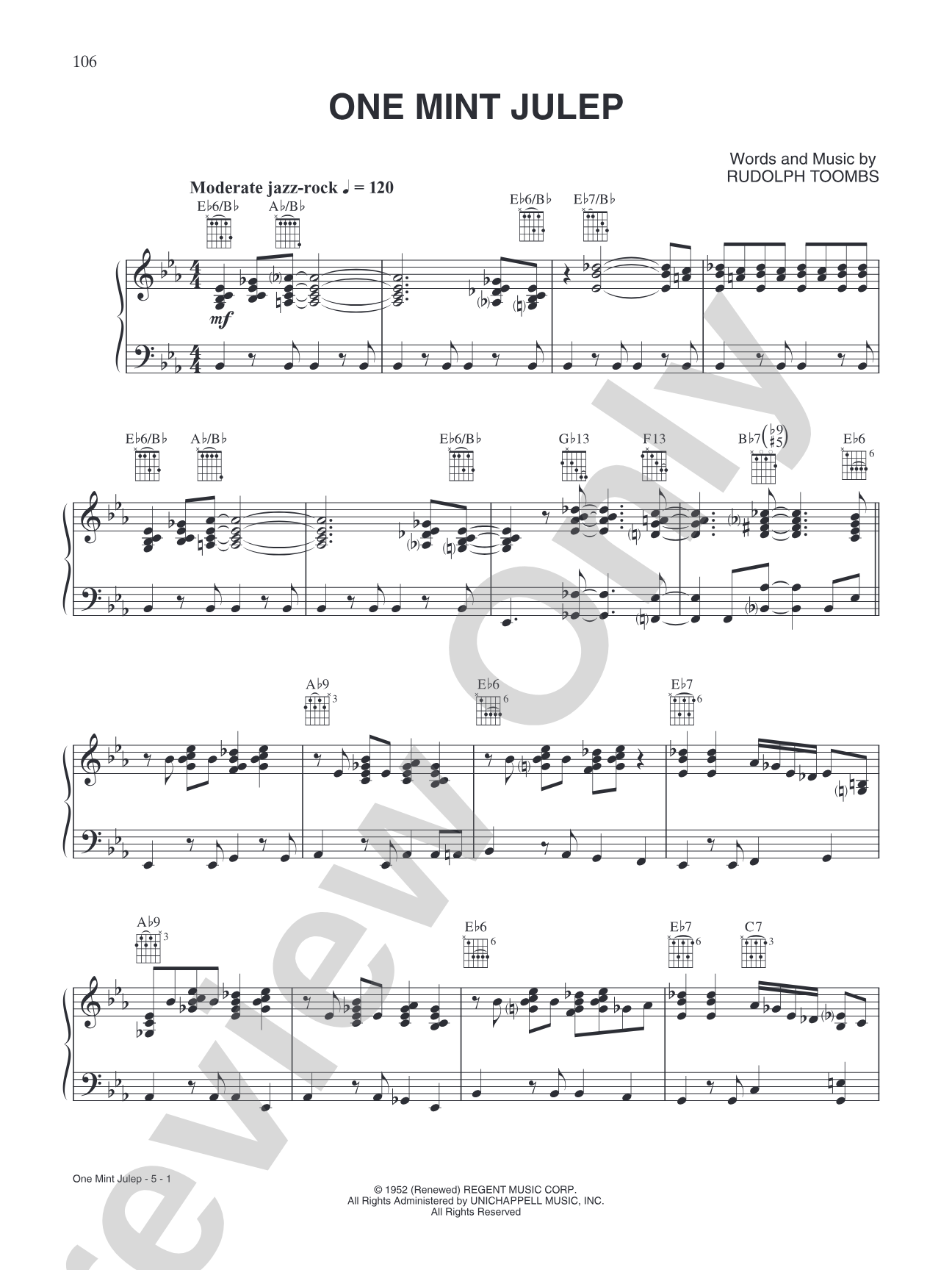

One Mine Julep: Piano/Vocal/Chords
Ray Charles
Item: 00-PS-0013240
$4.99
One moment…
Related Items
Hallelujah I Love Her So: Piano/Vocal/Chords |
$5.99
|
View | |
That Lucky Old Sun: Piano/Vocal/Chords |
$5.99
|
View | |
What'd I Say: Piano/Vocal/Chords |
$9.99
|
View | |
Let the Good Times Roll: Piano/Vocal/Chords |
$5.99
|
View | |
Over the Rainbow: Piano/Vocal/Chords |
$4.99
|
View | |
Ruby: Piano/Vocal/Chords |
$5.99
|
View | |
Ain't That Love: Piano/Vocal/Chords |
$4.99
|
View | |
I've Got a Woman: Piano/Vocal/Chords |
$5.99
|
View | |
Mary Ann: Piano/Vocal/Chords |
$5.99
|
View | |
Mess Around: Piano/Vocal/Chords |
$5.99
|
View | |
Sinner's Prayer: Piano/Vocal/Chords |
$5.99
|
View | |
This Little Girl of Mine: Piano/Vocal/Chords |
$5.99
|
View | |
Crazy Love: Piano/Vocal/Chords |
$5.99
|
View | |
Let's Go Get Stoned: Piano/Vocal/Chords |
$5.99
|
View | |
Seven Spanish Angels: Piano/Vocal/Chords |
$4.99
|
View | |
Come Rain Or Come Shine: Piano/Vocal/Chords |
$5.99
|
View | |
America the Beautful: Piano/Vocal/Chords |
$4.99
|
View |
Description
This collectible songbook celebrates the enduring legacy of Ray Charles at the 80th anniversary of his birth. Each sheet music transcription accurately renders his signature piano riffs and solos, and provides lyrics, vocal melodies, and chord changes. Ray Charles had three simple words of advice for achieving success: "Practice, practice, practice." With 28 fun and challenging transcriptions of some of popular music's most enduring standards, this collection gives pianists the opportunity to practice the techniques of the "Genius" himself. Titles: * Ain't That Love * America the Beautiful * Busted * Christmas in My Heart * Come Rain or Come Shine * Crazy Love * Georgia on My Mind * Hallelujah I Love Her So * Here We Go Again * Hit the Road Jack * I Can't Stop Loving You * I've Got a Woman * Let the Good Times Roll * Let's Go Get Stoned * Mary Ann * Mess Around * Night Time Is the Right Time * One Mint Julep * Over the Rainbow * Ruby * Seven Spanish Angels * Sinner's Prayer * That Lucky Old Sun * That Spirit of Christmas * This Little Girl of Mine * Unchain My Heart * What'd I Say * You Don't Know Me.


One Mine Julep: Piano/Vocal/Chords isn't in MakeMusic Cloud just yet...but it could be. Let us know you'd like to see it, and you'll help shape what comes next. In the meantime, start a free trial and dive into thousands of interactive titles your students can play along with today.
Request This Title
Tell us you want it.
Start Your Free Trial
Explore everything that's ready to play right now.
Sample Audio
No sample audio found.
Sample Video
No sample videos found.
Additional Details
Publisher:
Alfred Music
Page Count:
180
SKU:
00-PS-0013240
More about this title
About the Composer: Rudolph Toombs
Rudolph Toombs was a prolific songwriter and pianist whose compositions became foundational to rhythm and blues and rock and roll. Born in 1911, he wrote some of the most recorded songs of the 1950s, crafting material that defined the sound of early R&B. His work emphasized strong melodic hooks, blues-rooted harmonic structures, and rhythmic vitality that made songs instantly memorable and endlessly coverable.
Toombs' influence extends far beyond his original recordings. His compositions have been interpreted by countless artists across genres, but Ray Charles' interpretations stand as definitive versions that showcase the depth and sophistication embedded in Toombs' writing. For pianists studying blues, jazz, and popular song traditions, Toombs' melodies and harmonic language offer essential vocabulary and endless study material.
Why we love this
Ray Charles' approach to these standards reveals the pianistic architecture that underlies great popular songs. Transcribing his improvisations, comping patterns, and solo work gives pianists direct access to a master's understanding of harmony, voicing, and rhythmic displacement. The breadth of material here spans blues, jazz standards, sacred songs, and rock and roll, making it an unusually comprehensive study collection in a single volume.
What to expect
These transcriptions capture the infectious energy and emotional directness that defined Ray Charles' artistry. From the playful rhythmic bounce of uptempo numbers to the soulful restraint of ballads, the collection swings between joy and introspection, always rooted in blues sensibility and never losing sight of a melody. The piano parts sing, cry, and celebrate in equal measure, inviting performers to inhabit both the virtuosity and the vulnerability of the original performances.
Who it's for
Intermediate to advanced pianists seeking to deepen their understanding of American popular music through direct study of a master interpreter. Singers and guitarists working with a pianist will find valuable arrangements that balance vocal line with harmonic sophistication. Music students exploring the intersection of blues, jazz, and popular song will discover how Ray Charles unified these traditions at the piano.
How to get the most out of it
- Study the harmonic movement beneath Ray's melody lines. His piano voice leading often moves independently from the vocal line, creating counterpoint rather than doubling. Isolate these inner voices before attempting full performance.
- The swing feel and shuffle rhythms in pieces like 'Mess Around' and 'What'd I Say' demand attention to articulation and note placement. Practice the rhythm section patterns without the melody first to internalize the pocket.
- Ray's signature left-hand patterns often use stride or boogie-woogie foundations adapted with jazz voicings. Work these patterns slowly in isolation, then gradually add the right-hand melody to avoid competing rhythms.
- Listen closely to how Ray adjusts his approach between uptempo rockers and ballads. The same harmonic knowledge serves both contexts, but the execution and dynamics shift dramatically. Record yourself and compare against the original recordings.
How to use it
Build a recital around Toombs' songwriting legacy by selecting pieces that chart a journey through blues, jazz, and American popular traditions. Several selections work beautifully in mixed recitals pairing classical repertoire with vernacular music, demonstrating the harmonic sophistication of twentieth-century songwriting. For ensemble contexts, the pieces lend themselves to jazz combo arrangements or collaborative performances with singers and guitarists.
Skills your students will build
- Jazz voicing and reharmonization within the context of melody-driven songs
- Blues-based left-hand patterns (stride, boogie, and jazz comping foundations)
- Balancing keyboard accompaniment with vocal line in trio and ensemble settings
- Interpreting swing feel and shuffle rhythms with stylistic authenticity
- Understanding harmonic movement across chord changes and recognizing substitutions
- Adapting the same harmonic framework across tempos and emotional contexts