
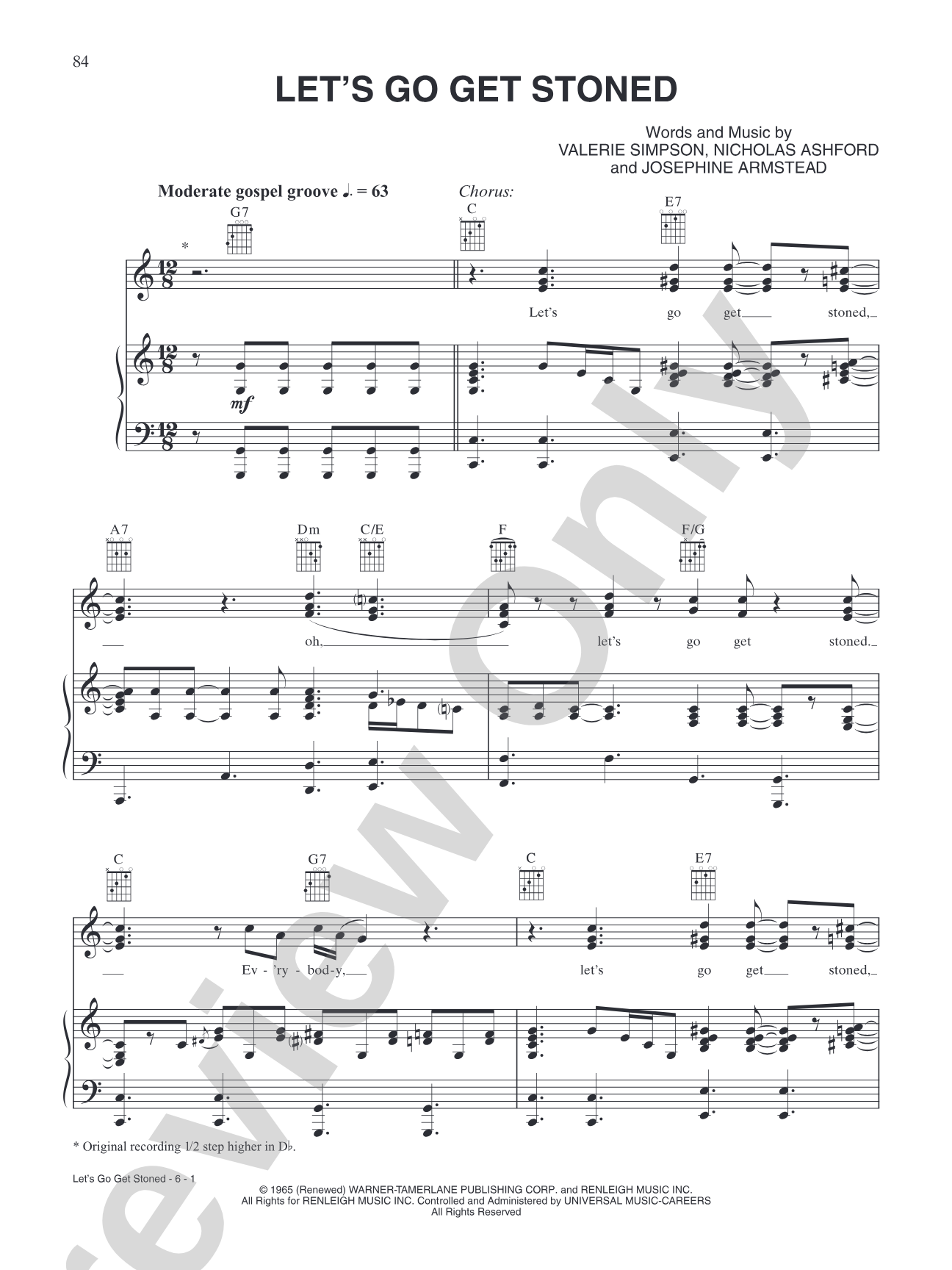
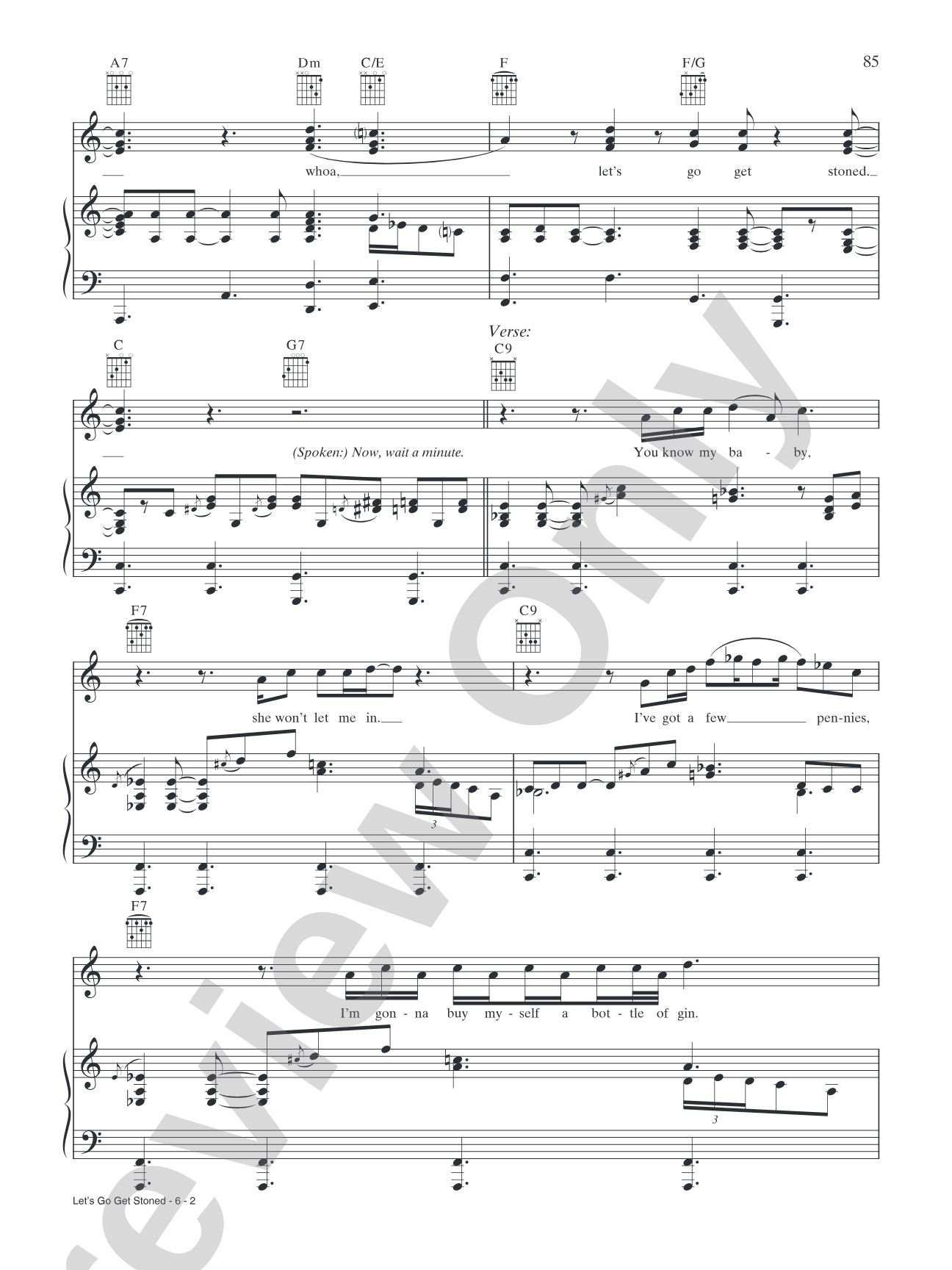

Let's Go Get Stoned: Piano/Vocal/Chords
Ray Charles
Item: 00-PS-0013246
$5.99
One moment…
Related Items
Hallelujah I Love Her So: Piano/Vocal/Chords |
$5.99
|
View | |
That Lucky Old Sun: Piano/Vocal/Chords |
$5.99
|
View | |
What'd I Say: Piano/Vocal/Chords |
$9.99
|
View | |
Let the Good Times Roll: Piano/Vocal/Chords |
$5.99
|
View | |
Over the Rainbow: Piano/Vocal/Chords |
$4.99
|
View | |
Ruby: Piano/Vocal/Chords |
$5.99
|
View | |
Ain't That Love: Piano/Vocal/Chords |
$4.99
|
View | |
I've Got a Woman: Piano/Vocal/Chords |
$5.99
|
View | |
Mary Ann: Piano/Vocal/Chords |
$5.99
|
View | |
Mess Around: Piano/Vocal/Chords |
$5.99
|
View | |
One Mine Julep: Piano/Vocal/Chords |
$4.99
|
View | |
Sinner's Prayer: Piano/Vocal/Chords |
$5.99
|
View | |
This Little Girl of Mine: Piano/Vocal/Chords |
$5.99
|
View | |
Crazy Love: Piano/Vocal/Chords |
$5.99
|
View | |
Seven Spanish Angels: Piano/Vocal/Chords |
$4.99
|
View | |
Come Rain Or Come Shine: Piano/Vocal/Chords |
$5.99
|
View | |
America the Beautful: Piano/Vocal/Chords |
$4.99
|
View |
Description
This collectible songbook celebrates the enduring legacy of Ray Charles at the 80th anniversary of his birth. Each sheet music transcription accurately renders his signature piano riffs and solos, and provides lyrics, vocal melodies, and chord changes. Ray Charles had three simple words of advice for achieving success: "Practice, practice, practice." With 28 fun and challenging transcriptions of some of popular music's most enduring standards, this collection gives pianists the opportunity to practice the techniques of the "Genius" himself. Titles: * Ain't That Love * America the Beautiful * Busted * Christmas in My Heart * Come Rain or Come Shine * Crazy Love * Georgia on My Mind * Hallelujah I Love Her So * Here We Go Again * Hit the Road Jack * I Can't Stop Loving You * I've Got a Woman * Let the Good Times Roll * Let's Go Get Stoned * Mary Ann * Mess Around * Night Time Is the Right Time * One Mint Julep * Over the Rainbow * Ruby * Seven Spanish Angels * Sinner's Prayer * That Lucky Old Sun * That Spirit of Christmas * This Little Girl of Mine * Unchain My Heart * What'd I Say * You Don't Know Me.


Let's Go Get Stoned: Piano/Vocal/Chords isn't in MakeMusic Cloud just yet...but it could be. Let us know you'd like to see it, and you'll help shape what comes next. In the meantime, start a free trial and dive into thousands of interactive titles your students can play along with today.
Request This Title
Tell us you want it.
Start Your Free Trial
Explore everything that's ready to play right now.
Sample Audio
No sample audio found.
Sample Video
No sample videos found.
Additional Details
Publisher:
Alfred Music
Page Count:
180
SKU:
00-PS-0013246
More about this title
About the Composer: Valerie Simpson
Valerie Simpson is a songwriter and producer whose work spans soul, R&B, and pop music. As part of the songwriting team Ashford & Simpson with Nickolas Ashford, she created some of the most recognizable hits of the 1960s and 1970s, writing for legends including Marvin Gaye, Tammi Terrell, and Ray Charles. Her compositions are marked by sophisticated harmonic language, memorable melodies, and emotional directness.
Simpson's arrangements and transcriptions demonstrate deep knowledge of instrumental voicing and the art of translating vocal-driven songs for different performers and instruments. Her work has influenced generations of songwriters and remains central to the soul and R&B repertoire.
Why we love this
This collection captures Ray Charles's distinctive pianistic voice through accurate transcriptions of his signature riffs, fills, and solo passages rather than simplified chord charts. Pianists engage with real jazz and blues vocabulary while building interpretive skills through songs that reward both technical mastery and emotional expression. The 28-song span gives students exposure to standards, blues, and Charles's own compositions, all grounded in his teaching philosophy: mastery comes through sustained, focused practice.
What to expect
These transcriptions pulse with the warmth and swagger of a master musician at work. You'll feel Charles's influence across genres: the jubilant energy of "Let's Go Get Stoned," the aching tenderness of "I Can't Stop Loving You," the gospel fervor of "Hallelujah I Love Her So," and the pure joy of "Mess Around." The piano writing balances accessibility with genuine sophistication, rewarding careful listening and repeated practice with layers of texture and expression that reveal something new each time through.
Who it's for
Pianists with intermediate to advanced technique who want to deepen their understanding of jazz and blues voicing, comping, and solo construction. This collection works equally well for students studying soul and R&B history, musicians preparing jazz standards, or pianists seeking material that bridges classical technique with vernacular American music. Singers learning Ray Charles repertoire will find accurate vocal lines and chord changes for accompaniment or arrangement study.
How to get the most out of it
- Study Charles's left-hand patterns across multiple arrangements to absorb his rhythmic groove and comping style; the consistency reveals his fundamental approach to accompaniment.
- Listen to Charles's original recordings while learning each transcription to understand his phrasing, dynamic shaping, and how he voices chords beyond what notation alone conveys.
- Lock into the shuffle or swing feel indicated in each piece before worrying about tempo; these songs demand rhythmic pocket and lift, not just note-for-note accuracy.
- Treat the vocal melody line as a guide for phrasing rather than a rigid melodic boundary; Charles frequently bent, extended, and improvised around the written line, and the piano part should reflect that conversational quality.
How to use it
Use this collection as a semester or year-long study in vernacular songwriting, working through 4 to 6 transcriptions at a time to balance technical growth with repertoire exposure. Pianists can perform individual arrangements in recitals, jazz combos, or as accompaniment for singers working through Charles's catalog. Alternatively, assign selections to students studying different eras of American popular music: the blues pieces connect to early twentieth-century traditions, while the later standards and soul numbers show how Charles synthesized multiple idioms into his distinctive style.
Skills your students will build
- Jazz and blues comping techniques: left-hand rhythmic patterns, shell voicings, and harmonic substitutions
- Reading and interpreting swing and shuffle feels with accurate rhythmic placement
- Solo piano voicing and reharmonization of standard melodies
- Translating vocal phrasing to instrumental expression; understanding how melodic flexibility serves emotional content
- Sight-reading chord symbols and translating them into idiomatic piano voicings across blues, soul, and jazz contexts