
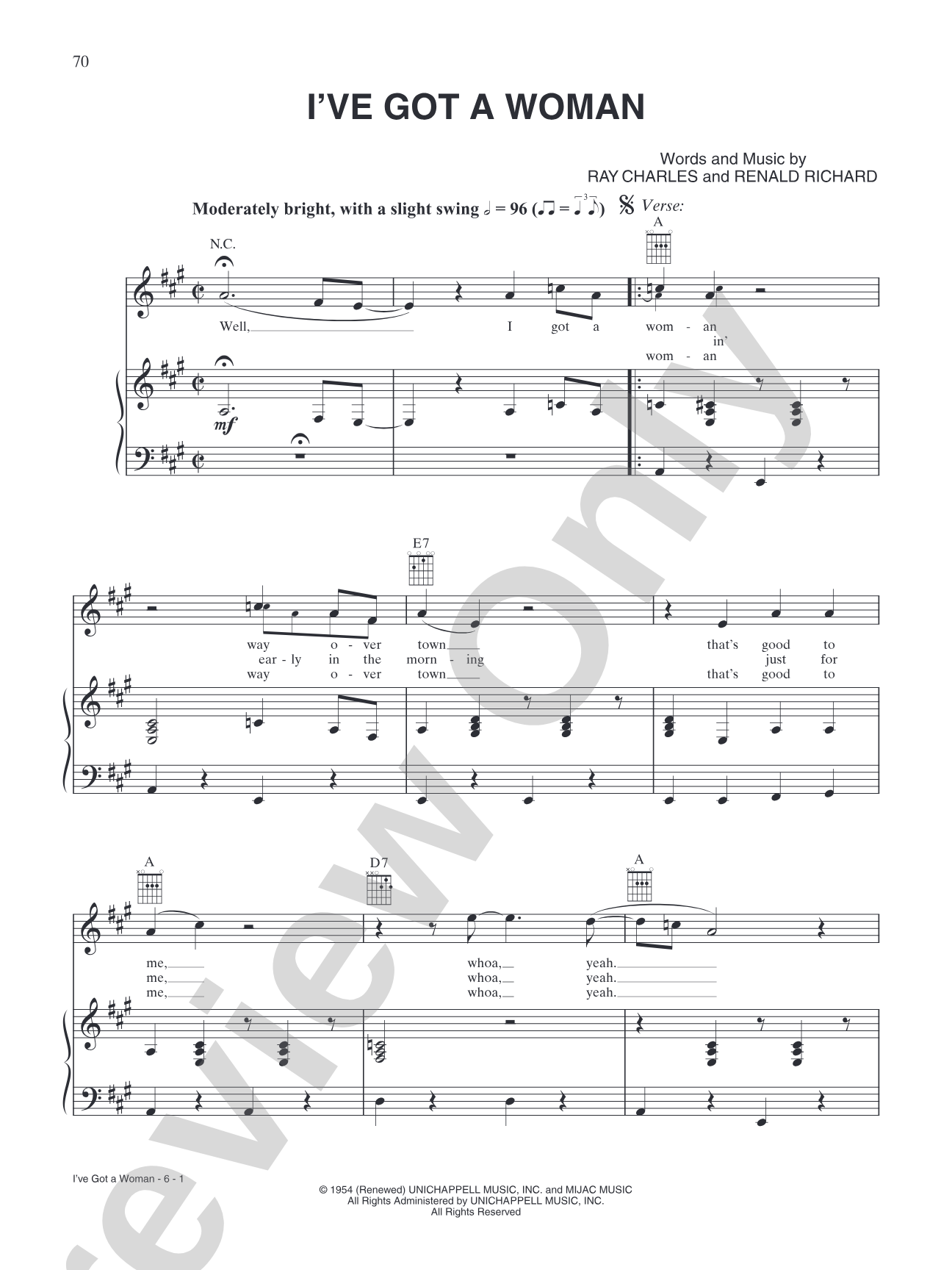
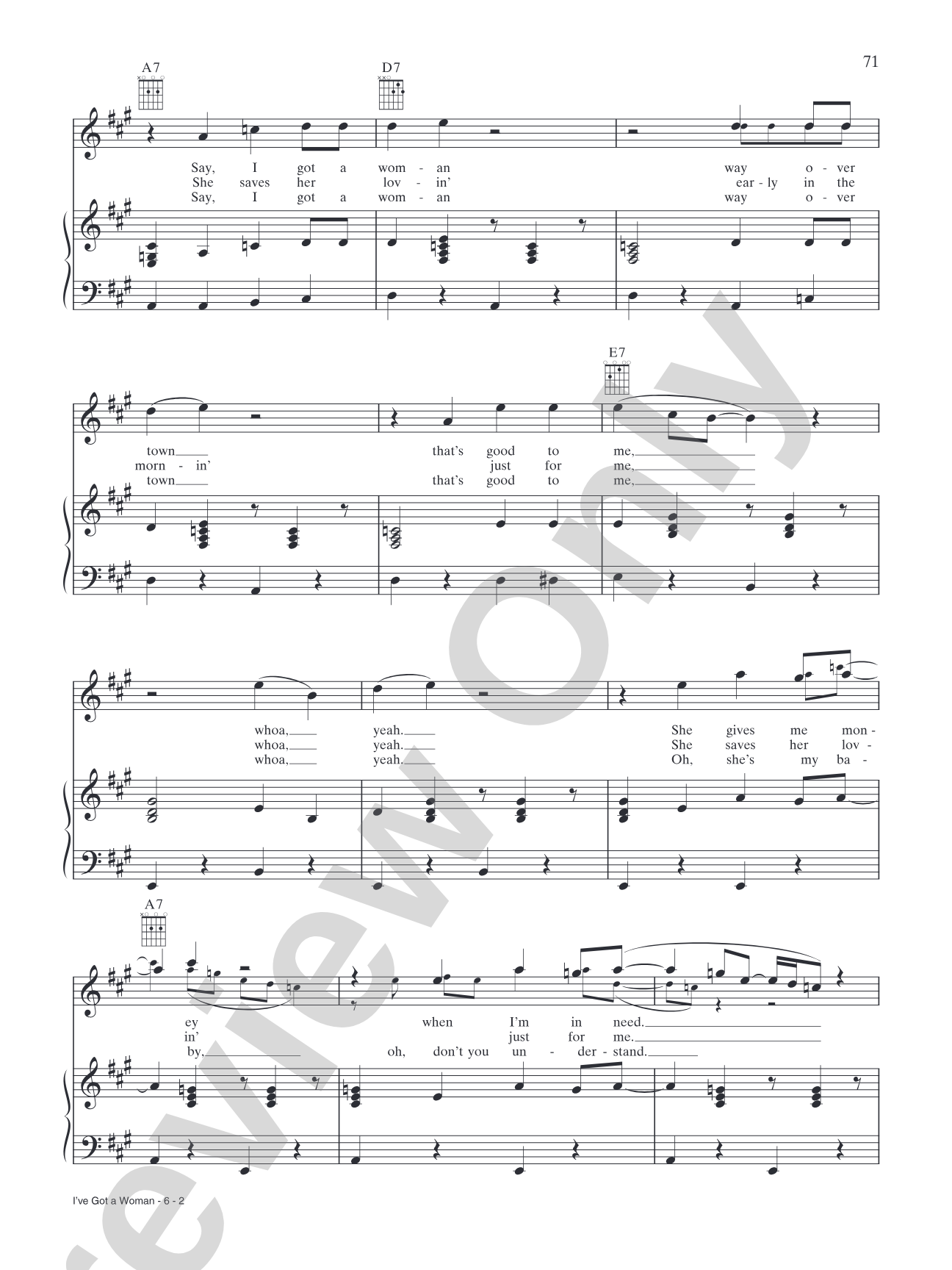

I've Got a Woman: Piano/Vocal/Chords
Ray Charles
Item: 00-PS-0013237
$5.99
One moment…
Related Items
Hallelujah I Love Her So: Piano/Vocal/Chords |
$5.99
|
View | |
That Lucky Old Sun: Piano/Vocal/Chords |
$5.99
|
View | |
What'd I Say: Piano/Vocal/Chords |
$9.99
|
View | |
Let the Good Times Roll: Piano/Vocal/Chords |
$5.99
|
View | |
Over the Rainbow: Piano/Vocal/Chords |
$4.99
|
View | |
Ruby: Piano/Vocal/Chords |
$5.99
|
View | |
Ain't That Love: Piano/Vocal/Chords |
$4.99
|
View | |
Mary Ann: Piano/Vocal/Chords |
$5.99
|
View | |
Mess Around: Piano/Vocal/Chords |
$5.99
|
View | |
One Mine Julep: Piano/Vocal/Chords |
$4.99
|
View | |
Sinner's Prayer: Piano/Vocal/Chords |
$5.99
|
View | |
This Little Girl of Mine: Piano/Vocal/Chords |
$5.99
|
View | |
Crazy Love: Piano/Vocal/Chords |
$5.99
|
View | |
Let's Go Get Stoned: Piano/Vocal/Chords |
$5.99
|
View | |
Seven Spanish Angels: Piano/Vocal/Chords |
$4.99
|
View | |
Come Rain Or Come Shine: Piano/Vocal/Chords |
$5.99
|
View | |
America the Beautful: Piano/Vocal/Chords |
$4.99
|
View |
Description
This collectible songbook celebrates the enduring legacy of Ray Charles at the 80th anniversary of his birth. Each sheet music transcription accurately renders his signature piano riffs and solos, and provides lyrics, vocal melodies, and chord changes. Ray Charles had three simple words of advice for achieving success: "Practice, practice, practice." With 28 fun and challenging transcriptions of some of popular music's most enduring standards, this collection gives pianists the opportunity to practice the techniques of the "Genius" himself. Titles: * Ain't That Love * America the Beautiful * Busted * Christmas in My Heart * Come Rain or Come Shine * Crazy Love * Georgia on My Mind * Hallelujah I Love Her So * Here We Go Again * Hit the Road Jack * I Can't Stop Loving You * I've Got a Woman * Let the Good Times Roll * Let's Go Get Stoned * Mary Ann * Mess Around * Night Time Is the Right Time * One Mint Julep * Over the Rainbow * Ruby * Seven Spanish Angels * Sinner's Prayer * That Lucky Old Sun * That Spirit of Christmas * This Little Girl of Mine * Unchain My Heart * What'd I Say * You Don't Know Me.


I've Got a Woman: Piano/Vocal/Chords isn't in MakeMusic Cloud just yet...but it could be. Let us know you'd like to see it, and you'll help shape what comes next. In the meantime, start a free trial and dive into thousands of interactive titles your students can play along with today.
Request This Title
Tell us you want it.
Start Your Free Trial
Explore everything that's ready to play right now.
Sample Audio
No sample audio found.
Sample Video
No sample videos found.
Additional Details
Publisher:
Alfred Music
Page Count:
180
SKU:
00-PS-0013237
More about this title
About the Composer: Ray Charles
Ray Charles (1930-2004) fundamentally reshaped American music by fusing blues, gospel, jazz, and country into a sound that belonged to no single tradition. Born in Albany, Georgia, and blind from childhood, he became one of the most influential pianists and bandleaders of the twentieth century, earning the title "Genius" not through marketing but through relentless innovation and technical mastery across multiple instruments and genres.
For music educators, Ray Charles represents a singular lesson: virtuosity emerges from deep study of vernacular traditions combined with fearless genre-crossing. His ability to inhabit blues changes, voice leading, and rhythmic displacement makes his arrangements endlessly teachable. His famous directive to "practice, practice, practice" wasn't mere motivation but a philosophy rooted in how he built his own technique from the ground up, making him an ideal model for serious students willing to invest in their craft.
Why we love this
These transcriptions give pianists direct access to the harmonic language and comping patterns of one of jazz and blues' greatest voices at the keyboard. Rather than simplifying Ray Charles' work, this collection captures his signature riffs and solos with accuracy, allowing intermediate to advanced pianists to study how he voiced chords, navigated changes, and built momentum through repetition and variation. The 28-song scope spans his most recognizable hits and deeper catalog cuts, making it an invaluable resource for building authentic blues and R&B vocabulary.
What to expect
These pieces carry the warmth, swagger, and unshakeable groove that defined Ray Charles' playing. You'll find yourself drawn into the rhythmic pocket he created, where every phrase feels both inevitable and playful, and where the piano serves as both a soloing voice and the engine driving the whole song forward. There's joy and soul woven through even the most complex harmonic moments.
Who it's for
This collection serves intermediate to advanced pianists who want to deepen their understanding of blues and R&B keyboard playing through transcriptions of authentic arrangements. It works equally well for jazz pianists building their blues vocabulary, singer-pianists preparing songs for performance, and guitarists using the chord charts to develop comping skills in these styles.
How to get the most out of it
- Study the recorded versions of these songs first. Ray Charles' rhythmic approach to comping and his placement of notes relative to the beat differ from written notation; listening trains your ear to the subtle swing and pocket that make these arrangements breathe.
- Lock into the bass line movement and chord progression changes before focusing on the right-hand riffs. Ray Charles built his piano work on solid harmonic foundation, so understanding the trajectory of changes will make the ornamental figures fall into place naturally.
- Pay attention to dynamics in the piano solo sections. These aren't meant to be played at constant volume; Ray Charles used dynamic shaping to build and release tension, especially in extended vamps like "What'd I Say."
- Treat the chord symbols as a framework, not a ceiling. Use them to understand harmonic function, then experiment with voicings and reharmonization as Ray Charles himself would have done in a live setting.
How to use it
Use this collection in a jazz or blues history unit to show students how a single musician can command multiple roles: pianist, bandleader, composer, and arranger all at once. Select individual transcriptions as recital pieces for advanced students, or use the chord charts as the foundation for a student ensemble arrangement of "Hit the Road Jack" or "I Can't Stop Loving You." The breadth of the songbook also makes it ideal for independent study, where a student can work through 2-3 pieces per month as a way to build stylistic fluency.
Skills your students will build
- Blues comping patterns and left-hand voicings
- Reading and executing piano riffs with rhythmic accuracy and swing feel
- Understanding harmonic function through changes common to blues, gospel, and R&B
- Dynamic shaping and phrasing in extended keyboard solos
- Integrating chord symbols with melody and improvisation
- Transcription and interpretation of recorded performances