
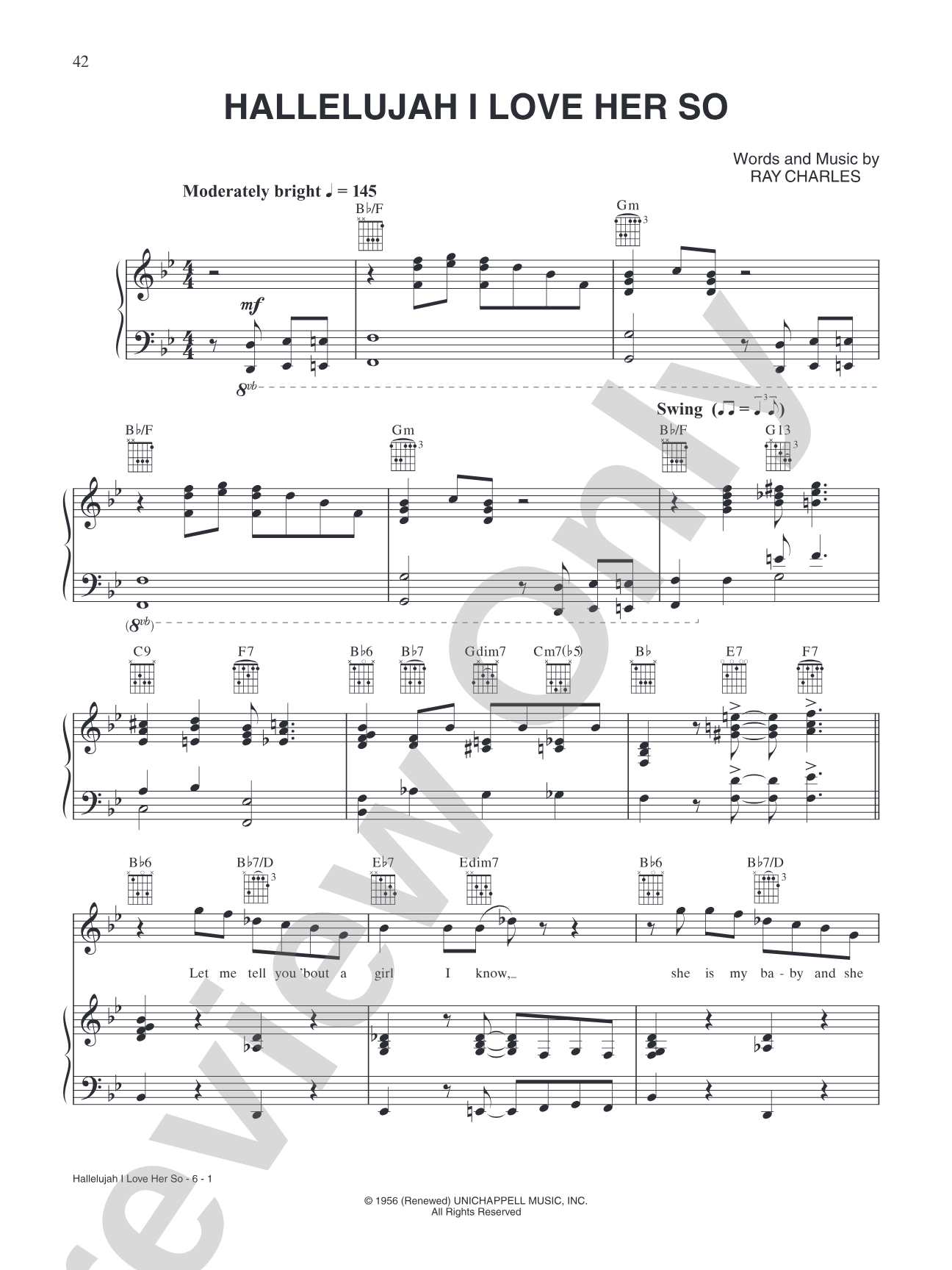
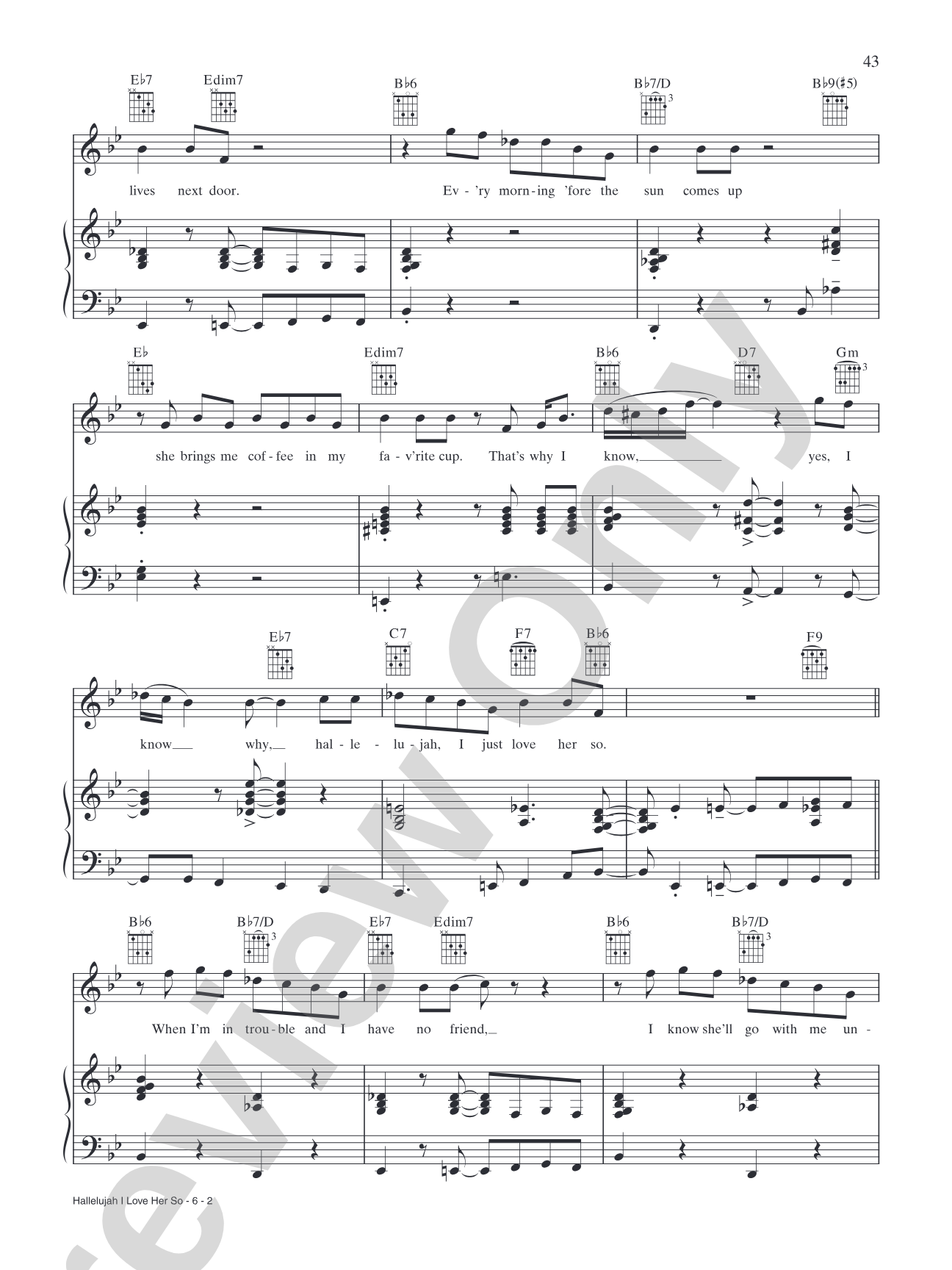

Hallelujah I Love Her So: Piano/Vocal/Chords
Ray Charles
Item: 00-PS-0013230
$5.99
One moment…
Related Items
That Lucky Old Sun: Piano/Vocal/Chords |
$5.99
|
View | |
What'd I Say: Piano/Vocal/Chords |
$9.99
|
View | |
Let the Good Times Roll: Piano/Vocal/Chords |
$5.99
|
View | |
Over the Rainbow: Piano/Vocal/Chords |
$4.99
|
View | |
Ruby: Piano/Vocal/Chords |
$5.99
|
View | |
Ain't That Love: Piano/Vocal/Chords |
$4.99
|
View | |
I've Got a Woman: Piano/Vocal/Chords |
$5.99
|
View | |
Mary Ann: Piano/Vocal/Chords |
$5.99
|
View | |
Mess Around: Piano/Vocal/Chords |
$5.99
|
View | |
One Mine Julep: Piano/Vocal/Chords |
$4.99
|
View | |
Sinner's Prayer: Piano/Vocal/Chords |
$5.99
|
View | |
This Little Girl of Mine: Piano/Vocal/Chords |
$5.99
|
View | |
Crazy Love: Piano/Vocal/Chords |
$5.99
|
View | |
Let's Go Get Stoned: Piano/Vocal/Chords |
$5.99
|
View | |
Seven Spanish Angels: Piano/Vocal/Chords |
$4.99
|
View | |
Come Rain Or Come Shine: Piano/Vocal/Chords |
$5.99
|
View | |
America the Beautful: Piano/Vocal/Chords |
$4.99
|
View |
Description
This collectible songbook celebrates the enduring legacy of Ray Charles at the 80th anniversary of his birth. Each sheet music transcription accurately renders his signature piano riffs and solos, and provides lyrics, vocal melodies, and chord changes. Ray Charles had three simple words of advice for achieving success: "Practice, practice, practice." With 28 fun and challenging transcriptions of some of popular music's most enduring standards, this collection gives pianists the opportunity to practice the techniques of the "Genius" himself. Titles: * Ain't That Love * America the Beautiful * Busted * Christmas in My Heart * Come Rain or Come Shine * Crazy Love * Georgia on My Mind * Hallelujah I Love Her So * Here We Go Again * Hit the Road Jack * I Can't Stop Loving You * I've Got a Woman * Let the Good Times Roll * Let's Go Get Stoned * Mary Ann * Mess Around * Night Time Is the Right Time * One Mint Julep * Over the Rainbow * Ruby * Seven Spanish Angels * Sinner's Prayer * That Lucky Old Sun * That Spirit of Christmas * This Little Girl of Mine * Unchain My Heart * What'd I Say * You Don't Know Me.


Hallelujah I Love Her So: Piano/Vocal/Chords isn't in MakeMusic Cloud just yet...but it could be. Let us know you'd like to see it, and you'll help shape what comes next. In the meantime, start a free trial and dive into thousands of interactive titles your students can play along with today.
Request This Title
Tell us you want it.
Start Your Free Trial
Explore everything that's ready to play right now.
Sample Audio
No sample audio found.
Sample Video
No sample videos found.
Additional Details
Publisher:
Alfred Music
Page Count:
180
SKU:
00-PS-0013230
More about this title
About the Composer: Ray Charles
Ray Charles (1930-2004) revolutionized American music by fusing blues, gospel, jazz, and country into a sound entirely his own. Blind from childhood, he became one of the most influential pianists and bandleaders of the 20th century, earning the title "The Genius" through decades of innovation and relentless artistry.
For music educators, Ray Charles represents a masterclass in musicianship across genres. His ability to bend melody, reharmonize standards, and build arrangements around the piano made him a model for understanding how classical training, blues feeling, and harmonic sophistication can coexist. His recorded performances are invaluable references for understanding interpretation, phrasing, and the role of the rhythm section in popular music.
Why we love this
These transcriptions capture Ray Charles at his most pianistically inventive, offering pianists direct access to his signature riffs, reharmonizations, and solo approaches. Rather than simplified arrangements, these are working transcriptions that demand the same interpretive sophistication Ray himself brought to each performance, making them ideal for advancing pianists ready to study authentic jazz-blues vocabulary.
What to expect
Playing Ray Charles's music means inhabiting a world where restraint and passion coexist, where a simple blues progression becomes profound through the weight of a single note. The piano riffs have groove built into them; you feel the swing and soul before you think about it.
Who it's for
Intermediate to advanced pianists with a foundation in jazz harmony and blues feel who want to study authentic popular music from one of its greatest practitioners. Vocalists will find carefully rendered melodies and chord progressions for accompanying themselves or learning Ray Charles's phrasing choices. Guitar players can use the chord charts to understand comping patterns and voicings from the era.
How to get the most out of it
- Listen closely to Ray Charles's original recordings before and during rehearsal. His piano voicings often defy conventional chord symbols; use your ear to understand how he voices and transitions between harmony.
- Commit the left-hand patterns to muscle memory early. Many of these pieces rely on grooved, repetitive bass figures that need to feel automatic so your right hand can focus on phrasing and dynamics.
- Approach dynamics and articulation as tools for storytelling, not technical display. Ray Charles's playing swung even when the notation suggested straight rhythm; experiment with subtle rubato and space between phrases.
- Use the chord symbols to understand harmonic function, but don't treat them as limits. This music invites reharmonization and improvisation; once you know the changes, explore how Ray's approach can inspire your own interpretations.
How to use it
Feature individual transcriptions in student recitals or jazz ensemble concerts to highlight different facets of Ray's artistry, from the upbeat shuffle of "Mess Around" to the emotional depth of "Georgia on My Mind." This collection also works beautifully as a curriculum resource for jazz history classes, offering students direct engagement with arrangements they can perform alongside listening to the originals.
Skills your students will build
- Jazz harmony voicings and reharmonization techniques
- Blues piano vocabulary and left-hand groove patterns
- Swing rhythm and feel without relying on notation alone
- Connecting melody, harmony, and rhythm in popular music interpretation
- Chord reading and practical application in a real-world repertoire context