
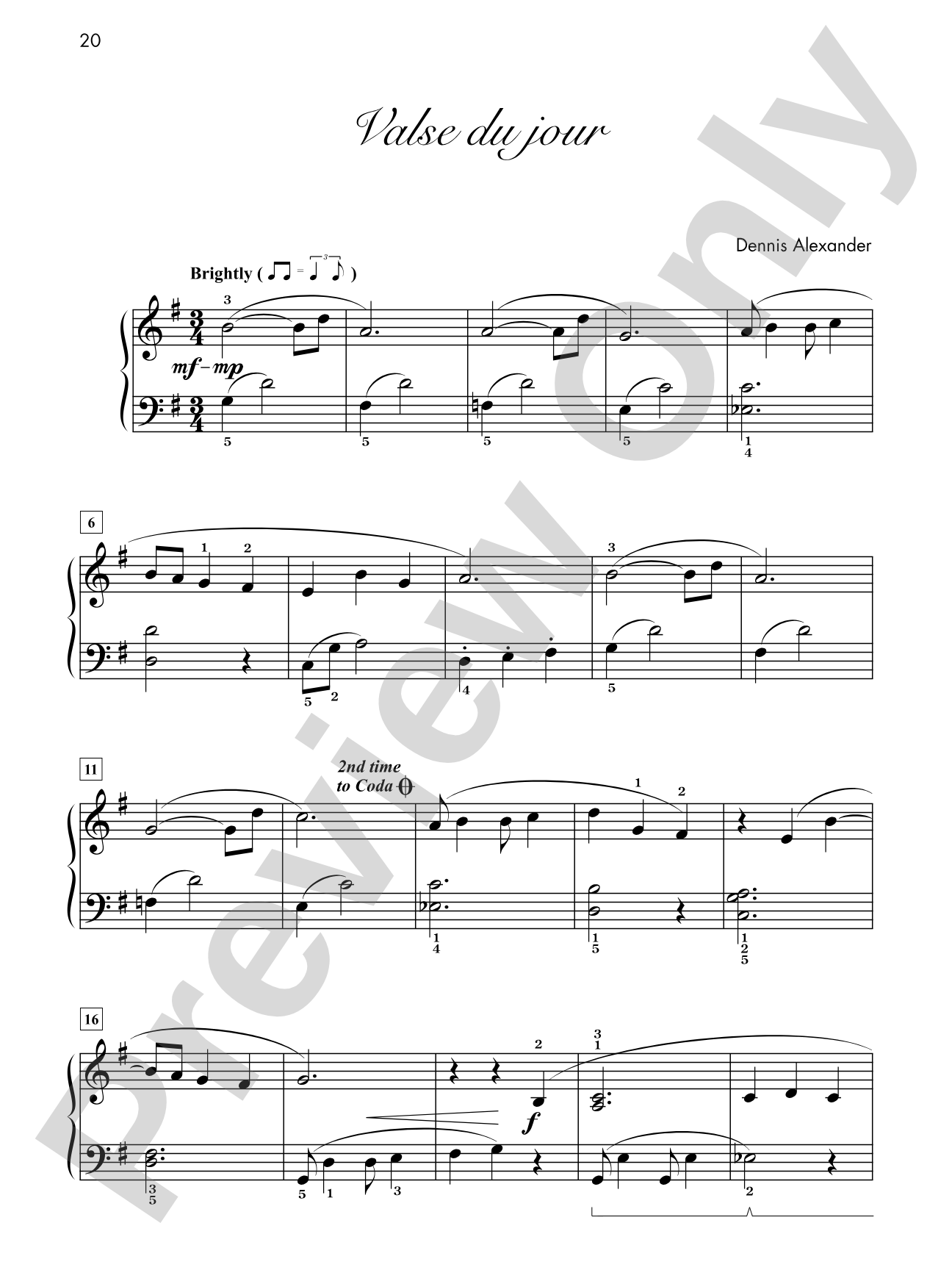

Valse du jour - Piano Solo: Piano Solo
11 Stylized Solos for Early Intermediate Pianists
By Dennis Alexander
Level: Early Intermediate
Item: 00-PS-0017566
$7.99
Pickup currently not available
Related Items
A Touch of Rhumba - Piano Solo: Piano Solo |
$4.99
|
View | |
As September Goes - Piano Solo: Piano Solo |
$4.99
|
View | |
Jazz Jam - Piano Solo: Piano Solo |
$4.99
|
View | |
Purple Sage - Piano Solo: Piano Solo |
$4.99
|
View | |
Rhythmicon - Piano Solo: Piano Solo |
$4.99
|
View | |
Smooth as Silk - Piano Solo: Piano Solo |
$4.99
|
View | |
Sneakin' 'Round - Piano Solo: Piano Solo |
$4.99
|
View | |
Soft-Shoe Blues - Piano Solo: Piano Solo |
$4.99
|
View | |
Soul Searcher - Piano Solo: Piano Solo |
$4.99
|
View | |
Tahitian Nights - Piano Solo: Piano Solo |
$4.99
|
View | |
Especially in Jazzy Style, Book 1: Piano Book |
$7.99
|
View |
Description
The goal of this series is to introduce students to the rhythms, harmonies and other unique characteristics of jazz. Students will be motivated by the variety of styles and sounds that have that special Dennis Alexander sound. From lyrical melodies to infectious rhythms and harmonies, playing jazz styles has never been more fun! Titles: As September Goes * Jazz Jam * Purple Sage * Rhythmicon * Smooth as Silk * Sneakin' 'Round * Soft-Shoe Blues * Soul Searcher * Tahitian Nights * A Touch of Rhumba * Valse du jour. A Federation Festivals 2024-2028 selection.


Valse du jour - Piano Solo: Piano Solo isn't in MakeMusic Cloud just yet...but it could be. Let us know you'd like to see it, and you'll help shape what comes next. In the meantime, start a free trial and dive into thousands of interactive titles your students can play along with today.
Request This Title
Tell us you want it.
Start Your Free Trial
Explore everything that's ready to play right now.
Sample Audio
1
A Touch of Rhumba
--:--
2
Purple Sage
--:--
A Touch of Rhumba
0:00
0:00
Sample Video
No sample videos found.
Additional Details
Series:
Especially
Publisher:
Alfred Music
Page Count:
24
SKU:
00-PS-0017566
More about this title
About the Composer: Dennis Alexander

Dennis Alexander has shaped music education for over four decades through his prolific output with Alfred Music Publishing. Since 1986, his compositions have introduced hundreds of thousands of students to piano repertoire spanning classical forms, jazz styles, and contemporary idioms. His 400+ publications reflect a deep understanding of how students learn and what motivates them to keep practicing.
Alexander's credentials span both the academy and the concert hall. He spent 24 years as piano pedagogy faculty at the University of Montana before relocating to California, where he taught at Cal State Fullerton and Cal State Northridge while maintaining an active performance schedule. His collaborative work with internationally recognized soloists and chamber ensembles, combined with his role as a clinician at state and national conventions, has made him a trusted voice in music education. He continues composing and touring from his home in Albuquerque.
Why we love this
Alexander has an uncanny gift for writing jazz that doesn't feel condescending to young pianists. The rhythmic vitality and harmonic sophistication here engage students' ears while staying within their technical reach. This collection earns its Federation selection not through difficulty alone, but through genuinely engaging writing that makes early intermediate students sound and feel like musicians.
What to expect
These pieces capture the sophistication of real jazz idioms without losing the directness that makes practice rewarding. You'll encounter lush harmonies, syncopated rhythms that snap into place once you feel them, and melodies that stick with you between lessons. There's genuine coolness here, the kind students recognize and want to own.
Who it's for
Early intermediate pianists ready to explore jazz beyond folk song arrangements. Students who respond well to rhythmic challenge and want to sound more mature without technical overwhelm. Piano teachers building a jazz curriculum that respects both pedagogical sequencing and musical authenticity.
How to get the most out of it
- Anchor the swing feel by thinking of the eighth notes as gently pushed rather than rushed; let the rhythm section breathe with you.
- Explore the recorded accompaniments included with this series. They establish the groove and give you a sense of how these pieces sit within their full jazz context.
- Pay attention to Alexander's dynamic markings and articulation choices. The difference between staccato and legato passages often signals a change in character or section purpose.
- In the blues-influenced pieces, allow rubato in the melody while keeping the underlying pulse steady. Jazz phrasing lives in that tension.
How to use it
Program individual selections from this collection in a recital that spotlights different jazz moods and styles. Pair contrasting pieces together (a blues with a Latin-tinged waltz) to show the breadth of the jazz tradition. Use this series as a bridge between classical technique and jazz ensemble work, preparing students who may later pursue small group playing.
Skills your students will build
- Reading and executing jazz articulation and phrasing conventions
- Swing rhythm and syncopation
- Chord voicing and jazz harmony application
- Interpreting stylistic notation and performance directions specific to jazz
- Building independence between hands in syncopated contexts
- Understanding blues form and Latin jazz rhythmic patterns