
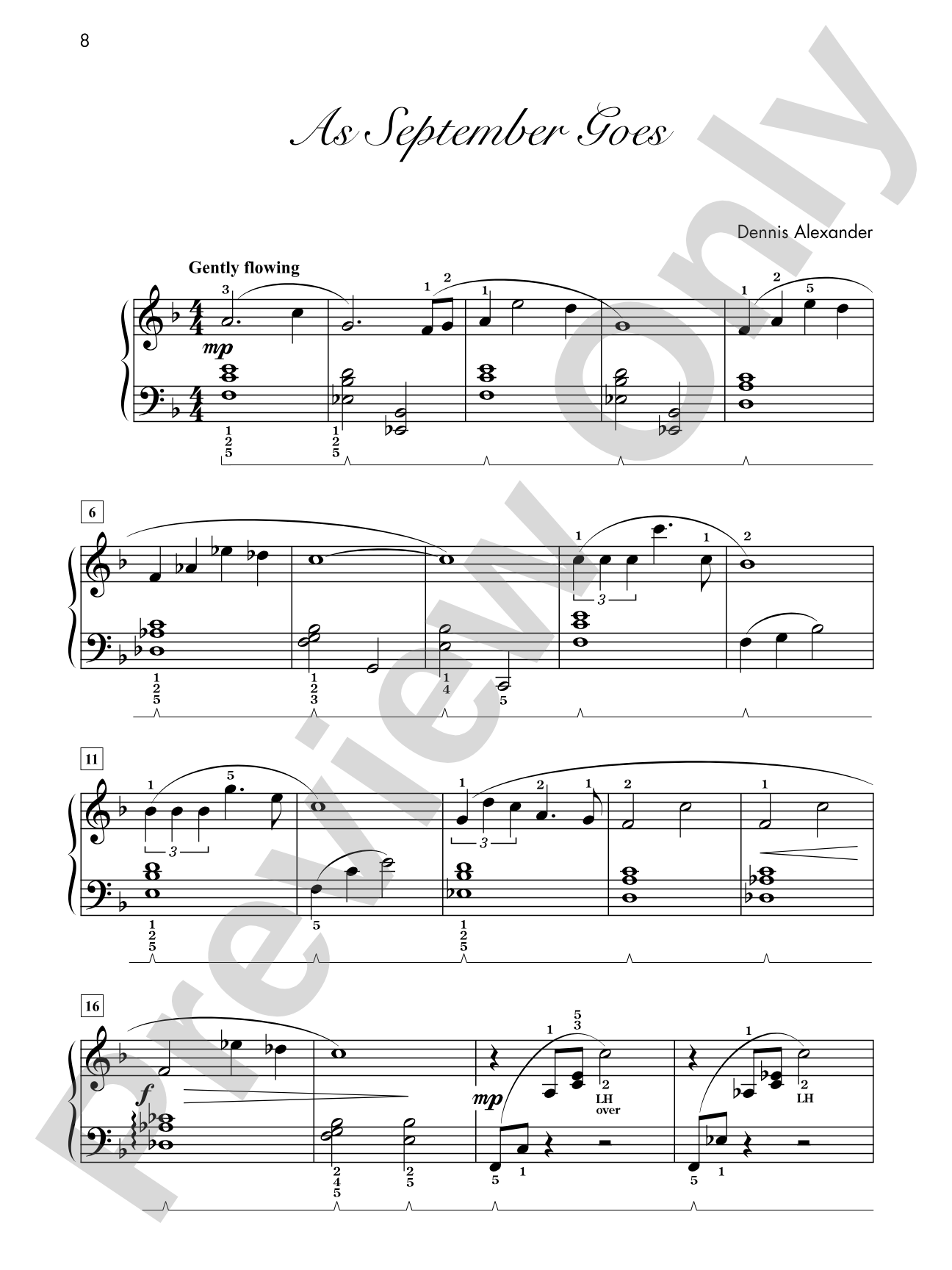

As September Goes - Piano Solo: Piano Solo
11 Stylized Solos for Early Intermediate Pianists
By Dennis Alexander
Level: Early Intermediate
Item: 00-PS-0017557
$4.99
Pickup currently not available
Related Items
A Touch of Rhumba - Piano Solo: Piano Solo |
$4.99
|
View | |
Jazz Jam - Piano Solo: Piano Solo |
$4.99
|
View | |
Purple Sage - Piano Solo: Piano Solo |
$4.99
|
View | |
Rhythmicon - Piano Solo: Piano Solo |
$4.99
|
View | |
Smooth as Silk - Piano Solo: Piano Solo |
$4.99
|
View | |
Sneakin' 'Round - Piano Solo: Piano Solo |
$4.99
|
View | |
Soft-Shoe Blues - Piano Solo: Piano Solo |
$4.99
|
View | |
Soul Searcher - Piano Solo: Piano Solo |
$4.99
|
View | |
Tahitian Nights - Piano Solo: Piano Solo |
$4.99
|
View | |
Valse du jour - Piano Solo: Piano Solo |
$7.99
|
View | |
Especially in Jazzy Style, Book 1: Piano Book |
$7.99
|
View |
Description
The goal of this series is to introduce students to the rhythms, harmonies and other unique characteristics of jazz. Students will be motivated by the variety of styles and sounds that have that special Dennis Alexander sound. From lyrical melodies to infectious rhythms and harmonies, playing jazz styles has never been more fun! Titles: As September Goes * Jazz Jam * Purple Sage * Rhythmicon * Smooth as Silk * Sneakin' 'Round * Soft-Shoe Blues * Soul Searcher * Tahitian Nights * A Touch of Rhumba * Valse du jour. A Federation Festivals 2024-2028 selection.


As September Goes - Piano Solo: Piano Solo isn't in MakeMusic Cloud just yet...but it could be. Let us know you'd like to see it, and you'll help shape what comes next. In the meantime, start a free trial and dive into thousands of interactive titles your students can play along with today.
Request This Title
Tell us you want it.
Start Your Free Trial
Explore everything that's ready to play right now.
Sample Audio
1
A Touch of Rhumba
--:--
2
Purple Sage
--:--
A Touch of Rhumba
0:00
0:00
Sample Video
No sample videos found.
Additional Details
Series:
Especially
Publisher:
Alfred Music
Page Count:
24
SKU:
00-PS-0017557
More about this title
About the Composer: Dennis Alexander

Dennis Alexander has shaped music education for decades through his prolific output of over 400 piano compositions published by Alfred Music. After teaching piano pedagogy at the University of Montana for 24 years and serving as department chair, he transitioned to private teaching and faculty positions at Cal State Fullerton and Cal State Northridge before settling in Albuquerque. His work spans all levels and styles, earning him recognition as one of the most widely performed educational composers of our time.
Beyond the page, Alexander maintains an active performance schedule as soloist, accompanist, and chamber musician. He has collaborated with internationally recognized artists and served as a clinician at state and national conventions. His compositions have been commissioned by numerous organizations, and his reputation extends globally; he has judged competitions and conducted master classes internationally, touring throughout the Far East to lead workshops and perform recitals.
Why we love this
Alexander's jazz collection stands apart for its genuine accessibility without sacrificing style. These pieces introduce early intermediate students to jazz language, harmony, and rhythm through writing that feels organic rather than didactic, with titles like "Smooth as Silk" and "Soft-Shoe Blues" that signal their character immediately. The range of moods keeps students engaged and gives you genuine programming flexibility.
What to expect
Each piece captures a distinct emotional and stylistic world. "Tahitian Nights" evokes tropical ease while "Rhythmicon" locks into infectious groove; "Valse du jour" brings elegance and "Soul Searcher" introspection. The collection moves between lyrical reflection and rhythmic playfulness without losing its jazz identity.
Who it's for
Early intermediate pianists ready to engage with jazz styles and non-classical idioms. Students need solid rhythmic foundation and comfort with contemporary notation, but no prior jazz experience is required. This series works equally well for private students preparing festival selections and classroom programs.
How to get the most out of it
- Listen to recordings of the titled styles before sight-reading; Alexander's writing assumes familiarity with the feel and swing of each idiom, and hearing the genre first makes the notation click.
- Give rhythmic figures breathing room rather than rushing them; Alexander's syncopation works only when the underlying pulse stays steady and relaxed.
- Treat the left hand as a rhythm section partner, not accompaniment; locking in the groove depends on treating bass and harmony as equally important to the melody.
- Vary your touch and dynamics within each piece; Alexander's diverse moods demand different voices, and a single sound flattens the collection's impact.
How to use it
Build a festival program around individual titles from this collection, or perform several back-to-back to showcase your student's stylistic range. The 24-page scope makes it manageable for students preparing for 2024-2028 festival cycles. You might also use the variety to demonstrate different jazz approaches within a single rehearsal or studio class.
Skills your students will build
- Reading and performing swing rhythm and syncopation
- Understanding jazz harmony and chord changes in context
- Interpreting jazz articulation and phrasing in a classical setting
- Coordinating independent rhythmic patterns between hands
- Building left-hand groove and bass-line musicality
- Responding to stylistic language markings beyond traditional tempo and dynamics