
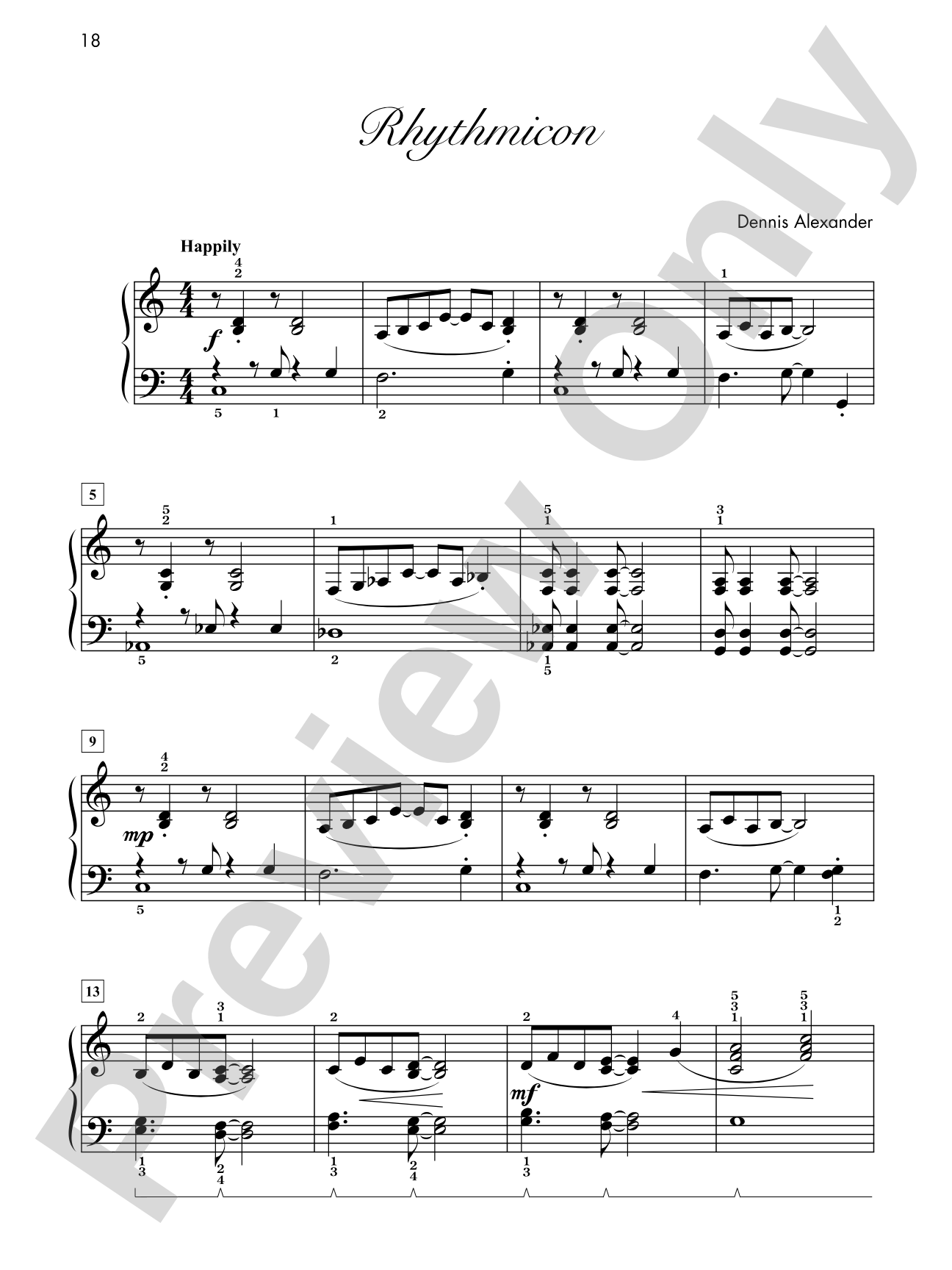

Rhythmicon - Piano Solo: Piano Solo
11 Stylized Solos for Early Intermediate Pianists
By Dennis Alexander
Level: Early Intermediate
Item: 00-PS-0017560
$4.99
Pickup currently not available
Related Items
A Touch of Rhumba - Piano Solo: Piano Solo |
$4.99
|
View | |
As September Goes - Piano Solo: Piano Solo |
$4.99
|
View | |
Jazz Jam - Piano Solo: Piano Solo |
$4.99
|
View | |
Purple Sage - Piano Solo: Piano Solo |
$4.99
|
View | |
Smooth as Silk - Piano Solo: Piano Solo |
$4.99
|
View | |
Sneakin' 'Round - Piano Solo: Piano Solo |
$4.99
|
View | |
Soft-Shoe Blues - Piano Solo: Piano Solo |
$4.99
|
View | |
Soul Searcher - Piano Solo: Piano Solo |
$4.99
|
View | |
Tahitian Nights - Piano Solo: Piano Solo |
$4.99
|
View | |
Valse du jour - Piano Solo: Piano Solo |
$7.99
|
View | |
Especially in Jazzy Style, Book 1: Piano Book |
$7.99
|
View |
Description
The goal of this series is to introduce students to the rhythms, harmonies and other unique characteristics of jazz. Students will be motivated by the variety of styles and sounds that have that special Dennis Alexander sound. From lyrical melodies to infectious rhythms and harmonies, playing jazz styles has never been more fun! Titles: As September Goes * Jazz Jam * Purple Sage * Rhythmicon * Smooth as Silk * Sneakin' 'Round * Soft-Shoe Blues * Soul Searcher * Tahitian Nights * A Touch of Rhumba * Valse du jour. A Federation Festivals 2024-2028 selection.


Rhythmicon - Piano Solo: Piano Solo isn't in MakeMusic Cloud just yet...but it could be. Let us know you'd like to see it, and you'll help shape what comes next. In the meantime, start a free trial and dive into thousands of interactive titles your students can play along with today.
Request This Title
Tell us you want it.
Start Your Free Trial
Explore everything that's ready to play right now.
Sample Audio
1
A Touch of Rhumba
--:--
2
Purple Sage
--:--
A Touch of Rhumba
0:00
0:00
Sample Video
No sample videos found.
Additional Details
Series:
Especially
Publisher:
Alfred Music
Page Count:
24
SKU:
00-PS-0017560
More about this title
About the Composer: Dennis Alexander

Dennis Alexander has shaped the landscape of educational piano music since 1986, when he began a long partnership with Alfred Music Publishing that has produced over 400 compositions and recordings. His work carries the stamp of a composer who understands exactly what students need at each level, earning him recognition as one of the most widely performed educational piano writers internationally. Alexander spent 24 years at the University of Montana as a piano pedagogy professor and department chair before relocating to California, where he taught at Cal State Fullerton and Cal State Northridge. Beyond the studio, he maintains an active performing career as a soloist and collaborative artist, has conducted master classes at national MTNA conventions, and has been invited to adjudicate competitions and lead workshops across Asia, the Caribbean, and throughout North America.
Why we love this
Alexander writes jazz arrangements that sound like they belong in a real musician's hands, not just a practice book. These pieces avoid the trap of oversimplifying jazz language; instead, they introduce authentic harmonic colors and rhythmic feels that make early intermediate students feel like they're playing actual jazz rather than simplified approximations. The collection's variety means you'll find something that fits different moods and concert contexts, from bluesy grooves to Latin-tinged styles.
What to expect
Playing through this book feels like discovering that jazz is accessible without being watered down. The melodies are singable and the grooves feel natural under the fingers; you'll find rhythmic energy in pieces like "Jazz Jam" and "Rhythmicon," lyrical warmth in "Smooth as Silk," and the kind of sophisticated harmony that reminds you why jazz captivates musicians.
Who it's for
Early intermediate pianists ready to explore jazz styles with guidance from a composer who knows how to scaffold the idiom carefully. This collection works for festival preparation, jazz literacy programs, and students who need to broaden their musical palette beyond classical repertoire.
How to get the most out of it
- Treat the swing rhythms as conversations between your hands. The left hand sets the groove foundation, but it's the right hand's phrasing that makes listeners hear the jazz feel; don't let the rhythm become mechanical.
- Spend time with the recorded accompaniments to internalize the harmonic backdrop and understand where your melody sits within the ensemble sound.
- Balance melody and accompaniment so that syncopated left-hand figures don't overshadow the tune. This is especially important in pieces like "Soft-Shoe Blues" where accompaniment patterns could easily grab too much attention.
- Shape dynamic contours across entire phrases rather than measure-to-measure; jazz thrives on forward motion and subtle intensity shifts that create breathing room.
How to use it
Consider pairing one of these pieces with a classical or contemporary work on a recital to showcase your student's versatility. Several titles fit perfectly into a spring or early summer concert focused on American musical idioms, and the collection's range means you can select pieces that speak to different student personalities and strengths.
Skills your students will build
- Reading and executing jazz articulations (legato eighth notes, swing feel)
- Understanding chord extensions and jazz harmony beyond functional harmony
- Syncopation and rhythmic independence between hands
- Stylistic interpretation of blues forms and Latin rhythmic patterns
- Listening and responding to recorded accompaniments