
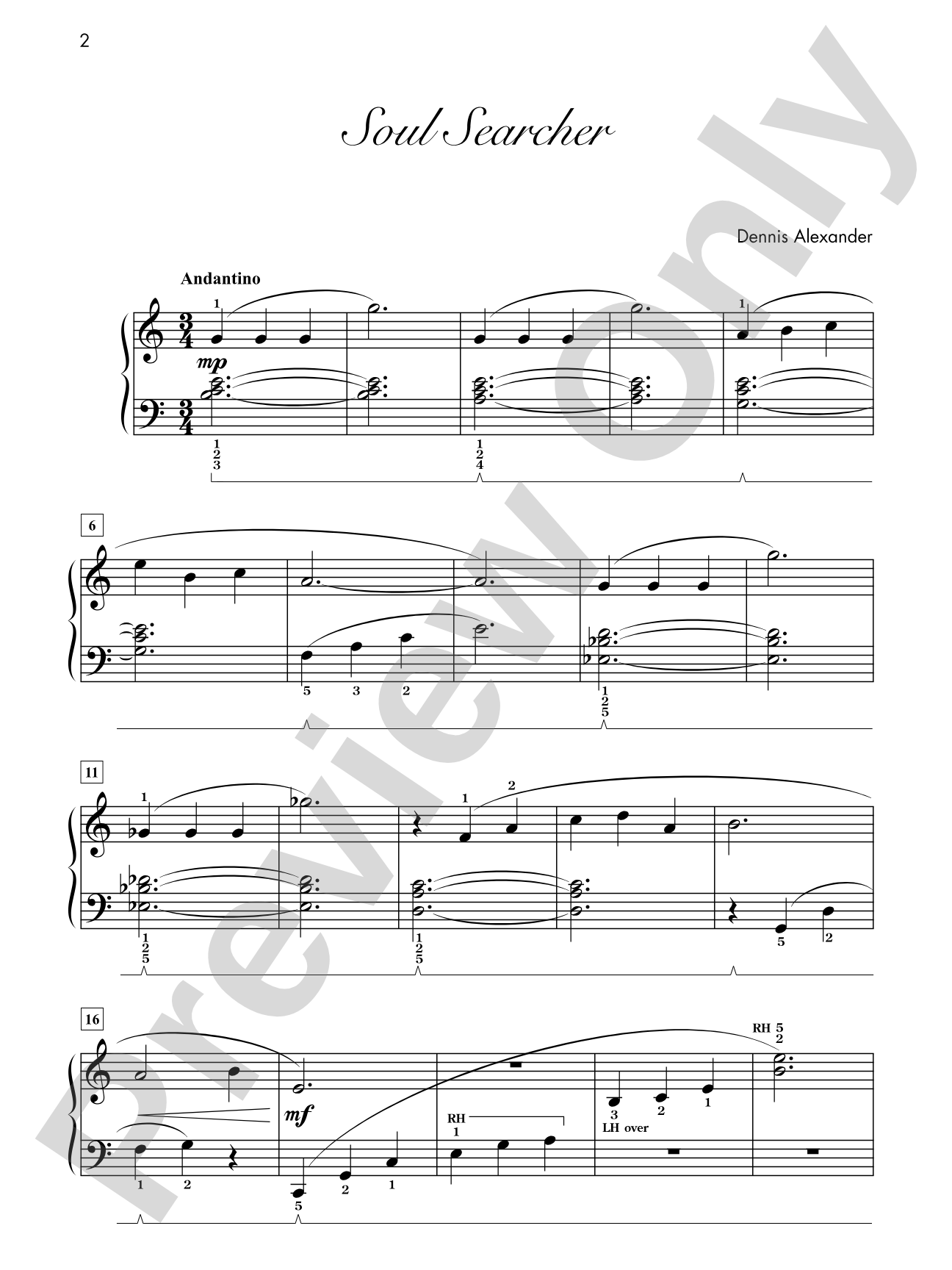

Soul Searcher - Piano Solo: Piano Solo
11 Stylized Solos for Early Intermediate Pianists
By Dennis Alexander
Level: Early Intermediate
Item: 00-PS-0017564
$4.99
Pickup currently not available
Related Items
A Touch of Rhumba - Piano Solo: Piano Solo |
$4.99
|
View | |
As September Goes - Piano Solo: Piano Solo |
$4.99
|
View | |
Jazz Jam - Piano Solo: Piano Solo |
$4.99
|
View | |
Purple Sage - Piano Solo: Piano Solo |
$4.99
|
View | |
Rhythmicon - Piano Solo: Piano Solo |
$4.99
|
View | |
Smooth as Silk - Piano Solo: Piano Solo |
$4.99
|
View | |
Sneakin' 'Round - Piano Solo: Piano Solo |
$4.99
|
View | |
Soft-Shoe Blues - Piano Solo: Piano Solo |
$4.99
|
View | |
Tahitian Nights - Piano Solo: Piano Solo |
$4.99
|
View | |
Valse du jour - Piano Solo: Piano Solo |
$7.99
|
View | |
Especially in Jazzy Style, Book 1: Piano Book |
$7.99
|
View |
Description
The goal of this series is to introduce students to the rhythms, harmonies and other unique characteristics of jazz. Students will be motivated by the variety of styles and sounds that have that special Dennis Alexander sound. From lyrical melodies to infectious rhythms and harmonies, playing jazz styles has never been more fun! Titles: As September Goes * Jazz Jam * Purple Sage * Rhythmicon * Smooth as Silk * Sneakin' 'Round * Soft-Shoe Blues * Soul Searcher * Tahitian Nights * A Touch of Rhumba * Valse du jour. A Federation Festivals 2024-2028 selection.


Soul Searcher - Piano Solo: Piano Solo isn't in MakeMusic Cloud just yet...but it could be. Let us know you'd like to see it, and you'll help shape what comes next. In the meantime, start a free trial and dive into thousands of interactive titles your students can play along with today.
Request This Title
Tell us you want it.
Start Your Free Trial
Explore everything that's ready to play right now.
Sample Audio
1
A Touch of Rhumba
--:--
2
Purple Sage
--:--
A Touch of Rhumba
0:00
0:00
Sample Video
No sample videos found.
Additional Details
Series:
Especially
Publisher:
Alfred Music
Page Count:
24
SKU:
00-PS-0017564
More about this title
About the Composer: Dennis Alexander

Dennis Alexander has been composing educational piano music since 1986, when he began his partnership with Alfred Music Publishing. Over four decades, he has produced more than 400 published works and recordings that have established him as one of the most widely performed educational composers in the world. His teaching career spanned nearly a quarter-century at the University of Montana, where he directed the piano program and taught pedagogy before relocating to California to continue private instruction and faculty work at Cal State Fullerton and Cal State Northridge.
Beyond the studio and page, Alexander has built a career as a clinician, collaborative musician, and international advocate for music education. He has performed recitals across Asia, judged national competitions, and served as a master class conductor at the Music Teachers National Association convention. His commissions from state and regional organizations have deepened his connection to the teaching community, and his touring schedule for Alfred Music continues to bring his pedagogical philosophy directly to students and educators.
Why we love this
Alexander writes jazz arrangements that don't condescend to students or pretend jazz is simpler than it really is. These pieces respect the idiom while remaining playable at the early intermediate level, which means your students will sound genuinely musical, not just technically competent. The collection's variety (from bluesy grooves to Latin touches to swing feels) keeps practice engaging and mirrors the actual breadth of jazz styles students should encounter.
What to expect
These pieces move between wistful and energetic, never staying in one mood for long. You'll hear moments of lyrical introspection (especially in Soft-Shoe Blues and Smooth as Silk) interrupted by rhythmic bursts and unexpected harmonic turns that keep the listener leaning in.
Who it's for
Early intermediate pianists ready to explore jazz language beyond beginner folk songs and classical miniatures. Students preparing for festivals, competitions, or simply looking to expand their stylistic range will find genuine musical material here.
How to get the most out of it
- Listen closely to the rhythmic swing in pieces like Jazz Jam and Soul Searcher; the notation may show straight eighths, but the feel should live somewhere between written and triplet.
- Let chord voicings breathe. Alexander spaces them deliberately, so resist the urge to fill empty space with extra notes or pedal wash.
- Anchor the left hand groove first, especially in the blues-based selections. Once your students lock that foundation, the right-hand melody lands with far more confidence.
- Record yourself playing through each piece once before rehearsal. Hearing where the phrasing naturally sits will help you guide students toward more idiomatic interpretations.
How to use it
Slot individual pieces into student recitals alongside classical and contemporary repertoire to showcase range; the Federation Festivals selection makes them natural choices for competition preparation throughout the 2024-2028 cycle. Alternatively, use the collection to build a full student concert program around jazz, letting each piece represent a different regional or historical influence.
Skills your students will build
- Reading and executing swing rhythms and triplet feels
- Interpreting jazz chord symbols and realizing voicings
- Maintaining consistent groove and time feel
- Shaping phrasing in a jazz context rather than classical phrasing patterns
- Understanding blues form and structure
- Exploring Latin jazz rhythmic patterns (rhumba, soft-shoe)