
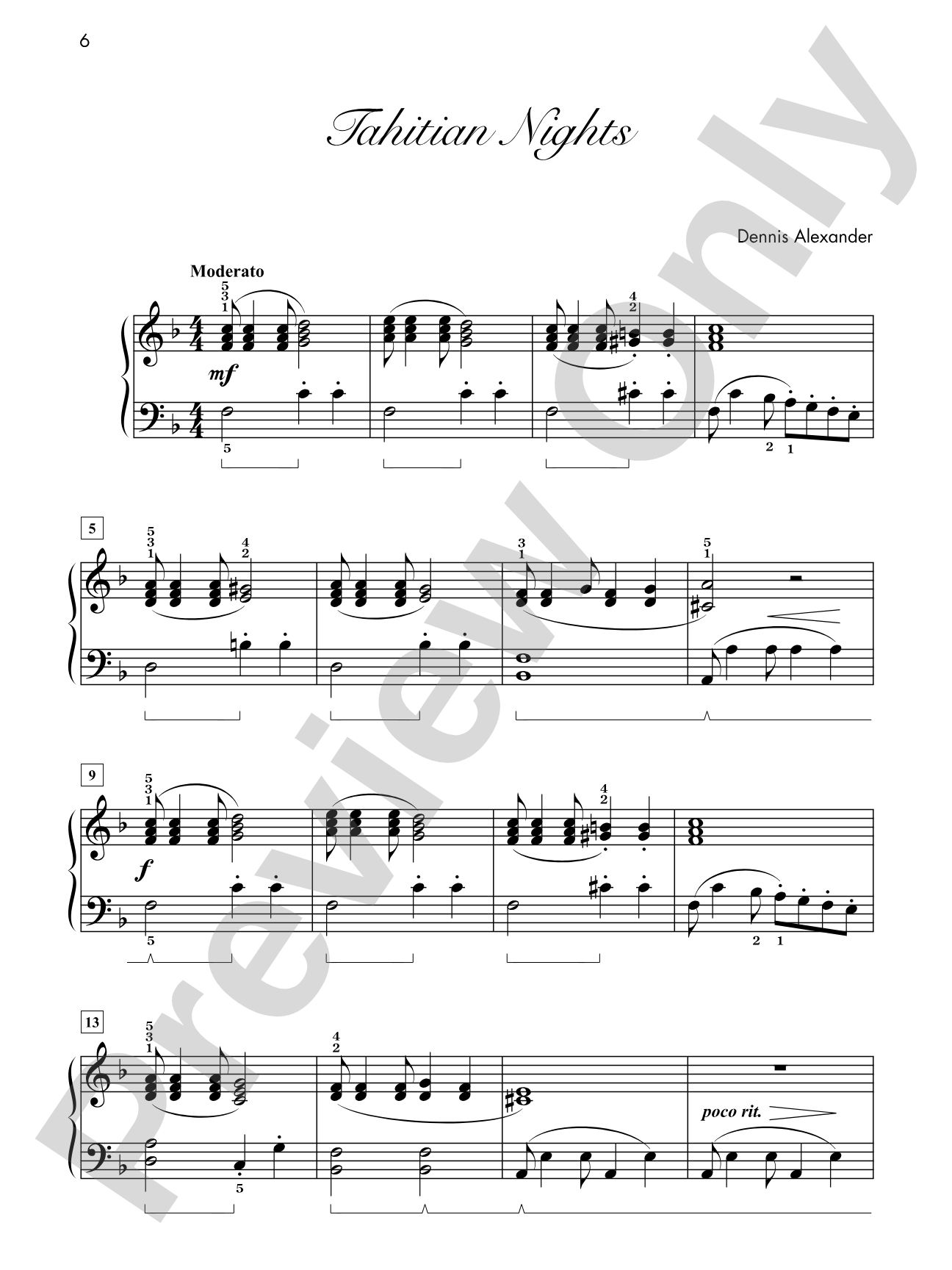

Tahitian Nights - Piano Solo: Piano Solo
11 Stylized Solos for Early Intermediate Pianists
By Dennis Alexander
Level: Early Intermediate
Item: 00-PS-0017565
$4.99
Pickup currently not available
Related Items
A Touch of Rhumba - Piano Solo: Piano Solo |
$4.99
|
View | |
As September Goes - Piano Solo: Piano Solo |
$4.99
|
View | |
Jazz Jam - Piano Solo: Piano Solo |
$4.99
|
View | |
Purple Sage - Piano Solo: Piano Solo |
$4.99
|
View | |
Rhythmicon - Piano Solo: Piano Solo |
$4.99
|
View | |
Smooth as Silk - Piano Solo: Piano Solo |
$4.99
|
View | |
Sneakin' 'Round - Piano Solo: Piano Solo |
$4.99
|
View | |
Soft-Shoe Blues - Piano Solo: Piano Solo |
$4.99
|
View | |
Soul Searcher - Piano Solo: Piano Solo |
$4.99
|
View | |
Valse du jour - Piano Solo: Piano Solo |
$7.99
|
View | |
Especially in Jazzy Style, Book 1: Piano Book |
$7.99
|
View |
Description
The goal of this series is to introduce students to the rhythms, harmonies and other unique characteristics of jazz. Students will be motivated by the variety of styles and sounds that have that special Dennis Alexander sound. From lyrical melodies to infectious rhythms and harmonies, playing jazz styles has never been more fun! Titles: As September Goes * Jazz Jam * Purple Sage * Rhythmicon * Smooth as Silk * Sneakin' 'Round * Soft-Shoe Blues * Soul Searcher * Tahitian Nights * A Touch of Rhumba * Valse du jour. A Federation Festivals 2024-2028 selection.


Tahitian Nights - Piano Solo: Piano Solo isn't in MakeMusic Cloud just yet...but it could be. Let us know you'd like to see it, and you'll help shape what comes next. In the meantime, start a free trial and dive into thousands of interactive titles your students can play along with today.
Request This Title
Tell us you want it.
Start Your Free Trial
Explore everything that's ready to play right now.
Sample Audio
1
A Touch of Rhumba
--:--
2
Purple Sage
--:--
A Touch of Rhumba
0:00
0:00
Sample Video
No sample videos found.
Additional Details
Series:
Especially
Publisher:
Alfred Music
Page Count:
24
SKU:
00-PS-0017565
More about this title
About the Composer: Dennis Alexander

Dennis Alexander has spent nearly four decades establishing himself as a leading voice in educational piano composition. Since 1986, his partnership with Alfred Music Publishing has resulted in over 400 published works and recordings, making him one of the most widely taught composers in studios and conservatories worldwide. He held a faculty position at the University of Montana for 24 years, where he taught piano pedagogy and chaired the piano department before relocating to California to teach at Cal State Fullerton and Cal State Northridge.
Beyond the classroom, Alexander maintains an active performance career as soloist, accompanist, and chamber musician. He has appeared at Carnegie Recital Hall, collaborated with internationally recognized artists, and served as a clinician at numerous state and national music teachers conventions. His work has been commissioned by organizations across the country, and in recent years he has expanded his reach internationally, touring Asia and judging national competitions. Alexander currently resides in Albuquerque, New Mexico, where he continues composing and conducting workshops for Alfred Music Publishing.
Why we love this
Alexander's jazz series balances accessibility with genuine style education. Each piece in this collection teaches real jazz vocabulary, rhythmic concepts, and harmonic language without sacrificing the melodic appeal that keeps early intermediate students engaged and wanting to practice.
What to expect
Sophisticated yet approachable. These pieces move from lyrical moments to rhythmically charged sections, creating variety across the collection while staying rooted in jazz idioms that feel fresh and current. You'll encounter blues changes, rhumba syncopation, and smooth ballad writing that teaches you how jazz really sounds.
Who it's for
Early intermediate pianists ready to explore jazz styles with structure and guidance. This collection works well for students curious about contemporary piano repertoire beyond classical tradition, or for those preparing for festival competitions that specifically seek educational jazz selections.
How to get the most out of it
- Lock into the swing feel from the first measure. Alexander writes explicit rhythmic notation, so respect his markings rather than trying to "swing" passages he's written straight.
- Layer the dynamics gradually. Many pieces in this series use subtle dynamic shifts to create sophistication; don't telegraph big changes or you'll flatten the phrasing.
- Balance syncopated melodies against steady accompaniment patterns. Your left hand anchors the groove while the right hand can breathe and bend around the rhythmic framework.
- Experiment with the recording before finalizing your interpretation. Alexander's accompaniments establish a specific groove and tempo feel that helps shape the solo part authentically.
How to use it
Feature individual selections in student recitals to demonstrate contemporary style range alongside classical repertoire. The Federation Festival designation makes this ideal for preparing competition programs, and the 24-page collection offers enough variety to support multiple students performing different selections throughout a season.
Skills your students will build
- Reading jazz chord symbols and comping patterns
- Swing rhythm and syncopation
- Blues changes and harmonic movement in jazz contexts
- Rubato and rhythmic flexibility within groove-based accompaniments
- Stylistic interpretation of multiple jazz subgenres (blues, rhumba, ballad, contemporary jazz)