
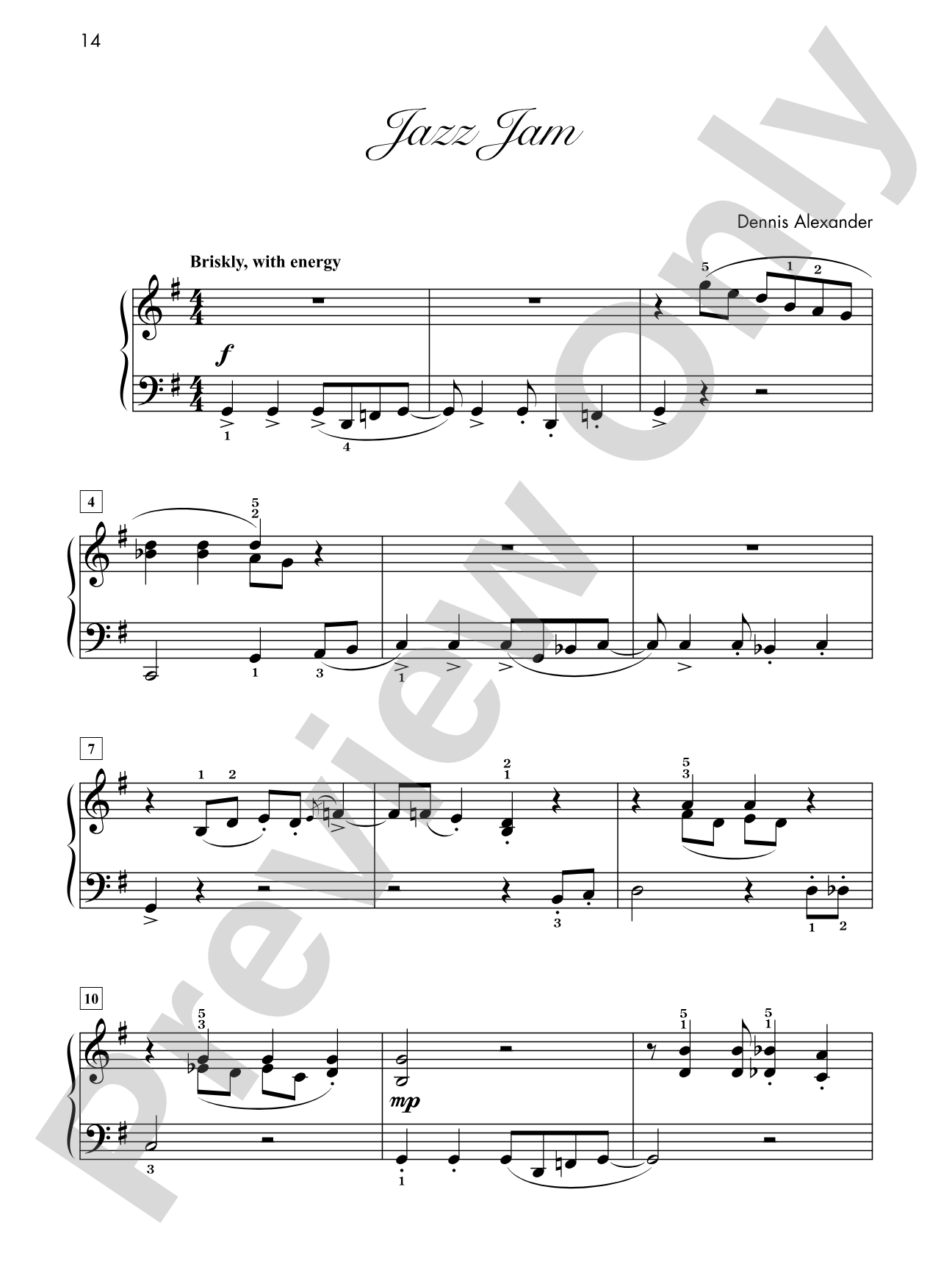

Jazz Jam - Piano Solo: Piano Solo
11 Stylized Solos for Early Intermediate Pianists
By Dennis Alexander
Level: Early Intermediate
Item: 00-PS-0017558
$4.99
Pickup currently not available
Related Items
A Touch of Rhumba - Piano Solo: Piano Solo |
$4.99
|
View | |
As September Goes - Piano Solo: Piano Solo |
$4.99
|
View | |
Purple Sage - Piano Solo: Piano Solo |
$4.99
|
View | |
Rhythmicon - Piano Solo: Piano Solo |
$4.99
|
View | |
Smooth as Silk - Piano Solo: Piano Solo |
$4.99
|
View | |
Sneakin' 'Round - Piano Solo: Piano Solo |
$4.99
|
View | |
Soft-Shoe Blues - Piano Solo: Piano Solo |
$4.99
|
View | |
Soul Searcher - Piano Solo: Piano Solo |
$4.99
|
View | |
Tahitian Nights - Piano Solo: Piano Solo |
$4.99
|
View | |
Valse du jour - Piano Solo: Piano Solo |
$7.99
|
View | |
Especially in Jazzy Style, Book 1: Piano Book |
$7.99
|
View |
Description
The goal of this series is to introduce students to the rhythms, harmonies and other unique characteristics of jazz. Students will be motivated by the variety of styles and sounds that have that special Dennis Alexander sound. From lyrical melodies to infectious rhythms and harmonies, playing jazz styles has never been more fun! Titles: As September Goes * Jazz Jam * Purple Sage * Rhythmicon * Smooth as Silk * Sneakin' 'Round * Soft-Shoe Blues * Soul Searcher * Tahitian Nights * A Touch of Rhumba * Valse du jour. A Federation Festivals 2024-2028 selection.


Jazz Jam - Piano Solo: Piano Solo isn't in MakeMusic Cloud just yet...but it could be. Let us know you'd like to see it, and you'll help shape what comes next. In the meantime, start a free trial and dive into thousands of interactive titles your students can play along with today.
Request This Title
Tell us you want it.
Start Your Free Trial
Explore everything that's ready to play right now.
Sample Audio
1
A Touch of Rhumba
--:--
2
Purple Sage
--:--
A Touch of Rhumba
0:00
0:00
Sample Video
No sample videos found.
Additional Details
Series:
Especially
Publisher:
Alfred Music
Page Count:
24
SKU:
00-PS-0017558
More about this title
About the Composer: Dennis Alexander

Dennis Alexander has spent nearly four decades establishing himself as a cornerstone voice in educational piano composition. Since 1986, his prolific output of over 400 publications through Alfred Music Publishing has earned him recognition across the globe; his work spans every student level and has become standard repertoire in studios and classrooms worldwide. Alexander's academic foundation runs deep. He served as chair of the piano department at the University of Montana for 24 years before relocating to California, where he held faculty positions at both Cal State Fullerton and Cal State Northridge. His training under Richard Reber at the University of Kansas shaped his compositional approach from the start.
Beyond the page, Alexander maintains an active performing life as soloist, accompanist, and chamber musician, with a 1987 Carnegie Recital Hall debut that launched decades of collaborative work with internationally recognized artists. He has been a regular clinician at state and national music teachers conventions, judged national competitions, and completed performance tours across Asia. Currently based in Albuquerque, New Mexico, Alexander continues his composing and touring schedule while remaining deeply connected to the music education community he has shaped.
Why we love this
Alexander captures the essence of what draws students to jazz without requiring advanced harmonic literacy or complex rhythmic reading. The collection balances genuine jazz language, swing feels, blues structures, contemporary harmonies, with accessible voicings and intuitive melodies, so young pianists hear themselves sounding sophisticated from day one. These pieces sit squarely in the sweet spot where musical authenticity meets student confidence.
What to expect
Sophisticated without pretension. You hear the warm, conversational tone of someone who knows how to write a tune, lyrical lines float naturally over gently syncopated rhythms, while pieces like the rhumba and Tahitian selections infuse the collection with genuine character and color. The overall effect is musical maturity wrapped in accessibility.
Who it's for
Early intermediate pianists ready to engage with real jazz language rather than jazz-flavored classical pieces. Teachers seeking a comprehensive entry point to jazz that doesn't ask students to fake it; the writing honors the idiom while remaining age-appropriate.
How to get the most out of it
- Treat the swing eighth notes as a rhythmic feel rather than a technical hurdle. Let students internalize the shuffle before drilling it; listening to recordings of these pieces helps the ear absorb the pocket.
- Anchor the blues pieces by establishing the steady pulse in your practice sessions first, then layer in the syncopation. This prevents rushed or flattened rhythm.
- Explore the recorded accompaniment early in learning. These arrangements were designed with the backing tracks in mind, so pairing them together builds confidence and stylistic awareness simultaneously.
- Experiment with pedal placement in the rubato passages. Alexander writes in moments of flexibility, and knowing when to clear versus sustain the harmony matters more here than in classical repertoire.
How to use it
Slot these pieces into the spring semester when students are ready for stylistic variety and want to break from classical repertoire. They work beautifully in recitals that blend genres, or as bridges between classical study and jazz ensemble participation. The Federation Festivals selection status also makes this an excellent choice for competitive event preparation.
Skills your students will build
- Swing rhythms and shuffle feels
- Blues harmony and form
- Syncopated rhythmic reading
- Pedal control in non-classical contexts
- Stylistic interpretation across multiple jazz idioms
- Voice leading in contemporary harmonic language