
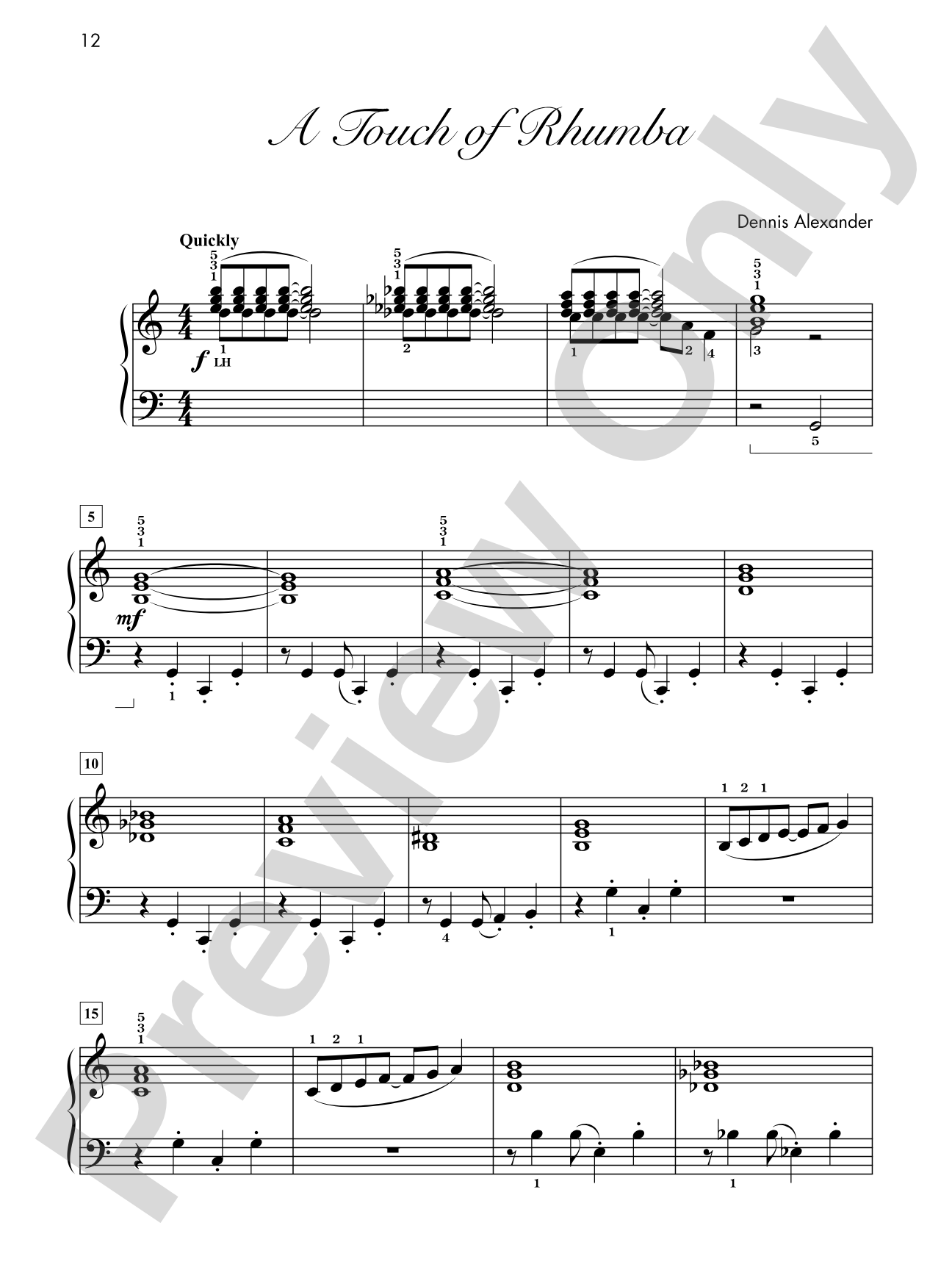

A Touch of Rhumba - Piano Solo: Piano Solo
11 Stylized Solos for Early Intermediate Pianists
By Dennis Alexander
Level: Early Intermediate
Item: 00-PS-0017556
$4.99
Pickup currently not available
Related Items
As September Goes - Piano Solo: Piano Solo |
$4.99
|
View | |
Jazz Jam - Piano Solo: Piano Solo |
$4.99
|
View | |
Purple Sage - Piano Solo: Piano Solo |
$4.99
|
View | |
Rhythmicon - Piano Solo: Piano Solo |
$4.99
|
View | |
Smooth as Silk - Piano Solo: Piano Solo |
$4.99
|
View | |
Sneakin' 'Round - Piano Solo: Piano Solo |
$4.99
|
View | |
Soft-Shoe Blues - Piano Solo: Piano Solo |
$4.99
|
View | |
Soul Searcher - Piano Solo: Piano Solo |
$4.99
|
View | |
Tahitian Nights - Piano Solo: Piano Solo |
$4.99
|
View | |
Valse du jour - Piano Solo: Piano Solo |
$7.99
|
View | |
Especially in Jazzy Style, Book 1: Piano Book |
$7.99
|
View |
Description
The goal of this series is to introduce students to the rhythms, harmonies and other unique characteristics of jazz. Students will be motivated by the variety of styles and sounds that have that special Dennis Alexander sound. From lyrical melodies to infectious rhythms and harmonies, playing jazz styles has never been more fun! Titles: As September Goes * Jazz Jam * Purple Sage * Rhythmicon * Smooth as Silk * Sneakin' 'Round * Soft-Shoe Blues * Soul Searcher * Tahitian Nights * A Touch of Rhumba * Valse du jour. A Federation Festivals 2024-2028 selection.


A Touch of Rhumba - Piano Solo: Piano Solo isn't in MakeMusic Cloud just yet...but it could be. Let us know you'd like to see it, and you'll help shape what comes next. In the meantime, start a free trial and dive into thousands of interactive titles your students can play along with today.
Request This Title
Tell us you want it.
Start Your Free Trial
Explore everything that's ready to play right now.
Sample Audio
1
A Touch of Rhumba
--:--
2
Purple Sage
--:--
A Touch of Rhumba
0:00
0:00
Sample Video
No sample videos found.
Additional Details
Series:
Especially
Publisher:
Alfred Music
Page Count:
24
SKU:
00-PS-0017556
More about this title
About the Composer: Dennis Alexander

Dennis Alexander has been composing educational piano music since joining Alfred Music Publishing in 1986, and his catalog of over 400 works has made him one of the most widely performed composers in piano pedagogy worldwide. A University of Kansas graduate and former piano department chair at the University of Montana, Alexander spent decades teaching piano pedagogy, applied study, and class piano before relocating to California and eventually settling in Albuquerque, where he continues an active schedule as a clinician, recitalist, and composer.
Beyond the studio, Alexander has appeared as a soloist and chamber musician at Carnegie Recital Hall, served as a collaborative artist for internationally recognized performers, and maintained a steady presence at state and national music teachers conventions. His work has been commissioned by numerous organizations, and his influence extends globally through performances, masterclasses, and judging roles across Asia, the Pacific, and throughout North America.
Why we love this
Alexander's touch with jazz idioms feels natural rather than forced, rooting the style in lyrical melody and clear harmonic progression rather than technical showmanship. The collection pulls students into jazz without overwhelming them, balancing approachable rhythmic figures with the sophisticated voicings that make jazz writing rewarding to play and hear.
What to expect
These pieces radiate warmth and invitation. The titles alone conjure specific moods, from the sleepy sensuality of "Soft-Shoe Blues" to the sun-soaked atmosphere of "Tahitian Nights." Each piece distills a jazz style into its most appealing essence without sacrificing the harmonic and rhythmic details that make the genre distinctive.
Who it's for
Early intermediate pianists encountering jazz vocabulary for the first time, and ensemble programs looking to round out concert programming with solo repertoire that students will actually enjoy learning. This collection works equally well for Friday afternoon recitals and spring concert finales.
How to get the most out of it
- Let the rhumba rhythm settle into your body first. Practice hands separately until the left hand's clave or tumbao pattern becomes reflexive, then layer in the melody with a natural lilt rather than mechanical precision.
- Listen to recordings of the idiom before rehearsing. Alexander's titles hint at the styles within them; knowing what authentic rhumba, blues, or Tahitian music sounds like will inform your touch and phrasing immediately.
- Shape the phrases around the harmonic changes rather than the written note values. Jazz writing on the page often undersells the breath and space that make the style sing.
How to use it
Slot one or two selections into a mixed recital to introduce parents and peers to jazz as a living, learnable tradition rather than something remote or academic. Alternatively, feature the entire collection as a standalone recital for students ready to explore a new genre, or distribute individual pieces throughout the year as students' reading and interpretive skills deepen.
Skills your students will build
- Reading and executing jazz rhythmic figures (syncopation, swing feel, anticipations)
- Understanding jazz harmony and voice leading conventions
- Translating written jazz notation into idiomatic phrasing and articulation
- Recognizing and performing diverse jazz subgenres (blues, rhumba, ballad styles)
- Building independence between hands in syncopated contexts