
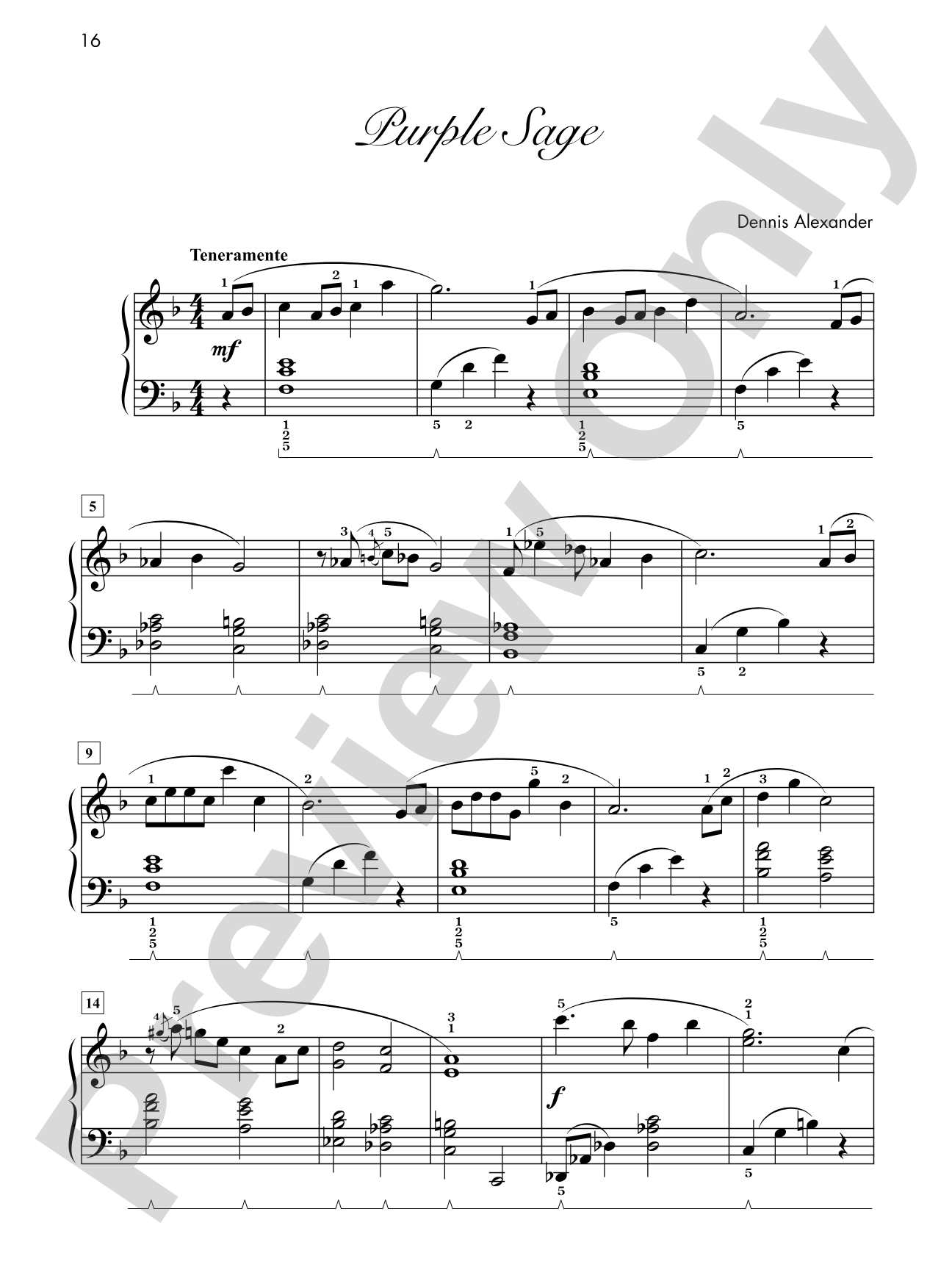

Purple Sage - Piano Solo: Piano Solo
11 Stylized Solos for Early Intermediate Pianists
By Dennis Alexander
Level: Early Intermediate
Item: 00-PS-0017559
$4.99
Pickup currently not available
Related Items
A Touch of Rhumba - Piano Solo: Piano Solo |
$4.99
|
View | |
As September Goes - Piano Solo: Piano Solo |
$4.99
|
View | |
Jazz Jam - Piano Solo: Piano Solo |
$4.99
|
View | |
Rhythmicon - Piano Solo: Piano Solo |
$4.99
|
View | |
Smooth as Silk - Piano Solo: Piano Solo |
$4.99
|
View | |
Sneakin' 'Round - Piano Solo: Piano Solo |
$4.99
|
View | |
Soft-Shoe Blues - Piano Solo: Piano Solo |
$4.99
|
View | |
Soul Searcher - Piano Solo: Piano Solo |
$4.99
|
View | |
Tahitian Nights - Piano Solo: Piano Solo |
$4.99
|
View | |
Valse du jour - Piano Solo: Piano Solo |
$7.99
|
View | |
Especially in Jazzy Style, Book 1: Piano Book |
$7.99
|
View |
Description
The goal of this series is to introduce students to the rhythms, harmonies and other unique characteristics of jazz. Students will be motivated by the variety of styles and sounds that have that special Dennis Alexander sound. From lyrical melodies to infectious rhythms and harmonies, playing jazz styles has never been more fun! Titles: As September Goes * Jazz Jam * Purple Sage * Rhythmicon * Smooth as Silk * Sneakin' 'Round * Soft-Shoe Blues * Soul Searcher * Tahitian Nights * A Touch of Rhumba * Valse du jour. A Federation Festivals 2024-2028 selection.


Purple Sage - Piano Solo: Piano Solo isn't in MakeMusic Cloud just yet...but it could be. Let us know you'd like to see it, and you'll help shape what comes next. In the meantime, start a free trial and dive into thousands of interactive titles your students can play along with today.
Request This Title
Tell us you want it.
Start Your Free Trial
Explore everything that's ready to play right now.
Sample Audio
1
A Touch of Rhumba
--:--
2
Purple Sage
--:--
A Touch of Rhumba
0:00
0:00
Sample Video
No sample videos found.
Additional Details
Series:
Especially
Publisher:
Alfred Music
Page Count:
24
SKU:
00-PS-0017559
More about this title
About the Composer: Dennis Alexander

Dennis Alexander has spent over four decades establishing himself as one of the most trusted voices in educational piano composition. Since partnering with Alfred Music Publishing in 1986, he has created more than 400 published works and recordings that span every level from beginner through advanced, earning him international recognition for his ability to write music that students actually want to play.
Alexander's career reflects deep roots in both pedagogy and performance. He taught piano pedagogy at the University of Montana for nearly a quarter-century before relocating to California, where he maintained a private studio and contributed to the faculty at Cal State Fullerton and Cal State Northridge. His background as a soloist and collaborative artist, including a Carnegie Recital Hall debut in 1987, informs his compositional approach. Today based in Albuquerque, New Mexico, he continues an active schedule as a clinician at state and national conventions, and has been sought out internationally to teach, adjudicate, and conduct master classes.
Why we love this
Alexander has a gift for writing jazz that feels authentic without overwhelming early intermediate players. Each piece in this collection delivers genuine harmonic interest and rhythmic variety, yet remains playable without excessive technical demands. Your students will experience real jazz sounds and styles from day one.
What to expect
These pieces capture the warmth and accessibility that Alexander is known for while introducing genuine jazz textures: syncopated rhythms, seventh chords, blues changes, and the kind of harmonic color that makes students feel like they're playing something real. There's immediate gratification mixed with room to grow.
Who it's for
Early intermediate pianists ready to explore jazz idioms in an approachable collection. This works especially well for students who have solid technique but limited exposure to jazz vocabulary and want a guided entry point.
How to get the most out of it
- Balance the melody against the harmonic complexity beneath it. These pieces reward clear voicing that lets the jazz flavor shine without muddying the line.
- Anchor the groove with consistent tempo. Jazz styles demand rhythmic confidence, so lock in your pulse before worrying about subtle phrasing.
- Lean into the character of each piece. The range from blues to rhumba to soft-shoe means thinking beyond "correct notes" and into style-appropriate interpretation.
How to use it
Feature a single piece as a recital opener to signal a shift away from classical repertoire, or program several selections across a season to build student comfort with jazz vocabulary alongside traditional literature. The range of styles also makes it ideal for jazz appreciation units or as supplementary material for students in technique-focused curricula.
Skills your students will build
- Reading jazz chord symbols and voicings
- Playing syncopated rhythms accurately in jazz contexts
- Interpreting swing eighths and other jazz articulation
- Recognizing and executing blues progressions
- Balancing melody against jazz-style accompaniment figures
- Developing sensitivity to style-specific interpretation (blues, rhumba, soft-shoe)