
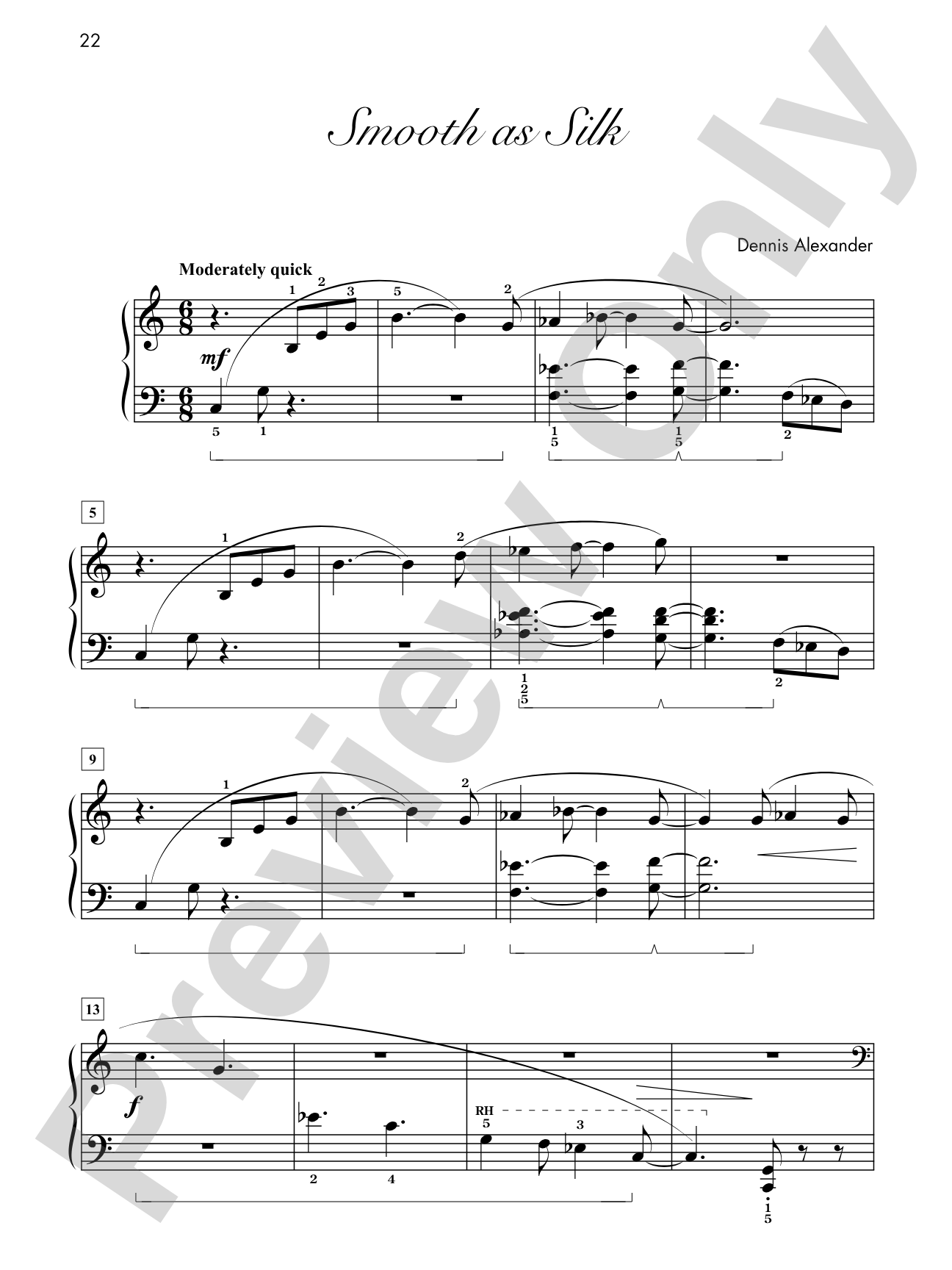

Smooth as Silk - Piano Solo: Piano Solo
11 Stylized Solos for Early Intermediate Pianists
By Dennis Alexander
Level: Early Intermediate
Item: 00-PS-0017561
$4.99
Pickup currently not available
Related Items
A Touch of Rhumba - Piano Solo: Piano Solo |
$4.99
|
View | |
As September Goes - Piano Solo: Piano Solo |
$4.99
|
View | |
Jazz Jam - Piano Solo: Piano Solo |
$4.99
|
View | |
Purple Sage - Piano Solo: Piano Solo |
$4.99
|
View | |
Rhythmicon - Piano Solo: Piano Solo |
$4.99
|
View | |
Sneakin' 'Round - Piano Solo: Piano Solo |
$4.99
|
View | |
Soft-Shoe Blues - Piano Solo: Piano Solo |
$4.99
|
View | |
Soul Searcher - Piano Solo: Piano Solo |
$4.99
|
View | |
Tahitian Nights - Piano Solo: Piano Solo |
$4.99
|
View | |
Valse du jour - Piano Solo: Piano Solo |
$7.99
|
View | |
Especially in Jazzy Style, Book 1: Piano Book |
$7.99
|
View |
Description
The goal of this series is to introduce students to the rhythms, harmonies and other unique characteristics of jazz. Students will be motivated by the variety of styles and sounds that have that special Dennis Alexander sound. From lyrical melodies to infectious rhythms and harmonies, playing jazz styles has never been more fun! Titles: As September Goes * Jazz Jam * Purple Sage * Rhythmicon * Smooth as Silk * Sneakin' 'Round * Soft-Shoe Blues * Soul Searcher * Tahitian Nights * A Touch of Rhumba * Valse du jour. A Federation Festivals 2024-2028 selection.


Smooth as Silk - Piano Solo: Piano Solo isn't in MakeMusic Cloud just yet...but it could be. Let us know you'd like to see it, and you'll help shape what comes next. In the meantime, start a free trial and dive into thousands of interactive titles your students can play along with today.
Request This Title
Tell us you want it.
Start Your Free Trial
Explore everything that's ready to play right now.
Sample Audio
1
A Touch of Rhumba
--:--
2
Purple Sage
--:--
A Touch of Rhumba
0:00
0:00
Sample Video
No sample videos found.
Additional Details
Series:
Especially
Publisher:
Alfred Music
Page Count:
24
SKU:
00-PS-0017561
More about this title
About the Composer: Dennis Alexander

Dennis Alexander has shaped music education for decades as both a composer and pedagogue. After 24 years directing the piano program at the University of Montana, he moved to California where he taught at Cal State Fullerton and Cal State Northridge while maintaining a prolific composing career. A Kansas native trained at the University of Kansas, Alexander made his Carnegie Recital Hall debut in 1987 and has performed as soloist and collaborator across North America and Asia.
Since 1986, Alexander's partnership with Alfred Music Publishing has produced over 400 publications that have become staples in studios and classrooms worldwide. He remains in high demand as a clinician at state and national conventions, and organizations continue to commission works from him. Currently based in Albuquerque, Alexander balances an active touring schedule with his compositional work, earning his reputation as one of the most accessible and effective voices in educational piano music.
Why we love this
Alexander writes jazz for students who need clear harmonic anchors and playable rhythmic patterns, never sacrificing genuine style in the name of simplification. The variety across these eleven pieces means you can assign something that matches each student's strengths, whether they gravitate toward lyrical expression or rhythmic drive. This collection earns its Federation Festivals selection precisely because it sounds contemporary and alive rather than pedagogically cautious.
What to expect
Relaxed, groovy, and genuinely fun. You're playing music that swings and breathes rather than strictly counts, with moments of soulfulness and rhythmic sparkle that keep your hands engaged. There's a warmth to Alexander's harmonies that makes learning jazz feel inviting rather than academic.
Who it's for
Students ready to explore jazz as a serious musical language rather than a novelty. These pieces work well for pianists who can manage early intermediate technique but benefit from repertoire that sounds sophisticated beyond their current reading level.
How to get the most out of it
- Let the jazz phrasing breathe. Early intermediate players often rush swing rhythms out of nervousness, but Alexander's mellower tempos reward a patient touch and cleaner articulation.
- Anchor the left hand first. These pieces layer sophisticated harmonies, and locking in the bass movement gives your right hand room to explore the melodic subtleties without guessing.
- Experiment with the pedal as part of your color palette. The harmonies shimmer when you're deliberate about when to blur and when to clear, especially in the slower ballad settings.
- Record yourself and listen back. Jazz inflection is harder to assess while playing; hearing playback reveals where your phrasing lands naturally and where you're fighting the style.
How to use it
Pull individual pieces into spring recitals to show your students' stylistic range, or program the whole collection as a jazz-themed studio concert where each student learns a different title. These pieces also work perfectly for summer jazz intensives or as supplements to group class when you want to make the transition into improvisation feel natural and achievable.
Skills your students will build
- Swing rhythms and syncopated phrasing
- Seventh chords and jazz chord extensions (9ths, 13ths)
- Left-hand jazz comping patterns and walking bass foundations
- Pedal control for harmonic color and clarity
- Listening to and recreating jazz articulation and phrasing
- Reading from lead sheets or chord charts