
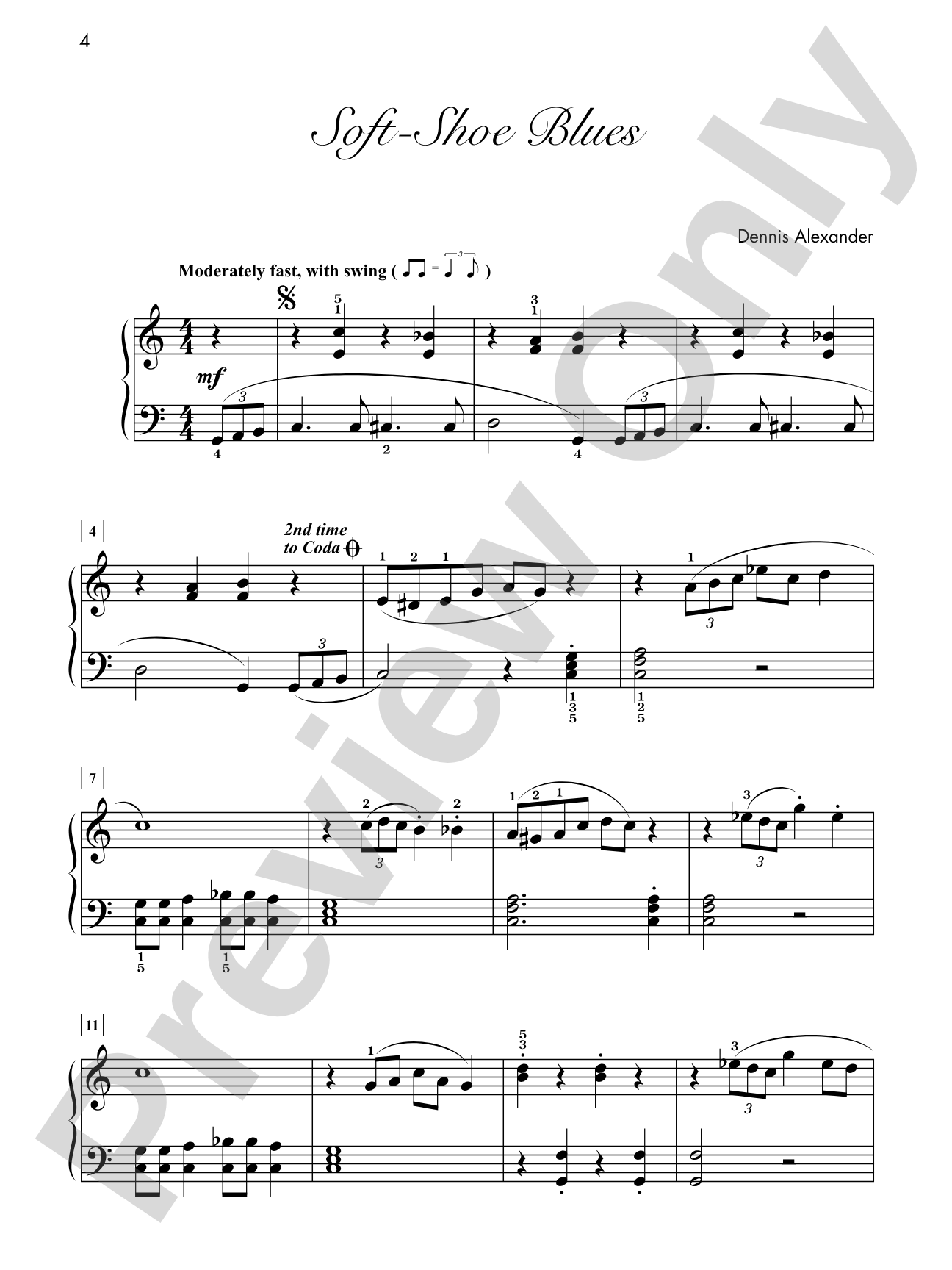

Soft-Shoe Blues - Piano Solo: Piano Solo
11 Stylized Solos for Early Intermediate Pianists
By Dennis Alexander
Level: Early Intermediate
Item: 00-PS-0017563
$4.99
Pickup currently not available
Related Items
A Touch of Rhumba - Piano Solo: Piano Solo |
$4.99
|
View | |
As September Goes - Piano Solo: Piano Solo |
$4.99
|
View | |
Jazz Jam - Piano Solo: Piano Solo |
$4.99
|
View | |
Purple Sage - Piano Solo: Piano Solo |
$4.99
|
View | |
Rhythmicon - Piano Solo: Piano Solo |
$4.99
|
View | |
Smooth as Silk - Piano Solo: Piano Solo |
$4.99
|
View | |
Sneakin' 'Round - Piano Solo: Piano Solo |
$4.99
|
View | |
Soul Searcher - Piano Solo: Piano Solo |
$4.99
|
View | |
Tahitian Nights - Piano Solo: Piano Solo |
$4.99
|
View | |
Valse du jour - Piano Solo: Piano Solo |
$7.99
|
View | |
Especially in Jazzy Style, Book 1: Piano Book |
$7.99
|
View |
Description
The goal of this series is to introduce students to the rhythms, harmonies and other unique characteristics of jazz. Students will be motivated by the variety of styles and sounds that have that special Dennis Alexander sound. From lyrical melodies to infectious rhythms and harmonies, playing jazz styles has never been more fun! Titles: As September Goes * Jazz Jam * Purple Sage * Rhythmicon * Smooth as Silk * Sneakin' 'Round * Soft-Shoe Blues * Soul Searcher * Tahitian Nights * A Touch of Rhumba * Valse du jour. A Federation Festivals 2024-2028 selection.


Soft-Shoe Blues - Piano Solo: Piano Solo isn't in MakeMusic Cloud just yet...but it could be. Let us know you'd like to see it, and you'll help shape what comes next. In the meantime, start a free trial and dive into thousands of interactive titles your students can play along with today.
Request This Title
Tell us you want it.
Start Your Free Trial
Explore everything that's ready to play right now.
Sample Audio
1
A Touch of Rhumba
--:--
2
Purple Sage
--:--
A Touch of Rhumba
0:00
0:00
Sample Video
No sample videos found.
Additional Details
Series:
Especially
Publisher:
Alfred Music
Page Count:
24
SKU:
00-PS-0017563
More about this title
About the Composer: Dennis Alexander

Dennis Alexander has shaped generations of pianists through over 400 compositions since joining Alfred Music Publishing in 1986. His career spans four decades of teaching, from his 24 years at the University of Montana (where he chaired the piano department) through faculty positions at Cal State Fullerton and Cal State Northridge, to his current base in Albuquerque. Beyond the classroom, Alexander maintains an active schedule as a soloist, chamber musician, and clinician at national music teachers conventions, having performed at Carnegie Recital Hall and toured Asia conducting master classes and recitals.
Alexander's reputation rests on his distinctive gift for writing music that students actually want to play. His ear for melody, harmonic color, and rhythmic vitality has made him one of the most frequently performed composers in music education. He was invited to judge national piano competitions and has received commissions from numerous state music associations. His work consistently appears on festival and competition lists, a testament to both its pedagogical integrity and musical substance.
Why we love this
Alexander writes jazz language that feels authentic without overwhelming early intermediate players. The series balances genuine swing feel and blues harmony with accessible voicings and logical hand positions, so students hear real jazz rather than a simplified approximation. Programming one of these pieces signals to your students that jazz is a serious style worthy of careful musicianship, not a detour from "real" piano repertoire.
What to expect
A relaxed stroll through jazz territory with genuine blues feeling. The piece draws its character from unhurried phrasing, walking bass lines, and harmonic colors that suggest a smoky room rather than a concert hall, all executed with the clarity and restraint that makes early intermediate jazz so satisfying to play.
Who it's for
Early intermediate pianists ready for their first sustained encounter with jazz idiom. Students in this series appreciate composers who take their capabilities seriously and write music that sounds sophisticated without requiring advanced technique.
How to get the most out of it
- Lock in the swing rhythm early. Alexander's phrasing depends on that uneven eighth-note feel, so drilling the rhythmic subdivision before adding melody prevents the piece from sounding mechanical.
- Shape the blues changes by listening to the harmonic movement underneath. Even when you're playing the melody line, understanding what the left hand implies about chord changes helps the improvisation sound grounded.
- Let the piece breathe at the rests. Alexander includes them purposefully, and respecting the silence keeps the soft-shoe groove from becoming relentless.
- Trust the syncopation. Students often want to "fix" the offbeat accents to feel more comfortable. Lean into them instead; that's where the blues character lives.
How to use it
Include this as a bridge between classical and contemporary repertoire in a student recital, or program it alongside other selections from the series to showcase different moods and jazz styles within a single performance. It pairs naturally with standards from the American songbook and works well as a confidence-builder before introducing more complex jazz vocabulary.
Skills your students will build
- Swing eighth-note rhythm and the difference between written and felt subdivision
- Blues harmony and chord changes (I-IV-V progression with jazz voicings)
- Syncopation and offbeat phrasing
- Pedal technique for sustaining jazz harmonies without muddiness
- Independence between hands in maintaining groove and melody simultaneously